

The Bottom Line:
Capstone expects more states will adopt battery extended producer responsibility (EPR) programs as the Environmental Protection Agency (EPA) publishes more guidance, including a forthcoming battery EPR framework meant to harmonize program design and adoption across states. The EPA is likely to pursue rulemaking to exclude plastics pyrolysis from solid waste incinerator standards, easing operating and reporting rules for pyrolysis facilities.
- California and Oregon continue to face litigation over the implementation of their packaging EPR programs. Seventeen states, primarily led by Republicans, sued CalRecycle and California’s producer responsibility organization on June 22nd, and the group is likely to request a preliminary injunction to halt enforcement of the program, similar to one granted by the Oregon District Court in February in National Association of Wholesaler-Distributors (NAW) v. Feldon. A packaging manufacturer in Oregon filed a class action on June 25th to extend the preliminary injunction granted to NAW to the other producers regulated under the state’s program.
- The EPA appears on track to publish a voluntary battery EPR framework in addition to reports on battery recycling best practices and battery labeling guidelines, which were mandated by the Infrastructure Investment and Jobs Act (IIJA). The framework should serve as a blueprint that unifies the different approaches states have taken, giving future state programs a common template to build from, leading to additional states passing battery EPR laws in the next two years.
Despite Democratic lawmakers’ opposition to exempting plastics pyrolysis operations (in which extreme heat is used to decompose plastics and biomass) from solid waste incinerator emission standards, we expect EPA to grant the plastics industry’s request and continue pursuing the carve-out through a future rulemaking, a positive for plastic waste pyrolysis operations that will likely reduce permitting burden and operating costs. Reclassifying pyrolysis operations under separate manufacturing standards would ease operating and reporting requirements, including potentially removing costly obligations such as the installation and operation of continuous emissions monitoring systems (CEMS).
Federal Update
EPA Explores Exempting Plastics Pyrolysis from Solid Waste Incinerator Emission Standards
In response to a March 2026 EPA request for public comment to reclassify pyrolysis operations under less stringent emissions standards than those applicable to other forms of solid waste incineration, Senator Jeff Merkley (D-OR) and Representative Jared Huffman (D-CA), alongside 48 other Democratic lawmakers, wrote a letter on June 18th to EPA Administrator Lee Zeldin opposing the reclassification. EPA is considering excluding pyrolysis units used in advanced recycling from being regulated as a municipal waste combustion unit under the Other Solid Waste Incinerator (OSWI) emission rules within Section 129 of the Clean Air Act (CAA).
Public comments from industry associations such as the American Chemistry Council and the Plastics Industry Association in support of the reclassification emphasized that Section 129 of the CAA does not give the EPA the authority to regulate plastics pyrolysis, given the process does not involve combustion, but is an endothermic manufacturing process designed for material recovery rather than waste disposal. Industry comments suggest that pyrolysis instead be regulated under Sections 111 or 112 of the CAA under chemical manufacturing standards. If EPA moves forward with this reclassification, the compliance burden on pyrolysis operations would be reduced:
- Emissions Monitoring: Section 129 generally requires the installation of CEMS, which are capital-intensive and costly to maintain. A facility regulated under Section 111 or 112 would typically only be required to do periodic stack testing, significantly reducing monitoring costs.
- Permitting: Section 129 requires Title V permits, which are administratively burdensome to obtain, regardless of facility size, whereas under Sections 111 and 112, Title V generally applies only to major sources.
Comments opposing the reclassification focused on health risks associated with pyrolysis emissions, and procedural concerns with the agency’s decision to embed the pyrolysis comment solicitation within a broader, unrelated rulemaking on air curtain incinerators and disaster recovery. We expect the agency to move forward with a favorable rulemaking for chemical recyclers, given that during the first Trump administration in 2020, it had proposed a similar carve-out. However, the EPA may do so through a separate standalone proceeding in light of the letter from Democratic lawmakers, which echoes concerns about rulemaking transparency.
EPA Recommends Best Practices for Expanded Battery Recycling, More States Likely to Adopt
As required by the IIJA in 2021, the EPA publicly released a report on battery recycling best practices for state, local, and tribal governments in May. The report, published by EPA’s Office of Land and Emergency Management (OLEM) and Office of Resource Conservation and Recovery (ORCR), highlights the government’s focus on increasing options for battery recycling, though it makes clear that the federal government is not pushing for a mandatory federal EPR framework.
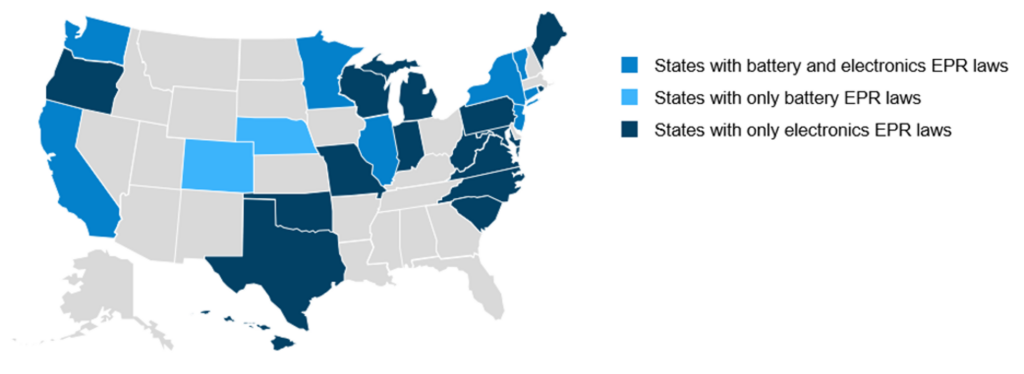
However, EPA is planning on putting together a voluntary EPR framework for the Department of Energy in 2026, which will focus on “battery recycling goals, cost structures for mandatory recycling, reporting requirements, product design, collection models and transportation of collected materials.” The agency held a virtual roundtable in February 2026 with speakers from the New York State Department of Environmental Conservation, CalRecycle, and the Illinois Environmental Protection Agency to inform its framework. Certain states may use that voluntary EPR framework as a model to adopt stronger, enforceable state frameworks. Battery recycling laws have become more prevalent since 2014, when Vermont established the first household battery EPR law. In addition, the expansion of electric vehicles (as well as e-mobility bikes and scooters) has stoked much higher state interest in battery recycling and EPR programs.
Exhibit 1: State Adoption of Battery and Electronic EPR Laws (as of June 2026)
Source: EPA
State Update
Litigation Over Oregon Packaging EPR Law Expands with Industry-Led Class Action
A class action led by Lollicup USA, a unit of Karat Packaging Inc. (KRT), was filed against the Oregon Department Environmental Quality (OR DEQ) over SB 582, the state’s packaging EPR law on June 25th. The class action was filed in the US District Court for the District of Oregon, which oversees a related lawsuit brought by the NAW in July 2025.
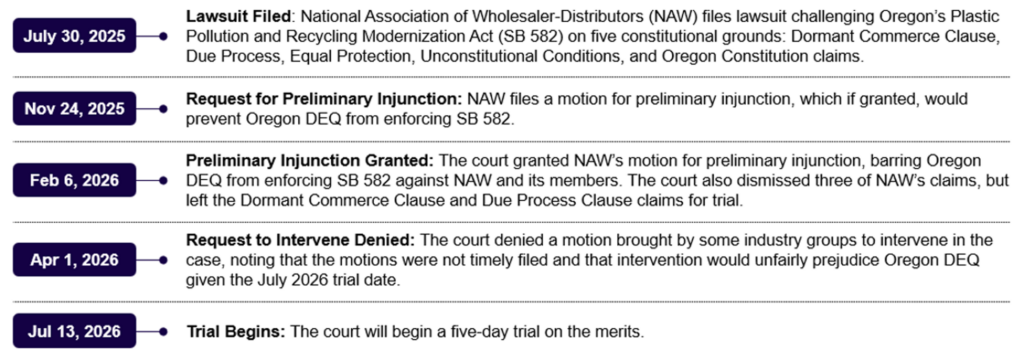
Exhibit 2: Case Timeline: National Association of Wholesaler-Distributors v. Feldon
Source: CourtListener
The court had granted a preliminary injunction halting enforcement of Oregon’s packaging EPR law in February, finding that “serious questions go to the merits of Plaintiff’s claims, there is a likelihood of irreparable injury, and the balance of hardships tips sharply in favor of Plaintiff.” However, the preliminary injunction would only apply to NAW and its members. Lollicup’s class action asks the court to extend this preliminary injunction to “all persons and entities classified as ‘producers’ under [SB 582] that exceed the de minimis thresholds […] and that are not afforded the protection of the preliminary injunction entered in [the NAW case].” If the court certifies Lollicup’s proposed class and grants a preliminary injunction, it would shield all regulated producers from enforcement of Oregon’s packaging EPR law, including the collection of EPR fees, pending a final ruling on the merits.
Lollicup filed its class action on the Dormant Commerce Clause and the Due Process Clause, the two claims that the court will review on the merits during the NAW trial beginning on July 13th.
California Faces Stiff Opposition to SB 54 Recycling Program
A group of primarily Republican states sued CalRecycle and California’s producer responsibility organization (PRO) over the implementation of the Plastic Pollution Prevention and Packaging Producer Responsibility Act (commonly known as SB 54), arguing that it infringes on the “sovereignty of California’s sister States” and vests power in an “unelected, unaccountable body.” The states (and the National Association of Wholesaler-Distributors) argue that SB 54 violates the US and California Constitutions, and specifically that it violates the Commerce Clause of the Constitution stemming from the Supreme Court’s 2023 decision in National Pork Producers v. Ross.
The suit was filed on June 22, 2026, and the state plaintiffs will likely try to get the court to grant a preliminary injunction to stop the state from implementing the program, similar to the preliminary NAW decision from a federal judge in Oregon to halt portions of its EPR law. The suit also comes on the heels of another suit by environmental groups filed in early June 2026 that the new regulations are not stringent enough.
Read more from Capstone’s energy team:
How Germany’s Building Modernisation Act Puts Renewable Heating at a Crossroads
The European Commission’s Hydrogen Pivot
How Policy and Market Trends Are Driving the Nuclear Renaissance