

Capstone believes Congress will reject the White House’s proposed major cuts to the FY27 US Environmental Protection Agency (EPA) budget. Key cuts target state water infrastructure funding, which, if enacted, would negatively impact water utilities and the broader water services industry. The agency’s final budget is expected to hold at levels similar to FY26.
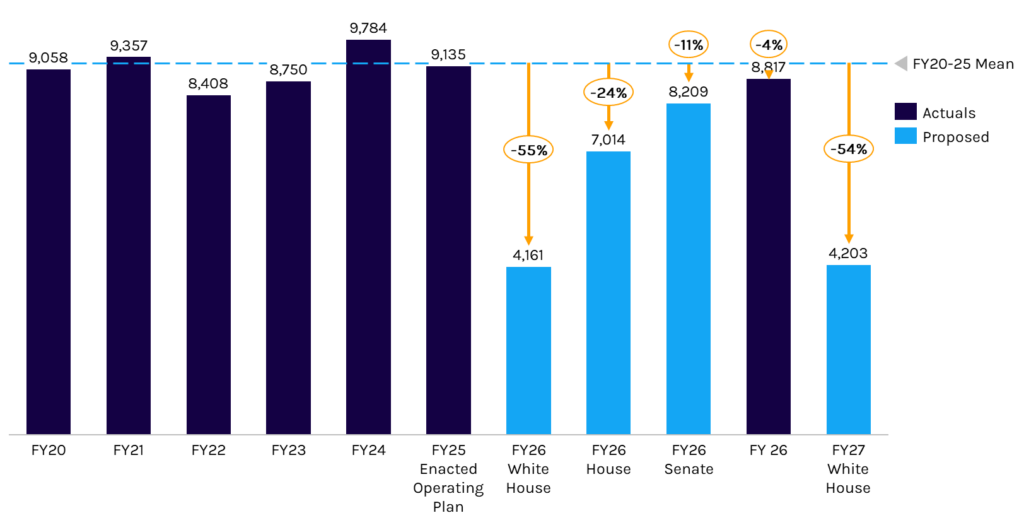
- The Trump administration is seeking to cut the EPA’s FY27 budget by more than 50% relative to FY26, with key cuts targeting grant and assistance programs for states. The White House’s proposal mirrors its FY26 request, which Congress largely rejected, passing instead a budget that was a slight reduction from the FY25 budget.
- As the next step, the House and Senate Appropriations Committees’ Interior & Environment subcommittees will draft their funding proposals over the next few months. We expect these bills to be released in June or July. EPA’s funding for this year will run out on September 30, 2026. Congress will need to pass a funding bill or a continuing resolution (CR) by this date to avoid a shutdown of EPA and other agencies.
- The White House proposal would cut nearly all of the funding for the state and tribal assistance grants, threatening to leave gaps in funding for water infrastructure and state environmental agencies. If passed, these changes would target water utilities and the water services industry through infrastructure funding cuts, as well as reduce the capacity at some state environmental agencies that depend more on federal funds. The cuts would also hurt the EPA’s logistical capacity for rulemaking and policy development.
- Proposed cuts to the Clean Water and Drinking Water State Revolving Funds (SRFs) face serious hurdles due to significant bipartisan support for the programs. According to official EPA reports, the US will need to invest more than $1 trillion in drinking water and wastewater infrastructure over the next 20 years. Any efforts that would directly reduce the amount that states can invest in such infrastructure would be unpopular.
EPA Budget Process
Federal agency budget requests typically kickstart the annual appropriations process. However, Congress is not bound by these requests and will ultimately decide how to fund federal agencies. As the next step, both the House and Senate Appropriations Committees’ Interior & Environment subcommittees will draft their funding proposals over the next few months. Based on the timelines of past years, we expect these bills to be released in June or July. FY26 annual appropriations, which are currently funding EPA, will run out on September 30, 2026. Congress will need to pass a funding bill or a continuing resolution (CR) to provide funding to EPA by this date to avoid a shutdown.
EPA’s FY27 budget request largely mirrors the agency’s FY26 request, which sought similar cuts across its programs. EPA’s FY26 budget request received bipartisan criticism from members of Congress, and was derided as “an unserious proposal” and “problematic.”
Exhibit 1: EPA Budget FY20-27, ($M)
Source: EPA, US Congress
Agency Priorities
Every four years, the EPA sets a plan focused on several strategic goals. For FY 26-30, the EPA is focused on five goals: (1) Provide clean air, land, and water for every American; (2) Restore American energy dominance; (3) Advance permitting reform, support cooperative federalism and cross-agency partnership; (4) Make America the Artificial Intelligence (AI) capital of the world; and (5) Bring back and protect American auto jobs.
The agency also highlighted two priority goals for FY26 and 2027 that will drive targeted rulemaking and policy efforts.
“Advance investment into America and job creation through permitting reform. By September 30, 2027, streamline the permitting process and improve efficiencies so the Nation can unleash economic growth while providing cost savings to hardworking Americans.”
- While the permitting reform debate in Washington, DC, is typically focused on pushing Congress to undertake legislative reforms, EPA’s deregulatory agenda is also viewed as a vector for de facto permitting reform. EPA has steadily moved to propose and finalize rulemakings that roll back more stringent Biden-era regulations, particularly those impacting the power sector and vehicles.
- Staffing reductions at EPA will create challenges to speed up permit decisions as well as completing rulemakings. According to reporting, EPA lost nearly a quarter of its staff between January 2025 and January 2026, including a disproportionate number of senior staff and team leaders. As of Q1 2026, EPA is at its lowest staffing levels in 40 years. If additional funding cuts were approved, it would lead to further staffing declines.
“Reduce Per- and Polyfluoroalkyl Substances (PFAS) risks to the public. By September 30, 2027, strengthen the science, fulfill statutory obligations, enhance communication, and build partnerships.”
- The Trump EPA has maintained a steady focus on PFAS, retaining key aspects of the Biden-era National Primary Drinking Water Regulation for PFAS and retaining the designation of PFOA and PFOS as hazardous substances under Superfund. The agency has planned several new PFAS regulations to be proposed and finalized in FY 26 and 27, with a focus on wastewater treatment standards for several industries and designating certain PFAS for additional waste treatment requirements.
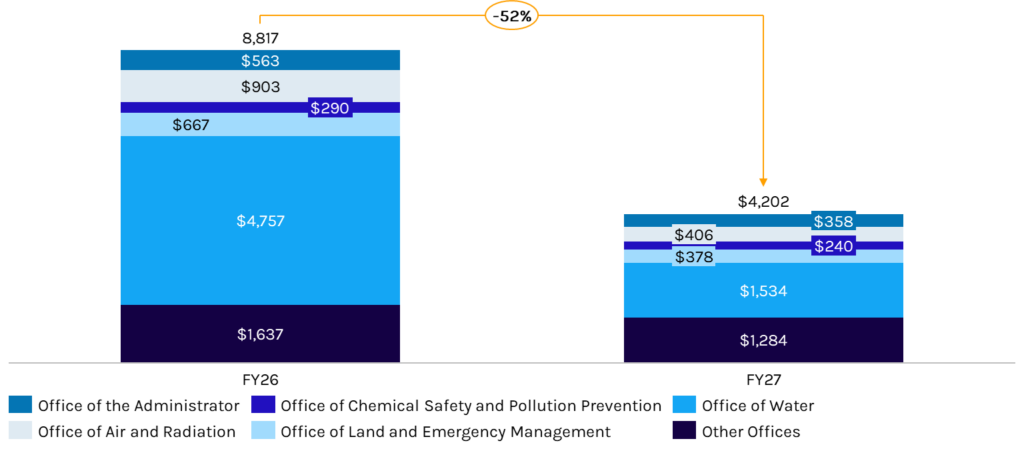
Exhibit 2: EPA Funding by Office ($M)
Source: EPA
Highlighting the Proposed Cuts
The proposed cuts primarily target State and Tribal Assistance Grants, a large program that covers a wide array of bipartisan programs. STAG also faced a similar proposed cut in the original FY26 proposed budget.
Exhibit 3: EPA Appropriations ($M)
| Program | FY2026 Enacted Operating Plan | FY27 Proposed Budget | Delta |
| Science & Technology | 744 | 508 | -32% |
| Environmental Programs & Management | 3,114 | 2,504 | -20% |
| Inspector General | 43 | 38 | -12% |
| Buildings & Facilities | 41 | 35 | -15% |
| Inland Oil Spill Programs | 21 | 16 | -24% |
| Hazardous Substances Superfund | 283 | 290 | 2% |
| Leaking Underground Storage Tanks | 89 | 53 | -40% |
| State and Tribal Assistance Grants (STAG) | 4,409 | 748 | -83% |
| Water Infrastructure Finance and Innovation (WIFIA) Fund | 72 | 8 | -89% |
| Good Samaritan Mine Remediation Fund | – | 2 | n/a |
| Total | 8,817 | 4,203 |
Source: EPA Budget in Brief
Further Transportation Emissions Rollbacks Planned
The budget affirms EPA’s commitment to additional rollbacks of transportation emissions regulations. The EPA finalized its repeal of the endangerment finding in February 2026 alongside a repeal of greenhouse gas (GHG) emissions regulations for light-, medium-, and heavy-duty vehicles, that is now being challenged in court. Planned rollbacks include the 2024 Light- and Medium-Duty Vehicle Multipollutant rule, the 2024 Heavy-duty Vehicle rule, and the 2022 Highway Heavy-Duty Engine Low NOx rule.
State Revolving Funds
Both the Clean Water SRF (CWSRF) and Drinking Water SRF (DWSRF) were again targeted for heavy cuts, but the cuts face hurdles to make it into the final budget. Through both these programs, the EPA appropriates funding and assigns portions of funds on needs-based assessments, rather than a politicized process. States contribute an additional 20% of funding to issue loans for clean water and drinking water infrastructure projects, and consequently the programs are popular with appropriators. The proposed budget also eliminates funding for Congressionally directed (or earmarked) funding for specific communities’ water infrastructure projects.
EPA has justified its cuts to the SRFs by stating that “this program change is a decrease in the resources provided to states through the capitalization grants. States operating CWSRF programs will continue to fund water infrastructure using funds that have already been paid back by past loans (i.e., revolving funds).” However, given the significant needs expected for both drinking water ($625 billion) and clean water ($630 billion) infrastructure over the next 20 years, appropriators will question substantial cuts to a popular program in a midterm election year.
Additional State and Tribal Assistance Grants
The EPA specifically has requested to zero-out many grants under the STAG program, including state and local air quality management grants. In FY25 and FY26, the program received $244 million and $237 million in funding, respectively, even as the initial proposed budget for the latter sought to reduce funding to zero, with Congress rejecting major cuts. This pattern is expected across a wide range of STAG categorical grants in this years’ budget negotiation process, with programs receiving funding similar to FY26 levels in an eventually-passed FY27 budget.
Superfund
The EPA’s Superfund budget has remained steady as the program has transitioned from appropriations-based funding to tax receipts-based funding. The program is expected to collect about $1.71 billion in tax receipts in FY27, compared to $1.59 billion in FY26 and $1.46 billion in FY25.
Data Centers and AI
Following the EPA’s strategic goal to Make America the Artificial Intelligence (AI) Capital of the World, the EPA is providing $202 million in funding for data center-related projects across EPA programs for FY27, with an aim to “reduce the impact of rapidly expanding and evolving AI data centers and supporting infrastructure.” This is a reduction of about $25 million from the FY26 budget, with most of the cuts appearing to target funding for the Office of Air and Radiation (OAR). The agency is still planning to release a wide array of resources for data centers in FY27, with the goal to streamline permitting reviews under the Clean Air Act’s New Source Review program (and other programs), as well as voluntary standards for wastewater treatment and water use reduction at data centers.
What’s Next
We expect the House and Senate Appropriations Committees to release their Interior & Environment funding bills in June or July; these will indicate the outlook for EPA funding for FY27.
Read more from Capstone’s energy team:
Winners and Losers in Trump’s 2027 Department of Energy Budget
How the EU’s Aviation Fuel Mandate Review Creates a Window for Airlines
How the Iran War Is Reshaping the Case for European Renewable Energy Investment