

The 2026 midterm elections were a seismic event, and we believe the incoming Democratic committee chairs will make conducting investigations and holding public hearings regarding data center policy in the next Congress a high priority. However, these investigations present headline risk only. The need for President Trump’s signature for any bill to become a law means that the political scrutiny they generate will not lead to the passage of materially adverse legislation for data centers. While the Senate’s bipartisan permitting reform bill takes a swing at making data centers pay for at least 100% of the embedded and incremental costs they cause, the states would be the entities that would oversee implementing the contours of these ratepayer protection provisions.
Instead, we believe the midterm elections have much larger implications for data center investors and developers at the state level, where Democratic gubernatorial victories in key markets, such as Texas and Georgia, are expected to lead to environmental permitting pauses. The pauses and the subsequent reform legislation that will be proposed will present the greatest regulatory uncertainty for projects that need to get permits in the first half of 2027 to meet timeline expectations. There will be delays to some project timelines and increases to construction and operating costs. However, as the year progresses, we do expect these pauses to be lifted and replaced with conditional permitting processes or new legislation. Reforms would likely include tax incentive repeals, closed-loop cooling requirements, and some local siting restrictions. While they may add to project costs, these policies will not be completely prohibit new data centers coming online. Ultimately, projects that have cleared most or all state and local permitting approvals will be best positioned to be ready for service as originally scheduled.
Permitting Reform Bill Reflects States’ Primary Role in Regulating Data Centers
Since Senate negotiators released text for the permitting reform bill in September, while the data center provisions are not being challenged, there’s been extensive debate in Democratic circles about whether the bill still enables robust environmental protections and binding guarantees of project certainty for wind and solar developers. However, the Democrats’ success in flipping both chambers by wide margins may have given party leadership enough leverage to demand that ratepayer protections be made more stringent or to punt negotiations until after they take control of the House and Senate.
If passed as currently written, the bill would implement two key reforms:
- Prohibit incremental costs from being allocated to, or recovered in the rates of, any customer other than covered loads. State regulators would be allowed to use an open season or competitive solicitation to allocate retail service among covered loads and do so to maximize ratepayer benefits on a present value basis.
- Allow states to condition the provision of retail service to a covered load on: (1) the procurement, construction, or contracting for new generation resources sufficient to serve its demand; and (2) taking or agreeing to take curtailment.
Both reforms reflect the role of the Federal Energy Regulatory Commission (FERC) and state utility commissions as the policymakers who will ultimately decide how much new data centers will need to pay to connect to the grid, rather than Congress. The deference to FERC and the states now has an outsized impact given the surprise wins in gubernatorial elections, particularly in Texas and Georgia. We expect data center developers to face greater scrutiny from Democratic committee leaders in official investigations and public hearings.
Texas Headlines Group of States on Verge of a Permitting Pause in Q1 2027
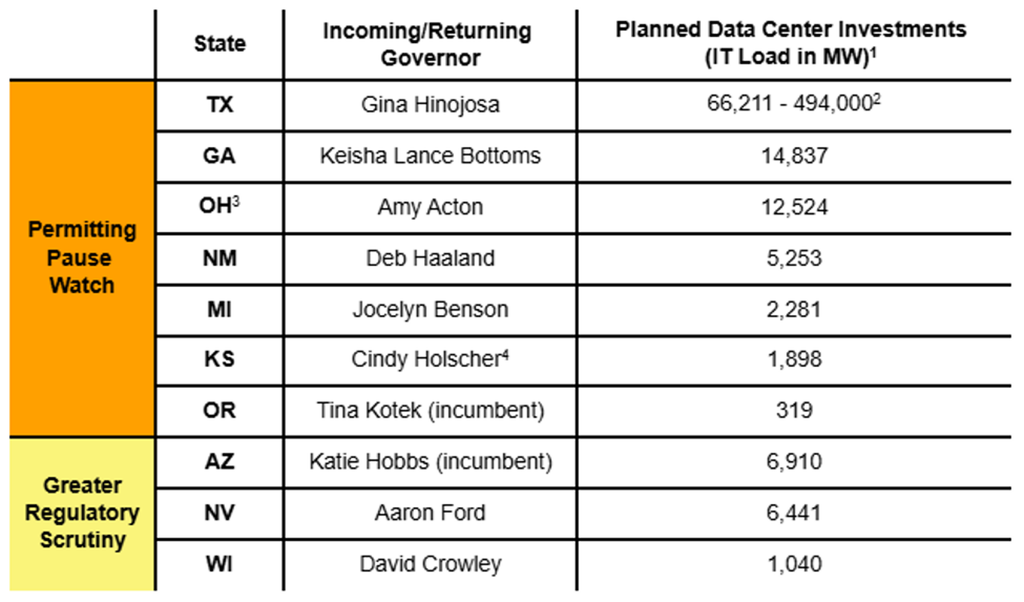
Nowhere are the impacts of the midterm elections on data center policy more apparent than in Texas, which leads by far in planned investments among the states most likely to implement a temporary permitting pause. Democratic Governor-elect Gina Hinojosa’s upset victory over three-term Republican incumbent Governor Greg Abbott will likely lead to a temporary statewide moratorium through re-implementing the Texas Council on Environmental Quality’s permitting pause after the current one rolls off in December. The pause is expected to last through May 2027, giving legislators a full session to pass bipartisan reforms. In our view, Q1 2027 will mark the height of regulatory uncertainty for developers in the state, as the permitting pause restarts and dozens of legislative proposals are introduced and considered. Similar scenarios will take shape in other key data center markets (see Exhibit 1). In Georgia, Democratic Governor-elect Keisha Lance Bottoms also campaigned on a statewide moratorium. While permitting is not tied as explicitly to the legislative session as in Texas, a shorter timeline to enact reforms could help limit permitting delays to Q1 2027.
Exhibit 1: Impact of Data Center Elections on Planned Data Center Investments
Source: New Project Media (NPM), Capstone analysis
(1) NPM dataset covers planned data centers. Facilities under construction or already in operation are not included in this analysis. NPM data takes interconnection queue data, where available, and confirms project details. Smaller (< 20 MW) and speculative larger projects are less likely to be captured by this data.
(2) ERCOT reported the total size of classified base load, studied load, and excluded load projects as 494 GW in September 2026. We use this figure as an upper estimate of planned investment.
(3) Governor-elect Acton framed her policy as a “conditional moratorium” indicating that a pathway through the pause will be available under certain conditions. It may take time to define those conditions, and projects will need to comply with them.
(4) As of November 8, the Kansas gubernatorial race has not yet been called. Holscher leads by ~7,000 votes.
Data Center Politics in the Wake of the 2026 Elections
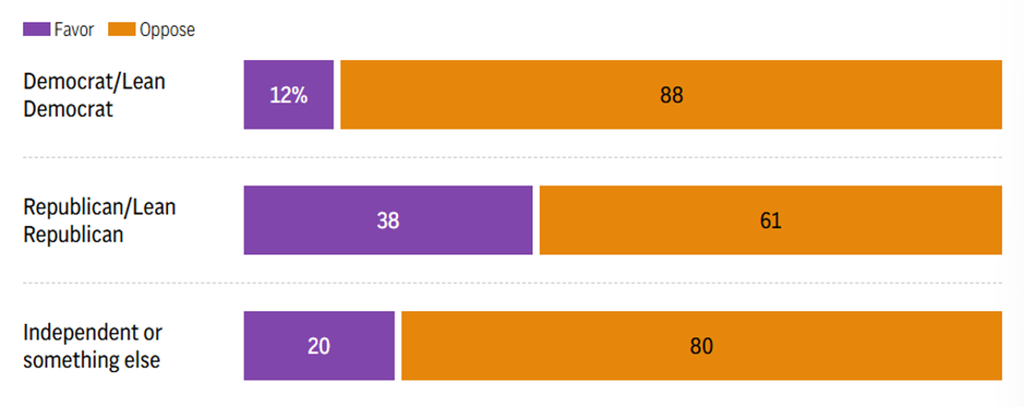
As Capstone previously highlighted, public support for data centers sharply declined over the last year among voters of both political parties. Exit polls from the elections confirmed this decline—voters across the political spectrum oppose the construction of new data centers in their community (see Exhibit 2). Local governments holding referendums also passed restrictive measures on data centers, including moratoriums, according to analysis by Redbud Consulting.
The results of the midterm elections and public polling clearly demonstrate to data center developers that directly addressing community concerns is the only way to course-correct ahead of the 2028 presidential election, in which the nominees could run on a more anti-industry platform. We will be watching how the approach of lawmakers and public sentiment evolves as Democrats start implementing their new policies, and assessing what the changes mean for investors and developers.
Exhibit 2: Survey of 2026 Midterm Electorate’s Opinion on Data Centers
Source: The Voter Poll (conducted by SSRS for The Associated Press, ABC News, CBS News, CNN, FOX News Media, NBC News, and Versant.
Note: Percentages may not add up to 100% due to rounding.
Read more of Capstone’s data centers coverage:
This Year’s Governors Races Will Give Data Center Investors a Message
How Wastewater Policies May Tighten Around Data Center Developers
What Progressive Democratic Primary Wins Means for Policymaking