

As the 2026 elections approach, the data center industry has faced increasing scrutiny from elected officials and candidates for public office at all levels of government and across the political spectrum. Investors should be watching closely, as the results will determine which data center developers, utilities, and independent power producers can capitalize on regional differences to data center regulations.
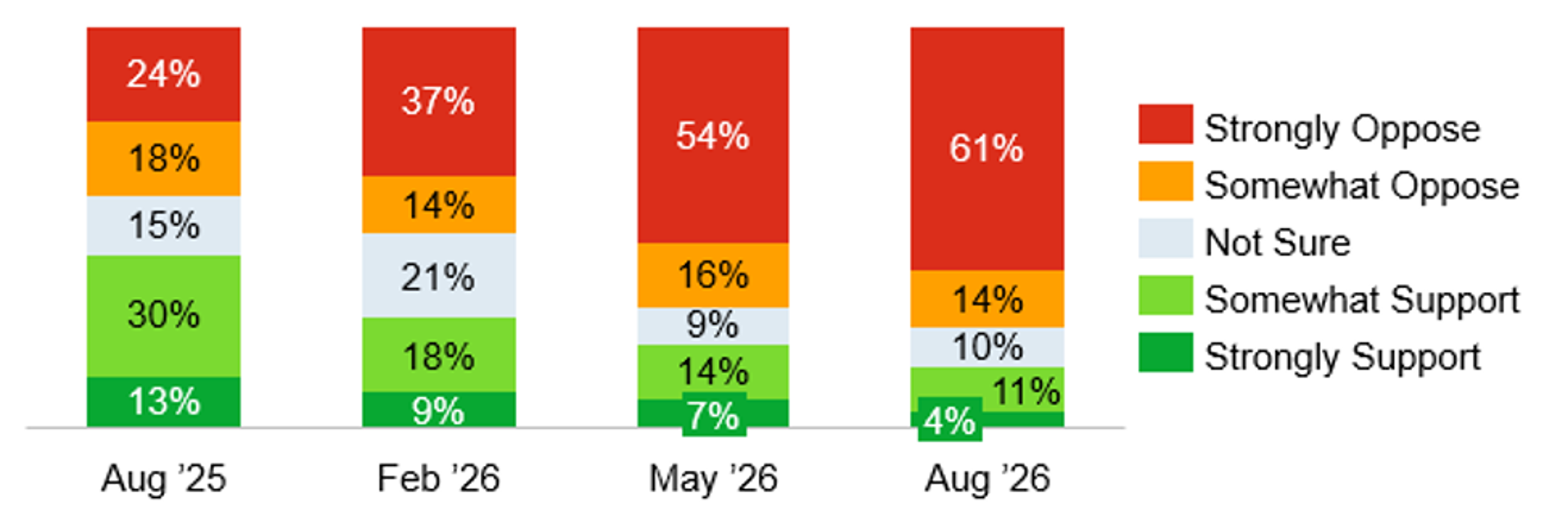
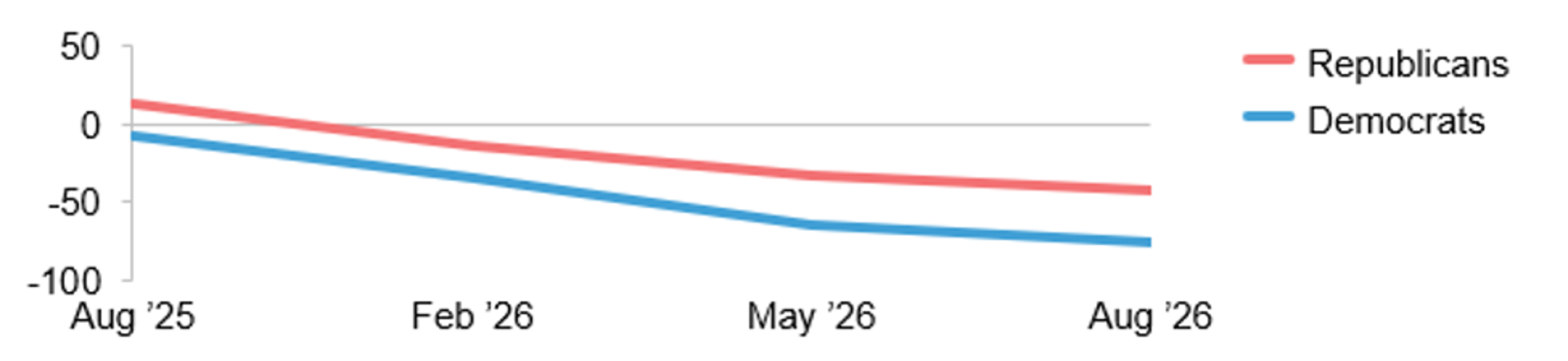
The added scrutiny from candidates comes as public support for data centers has declined over the last year among voters of both political parties (see Exhibits 1 and 2). Capstone expects this trend to continue through Election Day in November and into the 2027 state legislative sessions. Recent actions ahead of the elections by Texas Governor Greg Abbott (R) and Pennsylvania Governor Josh Shapiro (D) to address voters’ concerns about the impact of data centers on the taxes they pay and the public services they receive could inspire other governors or candidates for the office to embrace policies that conditionally permit new data center projects.
Exhibit 1: American Public Data Center Opinion, August 2025 to August 2026*
Source: Heatmap Pro, Embold Research
Note(*): May not total to 100% due to rounding off
Exhibit 2: Data Center Net Approval by Party, August 2025 to August 2026
Source: Heatmap Pro, Embold Research
Case Study #1: Texas Audit Ties Political Scrutiny to Election Season
On August 3rd, Gov. Abbott directed the Public Utility Commission of Texas (PUCT) and the Electric Reliability Council of Texas (ERCOT) to conduct a comprehensive audit of all data centers advancing through ERCOT’s interconnection process before they are approved to move forward, temporarily halting new data center interconnection. ERCOT will file its final report on the audit in mid-December. In the interim, ERCOT will issue a Request for Information (RFI) to all load customers and collect data through September for evaluation.
We believe Abbott’s mandate was driven largely by political pressure ahead of his November reelection bid. The audit pushes the risk of any headlines that might upset voters about Batch Zero and load forecast data past the elections. Apart from delaying Batch Zero, the audit does not pose risks to interconnecting loads unless they fail to respond to the RFI. If Abbott is reelected, we do not expect him to impose any further restrictions, but the audit may inform legislative policy in 2027.
Case Study #2: Pennsylvania’s Executive Order Elevates the Importance of Local Permitting Approvals
On August 18th, Gov. Shapiro signed an executive order to compel data centers (defined as facilities producing 25+ MWs) to comply with the Governor’s Responsible Development (GRID) standards, published earlier this year. This framework applies only to data center projects submitting permits to the Department of Environmental Protection (DEP) after August 18, 2026. Under this new permitting regime, two pathways for new construction exist:
- Comply with the Grid Standards: Developers seeking new permits can execute a Consent Order and Agreement (COA) with the DEP. The COA contractually obligates the developer to comply with the outlined GRID standards, including matching peak power demand with building, bringing, or buying sufficient incremental capacity. After the COA is executed, the DEP can start issuing permits on a rolling basis, assuming that local approvals are on track or already completed.
- Do Not Comply with the GRID Standards: Developers seeking new permits can forgo a COA. However, the DEP will not begin reviewing applications until the local land use and water/wastewater withdrawal permits have been approved. Additionally, the DEP would not issue permits on a rolling basis until it has received and reviewed all necessary permit or authorization applications. We believe that this pathway functionally disincentivizes data centers from attempting to circumvent the GRID standards pathway.
Shapiro’s executive order echoes broader calls from federal and state officials this year to empower localities with greater decision-making power over data center projects. Under either pathway, local governments’ approvals of land use permits will now be a key driver in most projects moving forward. If a developer is complying with the GRID standards, they must at least demonstrate progress towards local approval to ensure the state- and local-level tracks proceed in parallel.
We expect future developers to place greater emphasis on securing local approvals, in part by taking measures outlined in the GRID standards (such as by holding at least three in-person public information meetings, creating at least 200 construction jobs and hiring locally, creating at least 50 new permanent jobs, offering a community benefits agreement, using Tier 4 backup generators, etc.).
Which States to Watch
Capstone continues to monitor competitive gubernatorial elections, such as in Ohio, Michigan, and Wisconsin, that will ultimately shape how data center policy is addressed in 2027 and 2028. In Ohio, for example, both candidates are proposing to conditionally permit data centers through executive action or legislation.
- Amy Acton (D): She is calling for a “conditional moratorium” for any project that fails to cover the full cost of utility upgrades, employ exclusively unionized labor, operate with full transparency, and adhere to Ohio’s environmental standards.
- Vivek Ramaswamy (R): He is promising to issue an executive order on his first day in office to halt data center projects until the General Assembly passes a law establishing environmental and consumer guardrails, including “free electricity” for nearby residents.
Under new leadership or incumbents with 2028 presidential ambitions, like Illinois’ JB Pritzker (D), we expect governors in other states to follow Texas and Pennsylvania in implementing data center environmental or interconnection permitting reforms. While these potential measures may slow down state-level permitting, increase compliance costs, and weed out speculative projects, we believe this policy outcome would not be nearly as severe as sweeping statewide moratoriums or bans, which would not give developers a path to move forward. Capstone will be monitoring the outcome of the elections to help guide our clients about the risks and opportunities presented by the ongoing buildout of AI infrastructure.
Read more from Capstone’s Energy team:
The Risks and Implications of the USDA’s Expanded Land Disclosure Rule
How Wastewater Policies May Tighten Around Data Center Developers
Japan’s Crude Diversification Drive Presents Tailwinds for US Crude Exporters