

Capstone believes the November 2026 midterm results strengthen the outlook for community solar in Pennsylvania, Michigan, and Ohio by creating more favorable political conditions to advance previously stalled proposals. Pennsylvania appears best positioned to make progress, while Michigan and Ohio also have new political opportunities to move legislation forward.
- Prospects for community solar legislation in Pennsylvania, Michigan, and Ohio have improved following the midterm elections, but passage will still depend on lawmakers’ ability to address utility opposition and develop compensation structures that balance project economics with ratepayer protections.
- Pennsylvania appears best positioned to advance community solar legislation in 2027, as the newly empowered Democrats will be able to pass solar proposals that were stalled for years in the Republican-led legislature.
- Michigan’s incoming Democratic trifecta creates an opportunity to revive community solar legislation, which has stalled in committee, though heavy utility opposition may still prove a constraint.
- Despite Republicans retaining control of the Ohio legislature, Amy Acton’s (D) gubernatorial win elevates Democrats’ influence over shaping the state’s energy policy. HB 303’s passage in the House gives lawmakers a chance to advance legislation during the lame-duck session.
Common Obstacles to Community Solar Program Establishment
Community solar legislation often faces political, regulatory, and economic hurdles that make it difficult to secure enough support for passage in state legislatures. Divided governments can complicate negotiations, particularly when legislative chambers have competing energy policy priorities. However, even with bipartisan support, utility opposition and ratepayer concerns can become significant barriers, as investor-owned utilities have an incentive to protect existing business models and frequently argue that community solar programs could undermine cost recovery for grid infrastructure.
We believe political shifts in control following the midterm elections in Pennsylvania, Michigan, and Ohio will create additional momentum for passing laws establishing community solar programs. However, lawmakers will still need to address utility opposition and reach agreement on compensation design to protect ratepayers if they hope to build sufficient consensus for passage (see Exhibits 1, 2, and 3).
Pennsylvania
Exhibit 1: Pennsylvania Political Landscape and Community Solar Legislative Vehicle
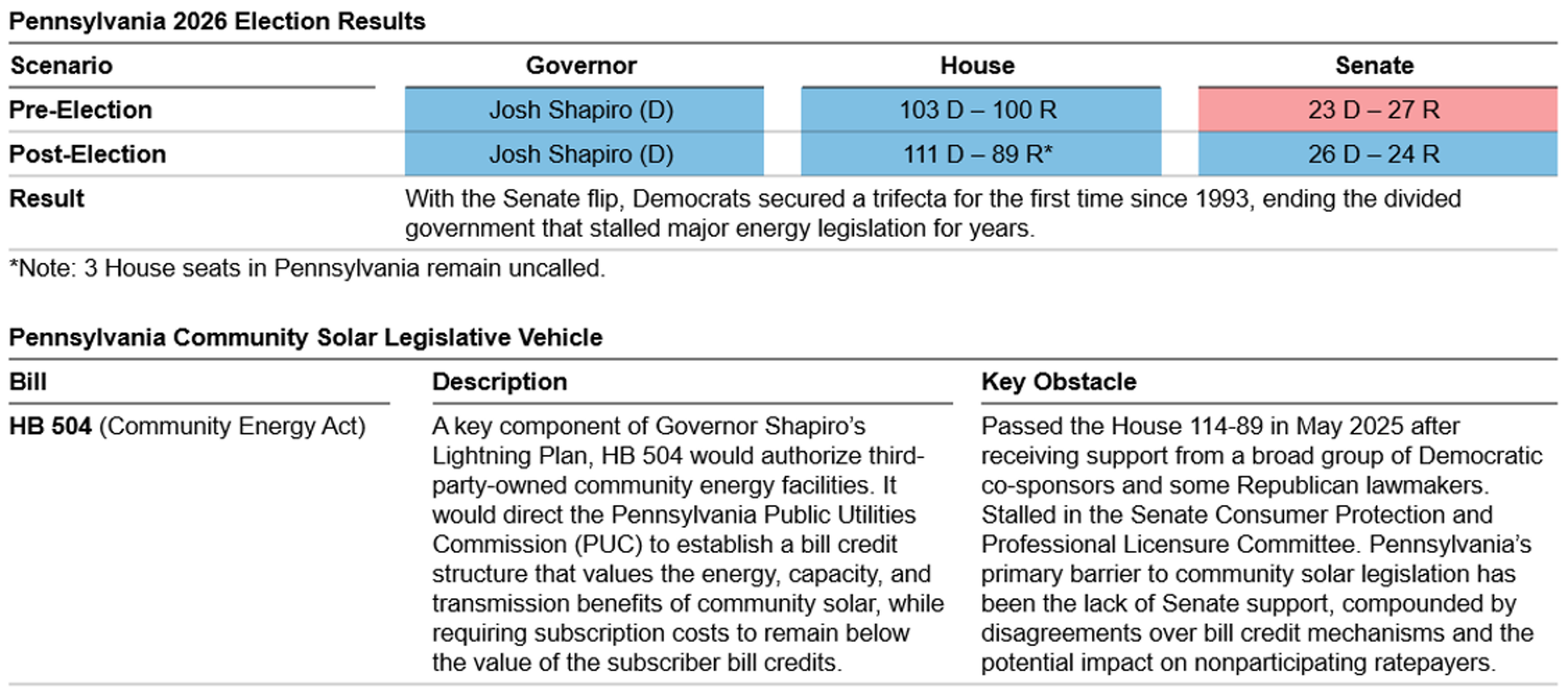
Source: Pennsylvania Legislature, Multistate Elections
Democratic trifecta will overcome long-held gridlock: Democrats won unified control in Pennsylvania for the first time in over three decades, with incumbent Governor Josh Shapiro (D) winning reelection and Democrats flipping the Senate and expanding their House majority. Republicans had controlled the Senate since 1994, creating a longstanding obstacle for energy legislation that advanced through the Democratic-controlled House but failed to gain consideration in the Senate.
The flip will give Democrats control over committee leadership and the ability to set Senate legislative priorities. Senator Nikil Saval (D) indicated that community solar could be the “low-hanging fruit” that the legislature looks to move on quickly in 2027. House Energy Committee Chair Representative Elizabeth Fiedler (D) has also said that expanding distributed energy resources—including community energy projects—is a top priority for the House.
Michigan
Exhibit 2: Michigan Political Landscape and Community Solar Legislative Vehicles
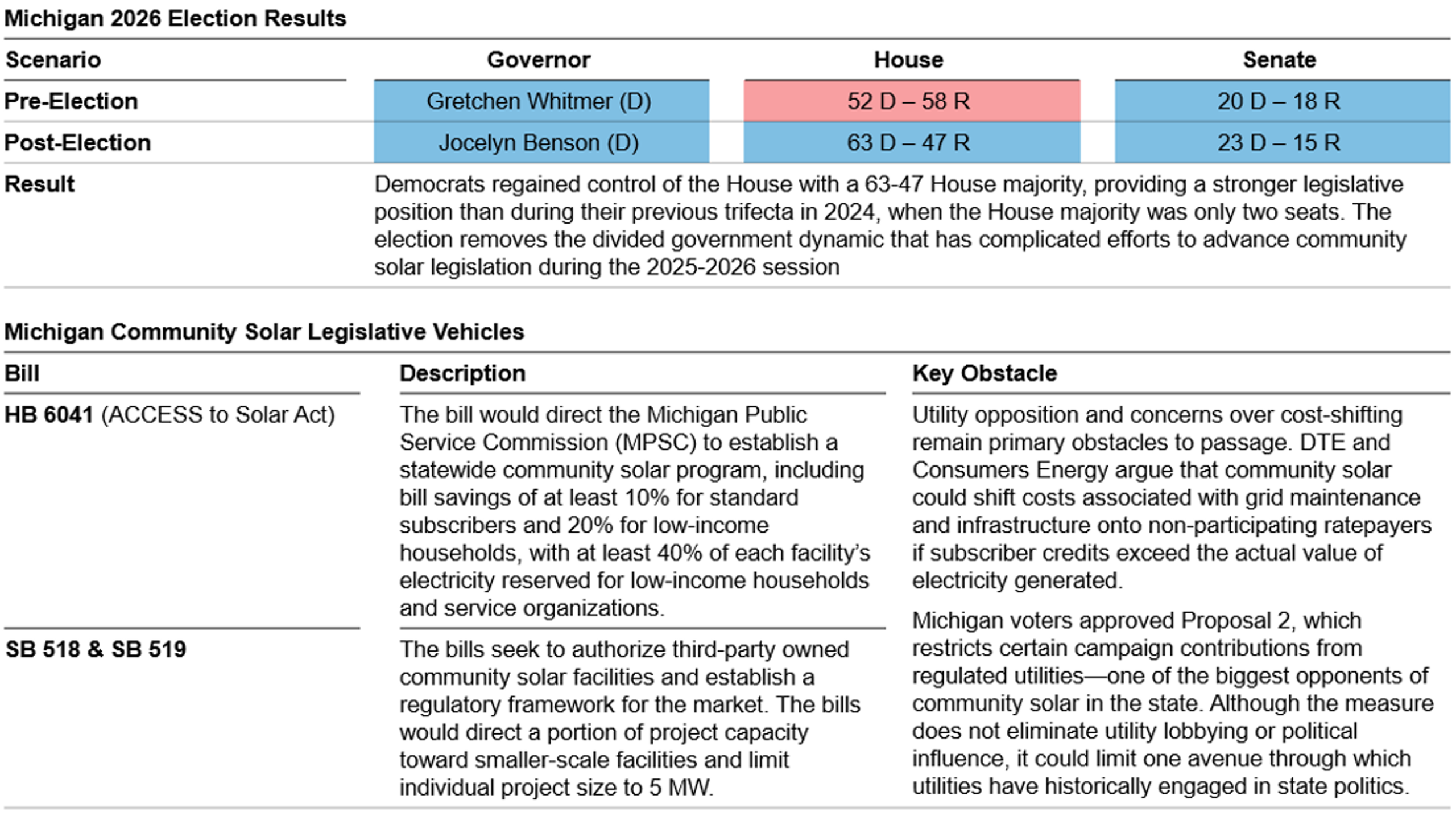
Source: Michigan Legislature, Multistate Elections
Democrats Restore Trifecta with Stronger Majority Margins: In the November midterm elections, Democrats restored unified control in Michigan, with Jocelyn Benson (D) winning the governorship and Democrats regaining control of the House and expanding their Senate majority. Democrats are expected to hold a 63-47 House majority and a 23-15 Senate majority, giving them a stronger legislative position than during their 2024 trifecta, when the House majority was only two seats.
Notably, community solar has gained bipartisan support in Michigan over the past several years, with both Republican and Democratic leadership having introduced community solar legislation since 2021. However, lawmakers will need to address utility concerns about how projects should be compensated to prevent cost-shifting to non-participating ratepayers. Reintroducing previous bills under unified Democratic control could provide a more direct path to legislative consideration.
Ohio
Exhibit 3: Ohio Political Landscape and Community Solar Legislative Vehicle
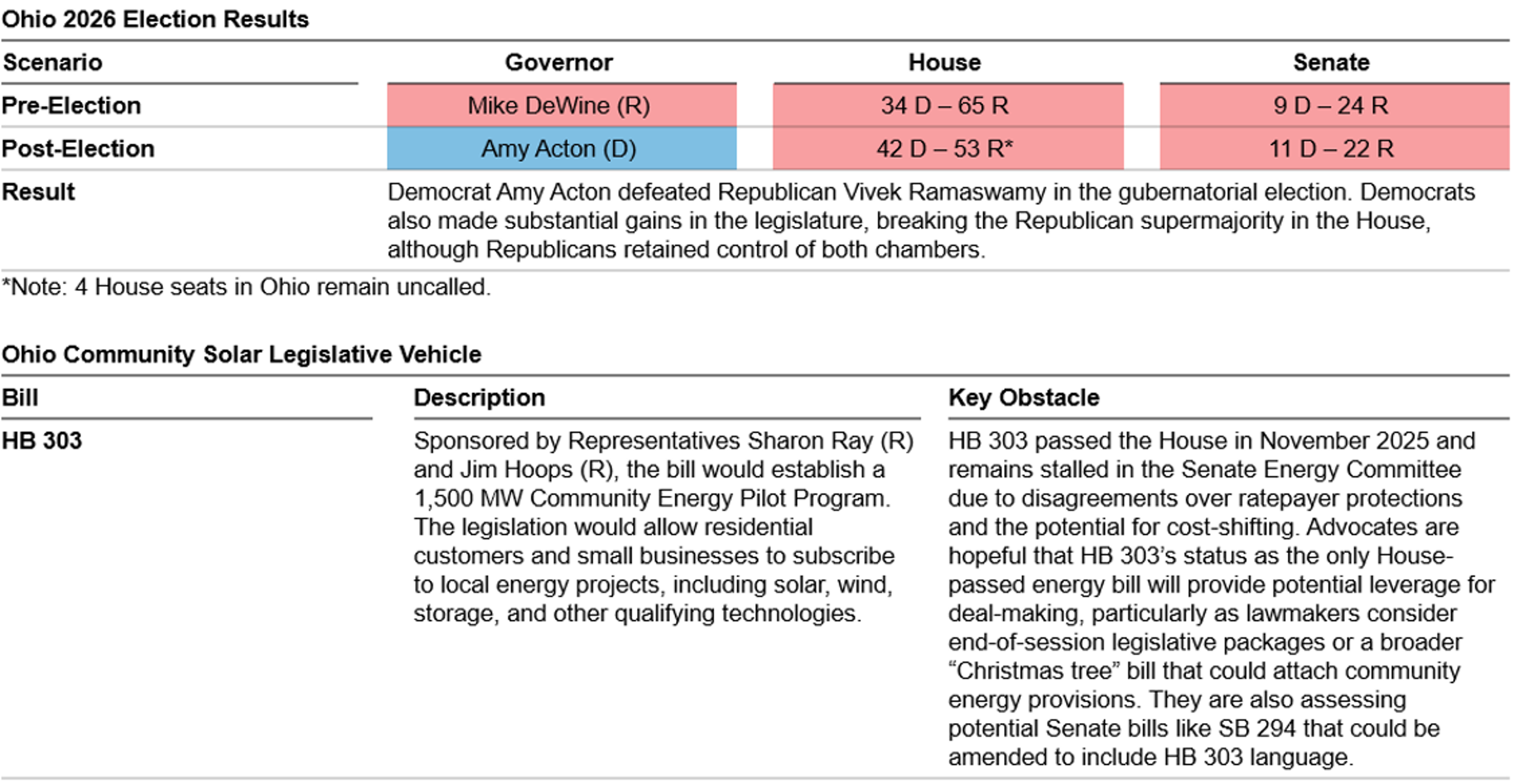
Source: Ohio Legislature, MultiState Elections
Democrats Win Gubernatorial Seat and Break Republican House Supermajority: The midterm elections ended 15 years of unified Republican control in Ohio, with Democrat Amy Acton taking over as governor. Unlike Pennsylvania and Michigan, which were able to secure a Democratic trifecta, Republicans will retain control of both legislative chambers. However, Democrats have made significant gains by picking up eight House seats, breaking the Republican supermajority in the House. This means that Republicans can no longer override the gubernatorial veto without Democratic support.
While the results of the elections do not give Acton control over the legislature, they create a more balanced political environment in which Republicans will need to negotiate with the incoming governor on energy policy.
What’s Next
The next legislative sessions begin in Ohio on January 4th, in Pennsylvania on January 5th, and in Michigan on January 13th. In the interim, Ohio lawmakers could look for a final opportunity to advance HB 303 during the lame-duck session, with committee hearings and floor sessions scheduled through December 17th.
Read more from Capstone’s Energy team:
The Emerging Packaging Laws Boxing in Producers on Costs
European Biomethane Tracker
New Power in Washington Puts Data Centers on the Hot Seat