


Capstone believes the Stop Corporate Takeovers of Physicians Act, the first corporate practice of medicine (CPOM) legislation at the federal level, marks a departure from CPOM’s history as a state-regulated matter. The bill is based on Oregon’s SB 951, a model addressing ownership of healthcare entities that has yet to gain traction in other states. The proposed bill faces an uphill pathway in Congress.
- The federal corporate practice of medicine bill, which a group of Democratic lawmakers introduced on September 16th, would ban certain corporate ownership arrangements of medical practices if the corporate entity is not majority-controlled by licensed clinicians.
- Oregon is the only state to enact this specific private equity ownership model requirement, while Vermont, California, and Connecticut have adopted narrower CPOM doctrines in the past year. Notably, Oregon’s model has failed to pass in other state legislatures due to industry pushback and lack of bipartisan support, signifying that a federal bill will face an even steeper uphill battle. Capstone views the proposed bill as a political messaging vehicle rather than a serious near-term legislative threat.
- The near-term impact on investment activities at the federal level would be limited, but investors should be aware of actions taken on CPOM bills at the state level. Oregon-level scrutiny in other states remains unlikely despite state interest in codifying CPOM.
Federal CPOM Action
The Stop Corporate Takeovers of Physicians Act, which a group of Democratic lawmakers introduced on September 16th, is a rare example of CPOM legislation at the federal level, rather than a state-led intervention. The bill would establish a federal CPOM framework and explicitly ban the corporate practice of medicine by making it illegal for private equity firms or other for-profit corporations to own healthcare practices. The legislation would ban certain corporate ownership arrangements of medical practices if the corporate entity is not majority-controlled by licensed clinicians.
Majority control requires that licensed clinicians hold both a majority ownership interest and a majority of the governing body of the entity, but includes notable exceptions for nonprofit and public healthcare providers, including rural emergency or critical access hospitals. The bill would close the “friendly physician” model, which occurs when a corporate business creates a management services organization (MSO) to provide non-clinical services to physician practices while maintaining de facto control over a healthcare practice. This structure allows a PE entity to comply with state-level CPOM laws. Furthermore, the bill would ban non-competes and non-disclosures—contract terms that could limit physician independence—and incorporate significant federal enforcement authority for CPOM violations.
If found in violation of the legislation, enforcement actions could include exclusion from federal healthcare programs, penalties stemming from state attorneys general, and/or other financial clawbacks. The Federal Trade Commission would be responsible for related enforcement actions.
The bill itself is modeled on Oregon’s CPOM legislation (SB 951 and HB 3410) and includes a ban on non-medical professional corporations (PCs) organized to practice medicine. Under this legislation, the state prohibits MSOs and their shareholders from owning a majority of shares in a PC. SB 951 also reiterates that MSOs cannot control clinical decision-making. Oregon’s CPOM legislation is considered the nation’s strictest due to the limitation on the PC-MSO ownership structure.
The bill is backed by Senators Elizabeth Warren (D-MA), Ron Wyden (D-OR), and Jeff Merkley (D-OR), in partnership with Representatives Val Hoyle (D-OR), Alexandria Ocasio-Cortez (D-NY), and Suhas Subramanyam (D-VA). The Democrat-led bill represents a growing trend of proposed legislation aimed at increasing oversight of PE-backed involvement in healthcare.
Despite the introduction of the Stop Corporate Takeovers of Physicians Act, Capstone maintains there are limited federal pathways to meaningfully limit private equity involvement within healthcare. There is no significant federal case law establishing legal precedent on PE investment in healthcare practices or corporate medicine. Conversations with key federal stakeholders suggest most federal scrutiny will remain focused on healthcare consolidation and antitrust action.
Capstone believes the timing of the bill is tied to the November 3rd midterm elections and reflects a larger trend of headline scrutiny of private equity involvement within healthcare. Most relevant rulemaking in the space occurs at the state level, and passage of the federal Stop Corporate Takeovers of Physicians Act is unlikely.
CPOM Doctrine
Corporate practice of medicine laws have historically been developed at the state level, typically through statute and case law (see Exhibit 1). They are intended to preserve clinician oversight over clinical decision-making, which is a well-accepted principle. CPOM doctrines in most states allow for some level of non-physician ownership by corporations or MSOs, but non-physician owners cannot control or interfere with clinical decision-making. Most states have a version of a CPOM doctrine, and some have looked to expand oversight of CPOM in the past year, given increasing investor involvement in healthcare.
Exhibit 1: CPOM Regulation by State
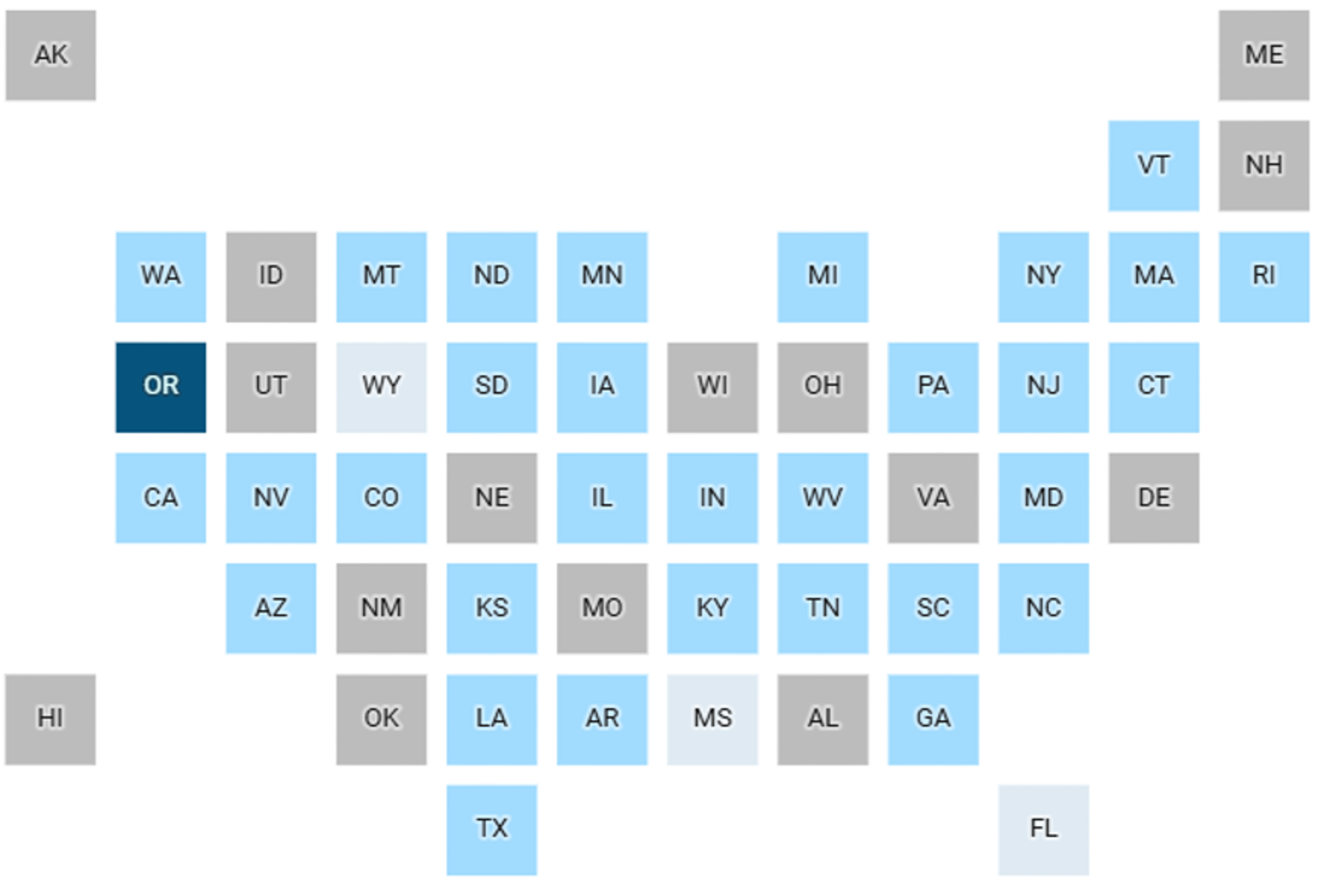

Source: Permit Health, state legislatures
States Strengthening CPOM Legislation
In June 2025, Oregon passed the nation’s most stringent CPOM legislation (SB 951 and HB 3410) targeting MSO de facto control over medical entities. California followed in October 2025 (SB 351), codifying existing medical board guidance and providing the state attorney general with enforcement authority. New CPOM legislation in California, however, does not target the MSO model as Oregon’s legislation does.
In June 2026, Vermont passed the state’s first CPOM legislation (H 583); MSOs must report ownership information, but similarly to California, the law does not target the dual ownership MSO-PC model.
Vermont’s H 583 first took effect in Vermont on July 1, 2026. The law prohibits interference with the clinical judgment of healthcare providers, keeping treatment decisions and other clinical decision-making out of the hands of private equity groups and hedge funds. The bill specifically states that PE groups or other entities controlled by PE groups cannot enter into an agreement with a healthcare facility offering diagnosis, treatment, inpatient, or ambulatory care that would lead to interference in healthcare decisions. Examples of prohibited action from an investor include, but are not limited to, setting staffing levels, setting prices or rates for services, controlling a patient’s care plan, or directing how many hours a provider works.
Unlike California, Vermont’s law does not provide the state attorney general with enforcement authority for CPOM violations, instead relying on private right of action as the primary enforcement mechanism. Vermont previously introduced language that mirrored Oregon’s SB 951, but the final version of the bill was watered down, indicating there is limited state appetite to fully follow Oregon’s lead.
Exhibit 2: State-level CPOM Bills
| Year | CPOM Bills Proposed | CPOM Bills Passed |
| 2025 | CA, CT, OR, NC, SC, VT, WI | CA & OR |
| 2026 | AZ, CT, NM, NY, RI, VT, WA | AZ, CT, & VT |
Source: Ropes & Gray LLP, Capstone analysis
Corporate practice of medicine legislation is poised to remain a state-level issue as states continue to propose bills that codify CPOM, but we expect most to avoid Oregon’s specific ownership mandate. The Stop Corporate Takeovers of Physicians Act reads as a messaging bill in response to increased investor interest in healthcare rather than a serious legislative vehicle. CPOM has historically been a state-level matter, and no other state has been able to replicate Oregon’s approach, suggesting a federal-level bill that aims to mirror Oregon is unlikely to pass.
At the state level, recent CPOM enforcement actions in California and Oregon suggest investors pursuing healthcare-related investments should continue to prioritize transaction diligence to ensure alignment with state-level legislation. Capstone believes investors should continue to monitor CPOM legislation, even though near-term impact on investment activities will be limited.
What’s Next
Capstone will continue to track relevant proposed legislation introduced at the state and federal levels. We expect to see a continued uptick in proposed legislation centered on CPOM when state legislative sessions resume in January 2027.
Read more from Capstone’s Healthcare team:
Clinical Trials Face an Enrollment Problem; Washington Is Betting on AI
Federal Agency Actions Provide Clues to Future Star Ratings Reforms
5 Key Takeaways from HLTH Europe 2026