


The second Trump administration is deeply supporting technology in healthcare, including in asking questions about how artificial intelligence (AI) could revolutionize trials. In clinical trials, the tech-forward shift began during the COVID-19 pandemic, when researchers had to either adapt to the new remote reality or end trials. The crisis spurred investment in technologies that could make trials more flexible, driven by US Food and Drug Administration (FDA) guidance for greater flexibility and demands of a newly remote research environment and patient population.
Now, as Washington begins to push AI into clinical-trial policy, its real test case may be enrollment, the single biggest driver of trial failure and cost overrun. One approach Capstone is watching is the “digital twin,” a computational model that could let trials run with fewer patients.
The Enrollment Bottleneck
Despite the versatility that digital health technologies such as medical devices, wearables, and sensors gave sponsors, i.e., the ability to allow patients to participate from their homes and to monitor patients, the underlying issue plaguing trials remained: enrollment. Three main enrollment problems exist:
- Too few people from the relevant population enroll, e.g., the commonly cited figure is that only 5% of cancer patients enroll in trials.
- Relevant population is not large enough to support a full drug trial for rare diseases.
- Ethical concerns exist about running a control arm, a group of participants that does not receive the therapy being studied, when there are no alternative treatments to offer them.
Not only do these problems prevent potentially viable drugs from being brought to market, but they are also extremely expensive for sponsors. Tufts Center for the Study of Drug Development estimates the average direct cost of conducting a Phase III clinical trial at about $56,000 per day, rendering solutions that can prevent enrollment delays a high return on investment.
Trump Administration Goes All-In on AI
The Trump administration is asking questions about how to speed clinical trials and overcome development barriers it believes threaten US biopharmaceutical dominance. Although the interest in AI and machine learning in drug development is not unique to the second Trump administration, the administration is truly driving forward this new AI-first version of clinical trials. The US Department of Health and Human Services (HHS) under Trump is asking questions such as:
- How do we use AI?
- Where can we use AI to create efficiencies?
- How can we reduce bottlenecks in early-stage trials?
- How do we make better use of existing data?
- What else can we do to bring patients into clinical trials?
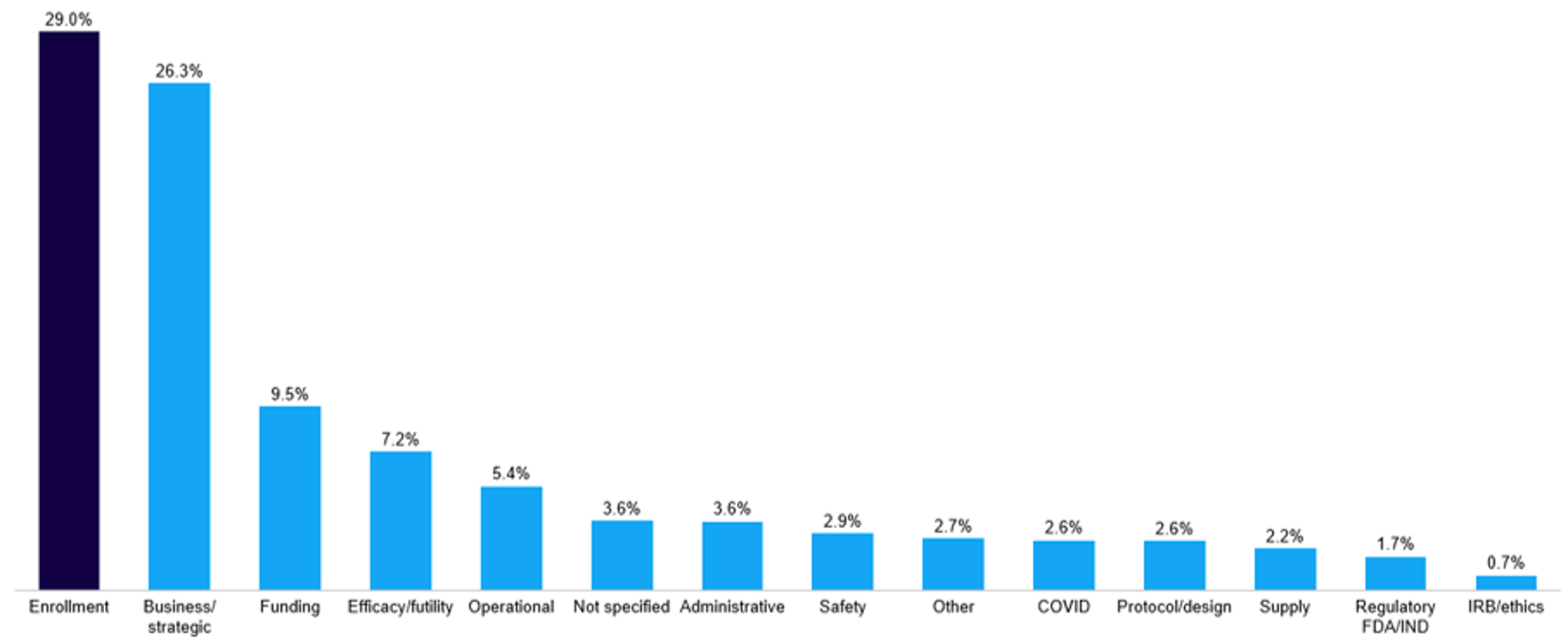
These questions level back up to the issue of enrollment—the most commonly cited reason for a trial failure, termination, or suspension in the last decade. Although the Trump administration is not only pursuing AI, it has also recently released a request for information (RFI) on increasing payment options for trial enrollees to improve enrollment. AI is the first evidence-driven step toward clinical trial optimization, and one that is being driven both by the administration and industry interests.
Exhibit 1: Share of Stopped Trials by Reason, January 2016–August 2026
Source: National Institutes of Health
Building on the Biden administration’s interest in AI for drug development, the Trump administration released a discussion paper and an RFI on the topic. The publications focus primarily on AI and machine learning for trial design and trial efficiencies. Since January 2025, the Trump administration has released draft guidance on AI use to produce data for regulatory submission and an RFI on a pilot for AI for Early Phase Clinical Trials. In addition, it has announced intent to launch a Real-Time Clinical Trials pilot—which would leverage AI to allow real-time interactions and monitoring between the FDA and sponsors. Based on this guidance and FDA announcements, we see a clear push toward innovative AI technologies and growing potential for the use of synthetic or AI-created data in clinical trials. The best opportunities for AI-data use currently exist in early-stage trials—which is the target of one pilot—and in well-understood, well-documented progressive diseases where disease trajectories are predictable enough for models to reliably forecast progression (e.g., neurology, oncology, and rare diseases).
Digital Twin: What We Are Watching
An emerging technology that we are monitoring is the “digital twin,” a computational model of a patient. The digital twin technology allows a sponsor to create a synthetic duplicate of an enrolled individual to observe both treatment and control conditions for the individual by building a model and training it on disease-specific data, e.g., historical placebo or control data from clinical trials, electronic health records, or claims data, or observational/natural-history studies. The model can then take that individual’s characteristics and predict how their disease would progress without intervention. We reiterate that such computational models work best with predictable, progressive diseases with strong historical data, e.g., neurology, oncology, and rare diseases, where the enrollment need is the highest.
By increasing the statistical power of clinical trial data, such computational models can measure treatment effect with fewer enrollees. Outcomes can be measured against every factor from age, sex, and disease severity to what is attributable to drugs rather than patient-specific intrinsic differences. This provides sponsors with more conviction in their detection of treatment effect with the same number of enrollees, or fewer. For sponsors, this translates to cost and timeline savings.
What’s Next
If the Trump administration continues to deliver on this vision of improving trial efficiency with AI, technologies such as digital twin will gain more regulatory credibility, changing the clinical trials landscape by allowing faster, more effective, and smaller trials, no longer restricted by the finite number of enrollees.
Read more from Capstone’s Healthcare team:
Federal Agency Actions Provide Clues to Future Star Ratings Reforms
5 Key Takeaways from HLTH Europe 2026
The Key Forces Shaping UK Adult Social Care