

Capstone believes funding for the National Institutes of Health (NIH) will remain stable for the next 3-5 years, and investors should look past headline appropriations to specific therapeutic area (TA) to assess regulatory risk. Congress continues to insulate funding for TAs such as oncology and rare disease, but forward-funding requirements and terminations are compressing new awards, creating tail risk to biopharma/medtech outside key TAs.
- Congress appropriated NIH $48.7 billion for fiscal year 2026 (FY26), after rejecting the Trump administration’s proposed 41% cut and coming in slightly above the prior year’s enacted level. Capstone expects the NIH’s topline budget to hold in FY27 and through the current administration with bipartisan support.
- The Office of Management and Budget’s (OMB) now-blocked preapproval requirement for agency spending held up NIH grant disbursement in early FY26. However, the NIH was able to close the gap and spend its full budget by fiscal year-end on September 30th.
- OMB was successful in executing a mandate to forward-fund 50% of grants. While this structurally reduced the volume of new and competing-renewal grants the NIH issued in 2026, the compression falls unevenly as Congress protects priority TAs, insulating pipelines with bipartisan support.
The NIH spent FY26 caught between the Trump administration trying to shrink and control it and a bipartisan Congress determined to protect it. The White House proposed cutting the NIH budget by 41% in its FY26 request, and bipartisan appropriators rejected it outright, ultimately funding the agency at $48.7 billion. OMB then proposed two new requirements to slow the NIH’s ability to spend that money: a preapproval process for processing funding that Congress shut down and a forward-funding mandate that has reduced the overall volume of grants NIH awarded in 2026. The effect of the slowdowns and reductions in NIH grant volume has been a smaller pool of new and competing-renewal award starts, depressing first-year capital equipment orders and disrupting clinical trials and research output for new drug and medical device developers for the next 3-6 years.
Appropriations
The NIH is made up of 27 institutes, including the National Cancer Institute (NCI) and the National Institute of Allergy and Infectious Diseases (NIAID), and dedicates more than 80% of its annual appropriations to extramural biomedical basic science research. The second Trump administration has repeatedly sought to reduce NIH appropriations by eliminating grants that do not align with its priorities, starting with a proposal to cut NIH funding to $27.9 billion in 2026. This marked a 41% reduction in allocated funds to the NIH, a sharp departure from prior administrations that have tried to maintain NIH funding stability. The first Trump administration also proposed budgets that were 3.5%- 27.9% lower than the amount Congress awarded, and reductions that were smaller than the FY26 budget request (see Exhibit 1).
Despite the Trump administration’s proposed cuts, Congress has continued to increase NIH funding, typically enacting funding 3%-4% greater than requested by administrations (see Exhibit 1). Legislators on both sides of the aisle, including Senators Susan Collins (R-ME) and Dick Durbin (D-IL), pushed back strongly against the White House’s proposed 41% reduction, reflecting bipartisan interest in maintaining stable funding for the agency. Capstone notes that NIH grants have meaningful impacts in both red and blue states and generate broad economic activity through jobs and healthcare infrastructure, giving policymakers a strong incentive to keep NIH funding stable (see Exhibit 2).
Exhibit 1: NIH Actual Appropriations vs. Presidential Requests, $B
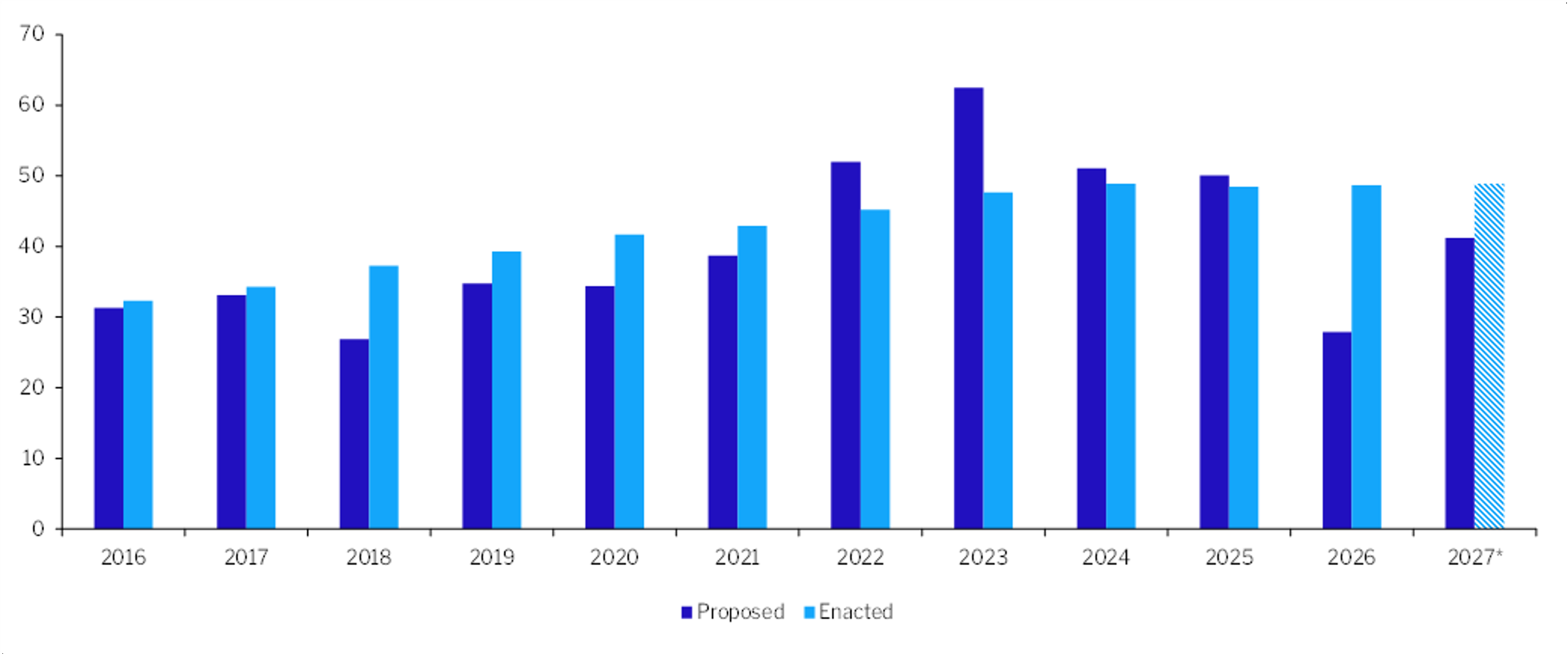
Source: NIH Office of Budget. Note: *Estimated appropriations for 2027 NIH budget based on historical continuing resolution trends for NIH funding.
A Republican-majority House and Senate appropriated $48.7 billion for FY26, underscoring the bipartisan support the agency continues to draw. The FY26 bill was not only flat-funded, but Congress also directed additional funding for specific disease areas, a sign of durable protection for their research. Research in oncology, Alzheimer’s, and other central nervous system (CNS) disorders; infectious disease; women’s health; and other rare disease has entrenched patient-advocacy constituencies and members of Congress who champion them, protecting the appropriations for those therapeutic areas. This disease-focused advocacy, in combination with the economic drivers offered by NIH-supported research, bolsters Capstone’s belief that NIH will continue to have bipartisan support for appropriations in FY27 in spite of pressure from the Trump administration.
Exhibit 2: 2025 Grant Spend by State
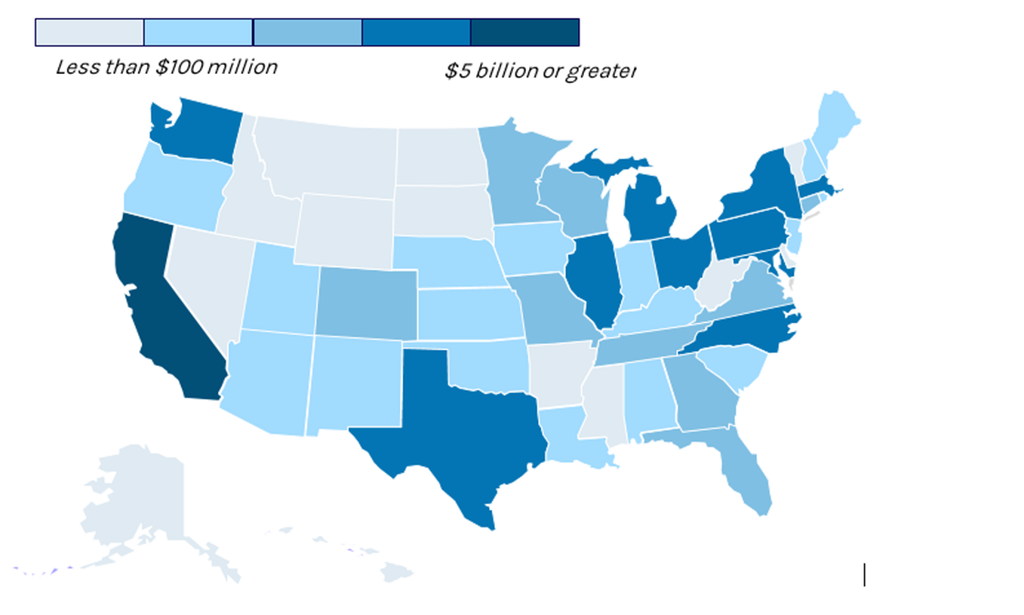
Source: NIH RePORTER
Grant Distribution
As FY26 drew to a close, the NIH lagged in disbursing its allocated funds due to a combination of a changed grant structure and administrative backlog (see Exhibit 3). In March 2026, NIH grant disbursements reached only $6 billion, lagging historical levels, as the agency had typically disbursed roughly $9 billion by the same time in previous years.
The slowdown in disbursements was tied to a new OMB policy requiring agencies to submit spending plans for approval before using appropriated funds. OMB’s delay in approving the NIH spending plan held up new grant approvals until mid-March, when the NIH budget was approved. Delays in grant funding led to hiring freezes and purchasing delays within clinical research labs, impacting early-stage research.
Exhibit 3: NIH Grant Distribution, $B
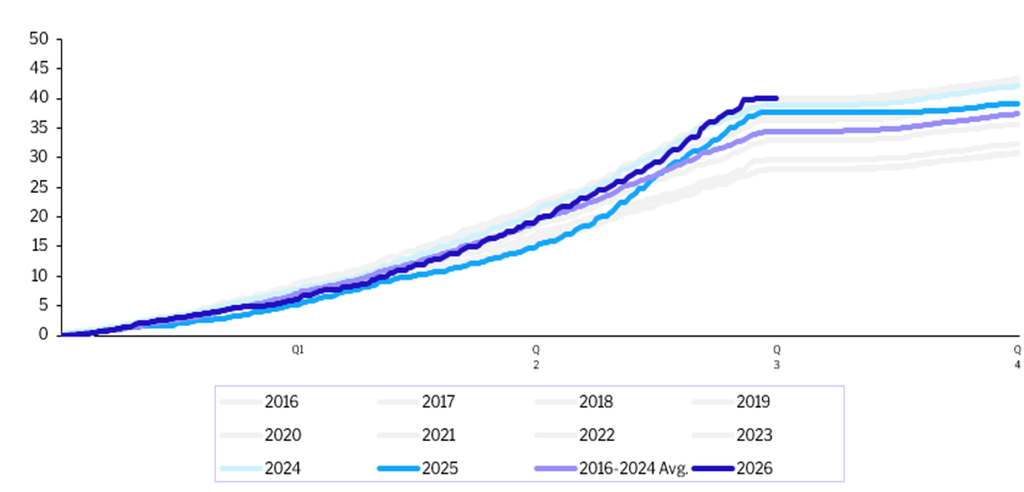
Source: NIH RePORTER
In 2026, delays in grant disbursements stemmed from another OMB policy change that required NIH institutes to fund 50% of total awards as forward-funded, meaning new grants are fully funded at the outset rather than partially awarded throughout each year of a grant period (typically five years). OMB’s model reduces the overall volume of grants that institutes within the NIH can distribute, delaying the purchase of equipment and other instrumentation that are typically funded through new or competing renewal grants.
Investors with exposure to lab testing and equipment have likely witnessed drop-offs in orders as a result of forward-funding, independent of TA exposure. Because capital instrumentation (e.g., mass spectrometers, sequencers, microscopes) is disproportionately purchased at the outset of a new or competing-renewal award, a smaller pool of new award “starts” automatically reduces first-year purchasing events, independent of changes to NIH’s topline appropriations. The new funding mechanism, which is set to expand to 100% of grants awarded in 2027 being forward-funded, places a structural ceiling on the pace of equipment purchasing.
In combination with the slowdown in overall grant disbursements, the NIH has continued terminating grants that focus on health disparities; structural racism; and diversity, equity, and inclusion (DEI) in 2026. The cancellations apply new contract language that was added to grants awarded after October 1, 2025, that lets NIH terminate an award because it is “no longer in alignment with” agency priorities. Research types that have not seen comparable 2026 terminations are the same ones Congress singled out for funding increases in the FY26 bill: cancer, Alzheimer’s and CNS, infectious disease, women’s health, and other rare disease research. This layer of protection insulates researchers and drug/device pipelines from significant disruptions during the next 3-6 years.
Though the NIH spent most of 2026 behind in disbursement compared to prior years, a similar pattern occurred in 2025, with the NIH ultimately allocating all its grant funds, approximately $40 billion, by the close of the fiscal year (see Exhibit 3). Capstone believes the NIH did successfully spend its full appropriation by the end of the 2026 fiscal year, September 30th, as it did in 2025, but final confirmation will be provided by the agency in its Treasury submission in the coming weeks. If the NIH had not disbursed all its appropriated funds, it would have been required to return the remainder to the Treasury. Traditionally, agencies that do not spend their full allocated budget will face a reduction in funding the following year. However, Capstone believes Congress will not reduce NIH funding even if the agency does not spend its full appropriated budget due to the economic importance of NIH grants.
Regulatory Changes
In the face of bipartisan resistance to reducing NIH appropriations, the Trump administration has attempted several regulatory changes to the grant process in 2026. Under the direction of OMB Director Russell Vought, the administration has attempted to introduce political controls into grant review and approval processes. The first attempt was through a proposed rule from OMB on Uniform Guidance in May 2026 that would require political appointees to review and approve grants. It would impact grants from every federal agency, not just the NIH. Then in September, the Washington Post leaked that President Trump directed Vought to draft an executive order to create a committee of political appointees to review and approve all NIH grants.
Congress delayed OMB’s second proposed rule in its stopgap funding bill through December 11th, and before an executive order could be published, bipartisan lawmakers, including Senators Collins, Tammy Baldwin (D-WI), and Chris Van Hollen (D-MD), pushed back, noting that any attempt to control or politicize NIH grantmaking would be contrary to congressional intent. The White House has walked back its plan to create a politically appointed commission for grant review. Capstone views the bipartisan resistance, which has been consistent throughout appropriations and congressional criticism of administration actions to control the NIH, as the primary check on further regulatory changes to the NIH’s grantmaking process for the remainder of the Trump administration.
Near-, Mid-, and Long-Term Impacts
Capstone sees disruptions at NIH this year as three main channels: 1) downstream commercial impacts already hitting lab purchasing and clinical trial activity; 2) a scientific talent pipeline that erodes during the next 5-10 years; and 3) a longer-tail threat to US competitiveness in biopharma and medtech innovation.
These channels are not distributed evenly across therapeutic areas, however. Labs and programs concentrated in oncology, CNS, infectious disease, and rare disease are meaningfully more insulated across all three channels than labs focusing on health disparities, structural racism, or other DEI-adjacent topics that have continued to face active termination risks in 2026. Even in core TAs, the delays in grant disbursements and reduction in overall volume still create friction that shows up in purchasing, hiring, and trial timelines, just with less severity and faster recovery than in higher-risk topic areas.
Capstone’s analysis of the downstream impacts of delayed and canceled funding shows that new clinical trial starts are already being impacted. NIH grant terminations disrupted nearly 400 clinical trials in 2025, impacting sponsors, contract research organizations (CROs), site management organizations (SMOs), and other businesses that support clinical trial processes. Fewer and delayed grant awards also are driving down lab purchasing, as labs cut back on the reagents, consumables, and equipment they would otherwise buy from suppliers. As fewer grants were awarded in 2026, we expect these issues to compound in the near term.
Labs in insulated TAs are far less likely to see outright termination, but slowdowns in grant disbursement could defer purchasing and hiring, or push clinical trial enrollment starts back by a quarter or two. Bipartisan groups of lawmakers are pushing for a return to more normalized NIH operations and grant disbursements, which would ease this pressure, allowing firms downstream of the NIH to better predict pipelines for next-generation biopharma products and medical devices.
Disruptions of NIH grants, through cancellations and slowdowns, also impact the scientific training pipeline that relies on that grant funding. We believe pharma manufacturers and clinical research organizations will begin to see a loss of eligible talent during the next 5-10 years as laboratories reduce the number of graduate and postdoctoral students who build their early research careers in NIH-supported labs.
In a September op-ed, Senator Dave McCormick (R-PA) noted that the NIH supports the long-term, high-risk foundational science research that businesses eventually transform into products and jobs. McCormick called for doubling NIH’s budget, arguing that even the current levels of investment are a threat to US leadership in commercializing science compared to China. Capstone believes further disruption of NIH grant funding will have long-tail impacts on US science competitiveness, impeding universities’ ability to effectively train and export researchers and new developments to support US innovation.
NIH disruption is having the most detrimental impact on US scientific innovation. The Trump administration is looking to pursue a new golden age of science that will push American innovation forward. The continued disruptions of NIH grants and the reduction in overall grant volume are having an inverse effect, not just on scientific development, but also on building and maintaining US scientific talent. As investors look for the next generation of pharmaceuticals and medical devices, there is a risk that early-stage assets, talent, and intellectual property increasingly originate abroad for less insulated TAs, rather than in US labs. This shift would erode the domestic sourcing advantage US-based biopharma and medtech investors have historically relied on. Investors should treat NIH’s grant volume and forward-funding mechanics, not just its topline appropriation, as a leading indicator of pipeline health for the biopharma and medtech sectors during the next 3-5 years.
What’s Next
Capstone expects the White House to continue in its mission to curtail NIH operations in FY27, despite consistent congressional pushback in the first two years of the administration. In fact, its FY27 budget request seeks a 12% cut from the enacted FY26 base funding. Capstone will continue to monitor proposed and enacted changes at the NIH and the potential impacts on markets exposed to NIH today and on downstream impacts in the next 3-5 years.
Read more from Capstone’s Healthcare team:
What Investors Should Know About Washington’s First Corporate Practice of Medicine Bill
Clinical Trials Face an Enrollment Problem; Washington Is Betting on AI
FDA Cracks Down on GLP-1 Compounding While Bolstering Peptides and Hormone Therapies