


Capstone believes that while continued scrutiny by the Food and Drug Administration (FDA) has ended large-scale GLP-1 compounding, non-GLP-1 product categories are unlikely to face targeted enforcement. Products such as peptides and hormone therapies are also likely to see regulatory tailwinds over the next 1-2 years, although investors should prioritize companies with diverse product portfolios to mitigate stroke-of-the-pen risk.
- In 2022, the FDA added semaglutide and tirzepatide to its drug shortage list, enabling large-scale GLP-1 compounding and the emergence of a billion-dollar market. After the resolution of both shortages in 2024, the FDA cracked down on compounding, and targeted enforcement shows no signs of abating.
- Capstone believes that despite intensifying enforcement and state legislative efforts foreclosing large-scale GLP-1 compounding, non-GLP-1 product categories, including peptides and hormone therapies, are likely to benefit from regulatory tailwinds over the next 1–2 years, though these categories face stroke-of-the-pen risk under future administrations.
- Investors should prioritize compounding entities with diverse product portfolios to mitigate enforcement risk and avoid entities that are overexposed to a single product category.
The Rise and Fall of Large-Scale GLP-1 Compounding
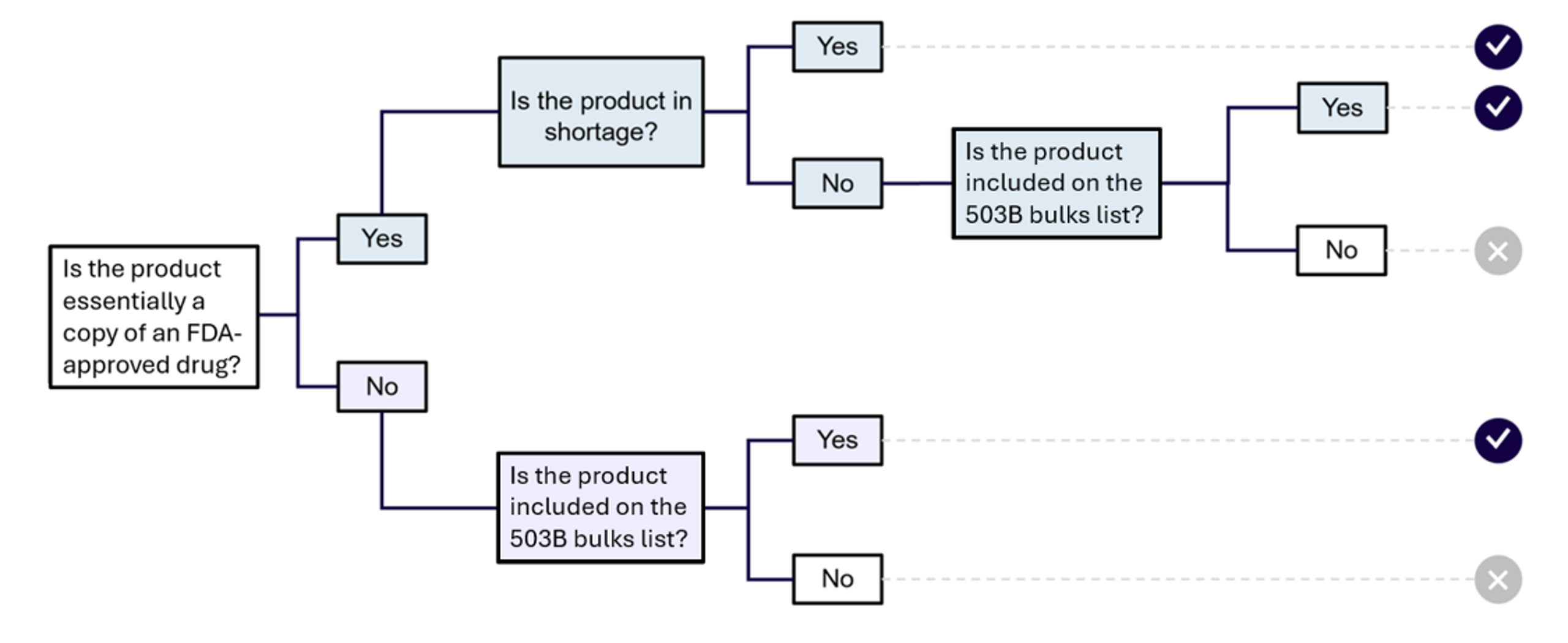
The recent boom and bust of the GLP-1 market stems from a complex ecosystem of regulatory barriers and loopholes surrounding drug compounding—the practice of creating custom formulations and, in some cases, copies of commercially available drug products. Section 503B of the Food, Drug, and Cosmetic Act (FDCA) provides two legal pathways for compounders to produce copies of an FDA-approved product in bulk: (1) the product must be included on the 503B Bulk Drug Substances List (bulks list); or (2) the product must be included on the FDA’s drug shortage list (see Exhibit 1). Section 503A also permits limited compounding of custom formulations of FDA-approved products.
Exhibit 1: Legal Pathways to Bulk Drug Compounding Under Section 503B
Source: Capstone analysis
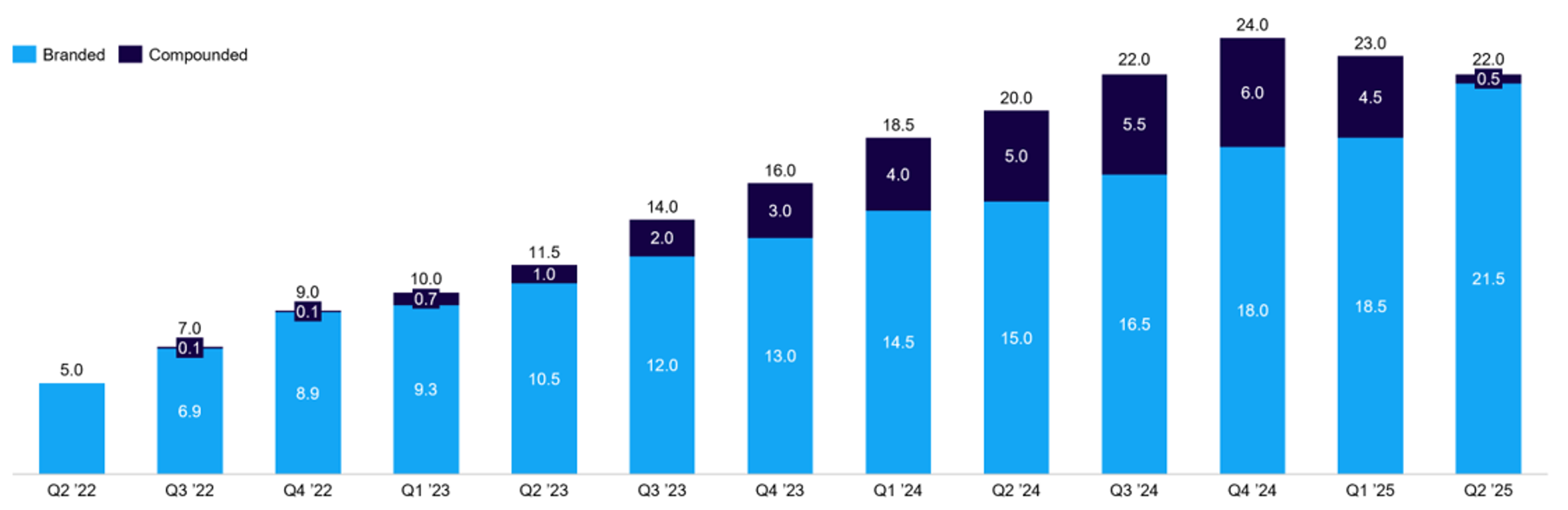
In 2022, the FDA added semaglutide and tirzepatide, the active ingredients in Ozempic/Wegovy and Mounjaro/Zepbound, to its drug shortage list, opening the door for compounders to dispense copycat products in bulk under Section 503B. Over the next two years, the market for compounded GLP-1s exploded, with compounded scripts accounting for a quarter of total GLP-1 script volume at its peak (see Exhibit 2). In 2024, tirzepatide was removed from the shortage list, followed closely by semaglutide, effectively closing the regulatory loophole that had allowed 503B bulk compounding of GLP-1s to proliferate.
Exhibit 2: Total GLP-1 Script Volume (millions)
Source: IQVIA, Trilliant Health, Komodo Health, Novo Nordisk, Eli Lilly
As a result, compounding of GLP-1s under section 503B is no longer permissible. However, compounding of personalized formulations under section 503A continues. Pharmacies and telehealth platforms continue to offer personalized formulations with custom dosage strengths or additives such as B-12 that could be considered distinct from the FDA-approved version. However, the FDA signaled disapproval of these practices in recent guidance and has increased enforcement against GLP-1 compounders.
Unpacking the Current Regulatory Environment
Since the shortage delisting, regulators have sharpened their focus on compounders, and the FDA has adopted a three-pronged approach to rein them in. Over the past year, the FDA has sent waves of enforcement letters targeting telehealth platforms and compounding facilities. Enforcement actions have focused largely on telehealth platforms’ advertising practices, particularly claims implying compounded GLP-1 drugs are equivalent to FDA-approved products. The latest wave of enforcement letters sent in June 2026 signals that GLP-1 compounding enforcement remains a priority for the agency, particularly against the backdrop of Hims & Hers Health Inc.’s (HIMS) continued attempts to produce GLP-1s in bulk.
The FDA also published a clarifying notice in April 2026 to address 503A compounding practices that the agency views as attempting to skirt restrictions. The agency specifically addressed the common practice of adding vitamin B-12 or other additives to semaglutide and tirzepatide formulations, clarifying that these additives are not sufficient to differentiate a product from the FDA-approved version and would still violate statutory restrictions. The FDA also indicated that it may take action against 503A pharmacies filling more than four prescriptions per month with copycat products. Since the notice, FDA enforcement has remained focused on sterility failures and mislabeling, but the notice signals a clear intent to monitor GLP-1 compounding compliance more closely.
Finally, the FDA is considering formally excluding semaglutide and tirzepatide from the 503B bulks list. Inclusion on the list is the only other pathway to legal bulk compounding outside the shortage list. GLP-1s are not currently included on the bulks list, so compounding is already not permissible; however, a formal exclusion would clearly codify the FDA’s position and firmly close the door on potential inclusion. For both semaglutide and tirzepatide, the agency has indicated it believes there is no basis to conclude that the FDA-approved versions are unsuitable for certain patients, meaning there is no clinical need to compound either product in bulk. Capstone believes the FDA will publish a final determination excluding both moieties from the list in the coming months.
Beyond the FDA, GLP-1 compounding has also drawn scrutiny from both state and federal legislators. Most recently, Senator Jim Banks (R-IN) wrote a letter to the acting FDA Commissioner, urging him to investigate marketing claims made by Hims & Hers related to compounded GLP-1s. Banks, along with Senator Martin Heinrich (D-NM), also introduced the Safeguarding Americans from Fraudulent and Experimental Drugs Act (SAFE Drugs Act) to tighten regulations around drug compounding. The bill would further clarify limitations on both 503A and 503B compounding and increase oversight of 503B facilities that ship large quantities of product across state lines.
A handful of states have also introduced legislation designed to stifle the lingering gray market for compounded GLP-1s. Their approaches vary slightly, but most focus on requiring clearer labeling warning consumers that compounded products are not FDA-approved and/or imposing new documentation requirements to restrict the sale and distribution of compounded products, although these provisions tend to be narrowly tailored to only GLP-1s. To date, only Indiana has enacted legislation, with the law focused on GLP-1 compounding practices in med spas specifically. While both state and federal bills pose minimal risk given their narrow scope and difficult path to passage, their introduction signals new awareness among lawmakers that will likely continue driving scrutiny.
Navigating the New Compounding Landscape
Capstone believes heightened scrutiny of GLP-1 compounding will continue, particularly as regulators look to the next generation of blockbuster products like Eli Lilly and Co.’s (LLY) retatrutide. However, the current administration’s stance on compounding is largely product-specific, and other product categories are unlikely to face the same level of scrutiny and, in some cases, will likely see tailwinds over the next 1–2 years.
While cracking down on GLP-1 compounding, the Department of Health and Human Services (HHS) is simultaneously trying to expand access to other compounded products such as hormone therapies and peptides. HHS Secretary Robert F. Kennedy Jr., a self-proclaimed “big fan” and user of regenerative peptides, is pushing to reclassify more than a dozen restricted peptides that were deemed unsafe for compounding in 2023. In July 2026, the Pharmacy Compounding Advisory Committee (PCAC) voted to reclassify six peptides as safe. While the recommendations are nonbinding, the FDA is expected to codify them in a formal rulemaking in the coming months, and the PCAC is expected to vote on another tranche of peptides in February 2027.
The agency’s product-specific approach will require investors to carefully consider product mix. Compounders with a history of bulk GLP-1 compounding will face heightened enforcement risks and should expect to see continued scrutiny even after pivoting to other product categories. On the other hand, longstanding use cases like bulk compounding for hospitals or veterinary clinics are unlikely to face notable regulatory scrutiny and will continue to provide stable revenue streams. Compounders also have opportunities to capture significant gains by transitioning to product categories viewed more favorably by the current administration. However, stroke-of-the-pen risk in these categories remains high, and future administrations may seek to reverse gains for these products, particularly as many career FDA officials have expressed concerns about widespread use.
Given the high stroke-of-the-pen risk and controversial nature of some compounded products, investors should avoid overreliance on a small subset of products. Capstone believes compounding entities with diversified product mixes still represent a compelling investment opportunity despite regulatory movement. Investors must prioritize balancing higher-risk, high-return products with longstanding compounding practices that have more sustainable use cases.
Read more from Capstone’s Healthcare team:
What Investors Should Know About Washington’s First Corporate Practice of Medicine Bill
Clinical Trials Face an Enrollment Problem; Washington Is Betting on AI
Federal Agency Actions Provide Clues to Future Star Ratings Reforms