

Capstone believes state and local regulators will more closely scrutinize data center wastewater discharge processes for health and safety issues during the next five years, leading to new requirements for on-site pretreatment before releasing to a wastewater treatment plant. Investors should be aware that data center developers will likely face higher construction costs and time-consuming remediation requirements for wastewater.
- Wastewater discharges will become an additional hurdle that data centers will face in the coming years, both during construction and regular operations. The discharges of wastewater used in the cooling process for data centers can increase the chances of health and safety issues if not managed correctly, as municipal treatment plants may not have the proper systems in place to treat the concentrated wastewater.
- Following wastewater contamination during the construction of its Wyoming data center, Meta Platforms Inc. has been banned from discharging wastewater to Cheyenne’s wastewater treatment plants and must truck the wastewater offsite for separate treatment. Without additional controls, whether company-side or regulatory, further contamination events will likely spur municipal or state governments to restrict center wastewater discharges to wastewater treatment plants without additional pretreatment.
- Data centers can lower the high volume of water they use with closed-loop cooling mechanisms, which will likely become more common as they continue to experience pushback on water use. However, the continuous recirculation of evaporative spray water can introduce a new suite of issues for wastewater treatment plants and local concerns about data center water use.
- Data centers with closed-loop systems have been able to implement workable treatment solutions, but often at a relatively high cost and under long timelines. Microsoft Corp.’s data center wastewater treatment system in Quincy, WA, went online in 2021, following nearly a decade of planning and construction, at a cost of more than $30 million.
How Data Centers Use Water and Release Wastewater
Open-Loop vs. Closed-Loop Cooling
Cooling systems are one of the key differences in how data centers utilize water and wastewater (see Exhibit 1). Open-loop systems allow for cooling process water to make direct contact with ambient air, utilizing evaporative cooling to help exchange heat with data center components. Open-loop cooling towers typically are less costly than other systems, but the open nature of the tower increases the amount of water consumed and its exposure to outside elements.
Closed-loop cooling (or indirect cooling) isolates the process water (or other fluid) from external air. This process water or fluid is continuously recirculated through heat exchangers and cooled via an evaporative spray loop. This generally reduces water consumption, but the recirculation and evaporation of the spray water concentrates metals, dissolved solids, and other fouling agents into the water. Closed-loop cooling systems are also more energy intensive than open-loop systems.
Exhibit 1: High-Level Overview of Open-Loop vs. Closed-Loop Cooling for Data Centers
| Cooling Type | Water Use | Complexity |
| Open-Loop | High | Open-loop evaporative cooling is generally less complex than closed-loop, but process water requires additional chemical treatment and filtration due to contact with ambient air. Open-loop generally requires less infrastructure to build and operate, but requires significantly more water to run. |
| Closed-Lopp | Low | Closed-loop cooling is less efficient than open-loop cooling, as process water must run through a heat exchanger rather than open air, but reduces the amount of water used for cooling overall. However, the infrastructure required for closed-loop systems is generally more involved than for open-loop systems, and flushing the spray loop wastewater can cause problems for wastewater treatment plants. |
Source: Louisiana Department of Conservation and Energy
Wastewater Regulations at the Federal and State Levels
Clean Water Act
Wastewater discharges are regulated under the Clean Water Act (CWA) at the federal level. Direct dischargers of pollutants into Waters of the United States (WOTUS) are regulated under the National Pollutant Discharge Elimination System (NPDES), and indirect dischargers under the National Pretreatment Program (a component of NPDES). Most data centers discharge wastewater to wastewater treatment plants such as publicly owned treatment works (POTWs). Most direct discharger standards are industry-based and the US Environmental Protection Agency (EPA) has not adopted effluent guidelines (ELGs) for data centers.
State and Local Regulations
State environmental agencies, rather than the federal EPA, are normally tasked with implementing the NPDES program in addition to other state or local requirements for dischargers. Local wastewater discharge limits are the most relevant to data centers, as a local POTW wields significant power to set site-specific limits for discharges to the POTW, including numeric limits for certain pollutants or additional best practices.
Meta’s Cheyenne Data Center and Wastewater Issues on Data Center Construction
In early 2026, the Board of Public Utilities (BOPU) for Cheyenne, WY, began observing levels of novel bacteria in samples from two wastewater plants around the city. After sending the samples to the Wyoming Public Health Laboratory, the lab identified the bacteria as Cupriavidus gilardii, which poses health risks to immunocompromised people. BOPU began investigating potential vectors in the system and identified wastewater from Meta’s Cheyenne Datacenter CHY1-2 site as containing the bacteria in mid-March 2026 following sampling.
After identifying the vector (and receiving confirmation from the Wyoming Public Health Laboratory), the BOPU directed the data center builder to cease any discharges associated with the fill-and-flush process for its wastewater.
In early July 2026, the BOPU issued a notice of significant noncompliance to Meta affiliate Goat Systems LLC following the board’s decision to disallow future discharges of wastewater from the data center. Goat filed an appeal on July 10, 2026.
In a question-and-answer document posted to its website, the BOPU did leave the option open for forgoing the suspension in the future for other data centers, but noted that the “broader suspension is precautionary to allow the staff time to research these types of discharge and the monitoring needed to prevent an event like this in the future.” Additionally, future fill-and-flush wastewater will be hauled to other industrial treatment facilities “until further notice.” The question-and-answer also noted that BOPU denied a request from another data center under construction in the area that utilized closed-loop cooling and sought to discharge to city wastewater treatment plants.
Microsoft’s Quincy Data Center and Remediation Options for Developers
Microsoft has operated a large data center in Quincy, WA, since 2007. In the original wastewater system for the data center, Microsoft would pull potable groundwater from Quincy and discharge it back to the city’s municipal wastewater facility after four or five cooling cycles. Due to the higher mineral content, the water cycles caused increased maintenance requirements following increases in the concentration of total dissolved solids (TDS). The city’s municipal wastewater reclamation facility was not equipped to handle elevated TDS concentrations, leading to issues with recharging groundwater basins and additional charges for data center users.
In 2021, the data center’s new wastewater treatment facility reached operational status, saving an estimated 138 million gallons of potable groundwater per year. The closed-loop system did not discharge industrial wastewater back into rivers and streams, instead treating wastewater before reuse at the data center by concentrating salts from the wastewater into brine ponds to reduce the wear on data center cooling and heat transfer equipment. The facility cost more than $30 million to build but took nearly 10 years of planning to achieve.
Where Is Regulation Going?
Federal Interest
There is significant federal interest in data center wastewater use and efforts to incentivize increasing water reuse to help reduce the total volume of water they use. Although no bills have been enacted, we expect continued interest in future sessions of Congress (see Exhibit 2).
Exhibit 2: Key Data Center Wastewater Bills Pending in Congress
| Bill Number | Description | Status |
| HR 5332 and S 3269 | Requires the Comptroller General to develop a technology assessment of liquid cooling systems for data centers for best-practice guidance for the federal government | In committee |
| HR 6984 | Requires EPA to issue a report on the type and amount of pollutants discharged into water by data centers, among an array of other provisions. | In committee |
| HR 2940 | Creates a 30% tax credit for qualifying water reuse projects for data centers. | In committee |
Source: Congress.gov
Following the issues in Cheyenne, Representative Harriet Hageman (R-WY) sent Meta CEO Mark Zuckerberg a letter requesting answers from the corporation on the steps that led to the discharges and whether the issues had shown up in other data centers. Hageman later noted that her office “had a productive call with Meta” and that she had “been assured that additional testing to confirm the safety of the wastewater has been routinely conducted.”
There is also interest in data center wastewater use at the agency level, and the EPA issued its updated Water Resource Action Plan (WRAP 2.0) in April 2026. One of its key initiatives is advancing the Trump administration’s plan to make the US the world’s premier artificial intelligence (AI) power. Although WRAP does not mandate regulatory action, it does highlight the EPA’s interest in strong practices to achieve this goal.
State and Local Interest
State and local interest in data centers continues to be a major flashpoint in politics and land use policy. Wastewater issues are generally less publicized compared to air emissions from data centers or total water use, but recent litigation highlights the potential for action on wastewater discharges. In late March 2026, Amazon Data Services settled a case with a group of plaintiffs in the Lower Umatilla Basin Groundwater Management Area (LUBGWMA) in Oregon. The settlement arose from allegations that ADS data center wastewater contributed to significant nitrate contamination in the area from “tens of millions of gallons of high-nitrate wastewater every year” and that Amazon consistently violated its discharge permits. The case settled for $20.5 million, with a focus on funding new projects to improve drinking water for LUBGWMA residents.
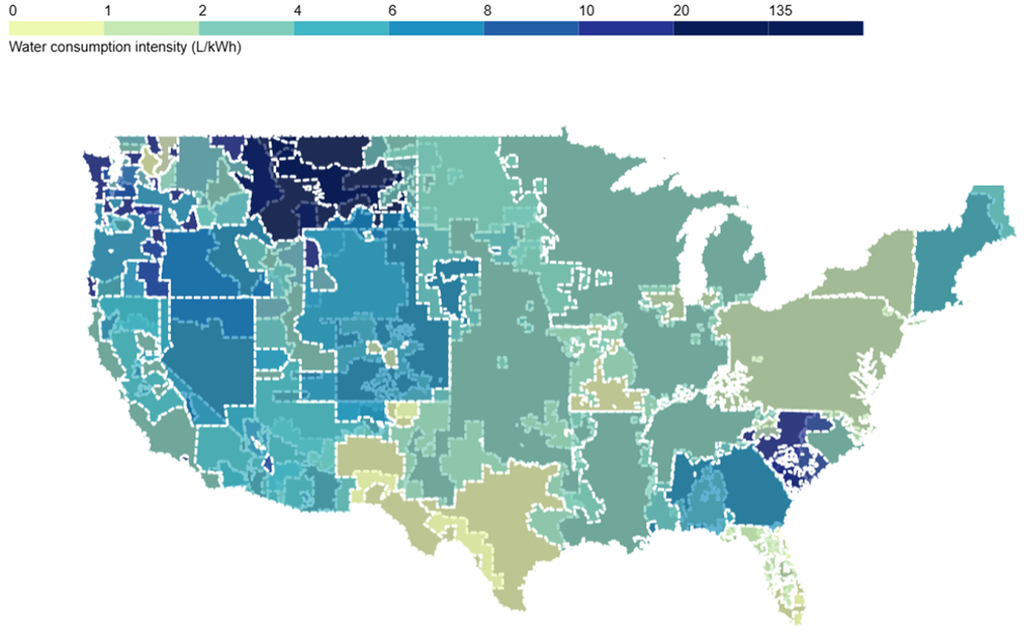
We believe wastewater issues are more likely to materialize in Western states. Many communities, particularly in Arizona, Wyoming, Utah, Nevada, and New Mexico, are sensitive to data centers’ high water use and likely to adopt zoning ordinances requiring closed-loop technologies (see Exhibit 3).
Exhibit 3: Water Consumption Intensity (in liter/kilowatt-hour) by Balancing Authority, 2023
Source: Lawrence Berkeley National Laboratory
What’s Next
Although it has been successful, the Quincy experiment also has been time-consuming. The project took about a decade to build‒far longer than the expected AI infrastructure buildout. The critical questions then become: How should data center infrastructure planners and builders view wastewater infrastructure, and what kind of pretreatment may be necessary? Overall, the largest threat is likely to be similar to what happened in Cheyenne, where a local POTW refuses future wastewater discharges from a data center. The data center owner would have to transport the wastewater offsite for further treatment, which would raise its operating costs and create logistical headaches.
Data center wastewater treatment issues will likely push federal, state, and local governments and other permitting entities to heavily scrutinize plans for proposed or upcoming data centers and require additional treatment mechanisms, adding to the overall capex and operating expenses for the data centers.
We believe one of the major moves that data center developers can make now is to get involved with planning with wastewater authorities early in the process to determine POTW concerns based on planned cooling infrastructure and ways to address high water use and to ameliorate potential health and safety issues.
Read more from Capstone’s Energy Team:
GHG Rollbacks Create Investment Uncertainty for Industry, Shifts Focus to Congress
Plastic Recycling Mandates Face Threats While Battery Mandates Gain Steam
The EU Chemical Industry’s Looming Carbon Cost Pain and Reform Uncertainty