


Capstone believes that a proposed rule increasing disclosure requirements for foreign investors in solar, wind, and pipelines located on agricultural land also threatens to impose new costs and risks. Though the proposal will likely be softened by the time it is finalized, it would increase reporting burdens for investors, potentially covering minority investors and non-controlling stakes, primarily for renewable energy developers and investors.
- In June, the United States Department of Agriculture (USDA) proposed changes to regulations implementing the Agricultural Foreign Investment Disclosure Act (AFIDA). The law requires foreign investors who own interests in US agricultural land to report those holdings to USDA.
- Updates to the rule would lower the reporting requirement threshold for foreign ownership to 10% from 50% and require foreign owners or lessors with significant interest or substantial control of solar, wind, and pipeline assets located on agricultural land to report those interests to USDA. The proposed changes would also require additional disclosures. The revised rule poses a risk to funds that own minority stakes in land yet have no control over how it is used or maintained.
- Comments on the rule highlight several issues with the planned scope, particularly in the context of beneficial ownership and the scope of covered land.
- The Treasury Department’s implementation of the similar statutory requirements for the foreign entity of concern (FEOC) rules enacted in the One Big Beautiful Bill Act (OBBBA) for energy tax credits offers a point of comparison and leads us to expect that proposed rules regarding AFIDA will be refocused in a final version to make them more administrable and feasible for regulated entities.
Proposed Rule Coverage
AFIDA and its Historic Coverage
The Agricultural Foreign Investment Disclosure Act of 1978 requires any foreign person or government who acquires, transfers, or holds an interest in US agricultural land to report the transaction and holding to the Secretary of Agriculture within 90 days. Agricultural land is currently defined as land that is “currently used for, or, if currently idle, land last used within the past 5 years, for farming, ranching, forestry, or timber production.” The current regulations also provide for a de minimis exemption for land not exceeding 10 acres in the aggregate, provided that annual gross receipts from products derived from the land do not exceed $1,000. The proposed rule would expand the definition of agricultural land to include certain renewables and pipelines facilities and remove the de minimis exemption.
Failure to comply with the AFIDA reporting requirements could result in a civil penalty that accrues 0.1% of the land’s fair market value per week, as determined by the US Department of Agriculture, up to a cap of 25% of the fair market value.
Renewable energy assets, particularly wind assets, are often sited on land currently or previously used for agriculture. The USDA’s Economic Research Service released a report on utility-scale solar and wind generation development between 2009 and 2020 that found that nearly all wind generation assets and more than 80% of solar generation assets were sited on agricultural land (see Exhibit 1). Additionally, 99% of wind generation sites remained in use for agriculture after the assets were developed (compared to 85% for solar generation assets).
Exhibit 1: 2024 Disclosure Data and Heatmap
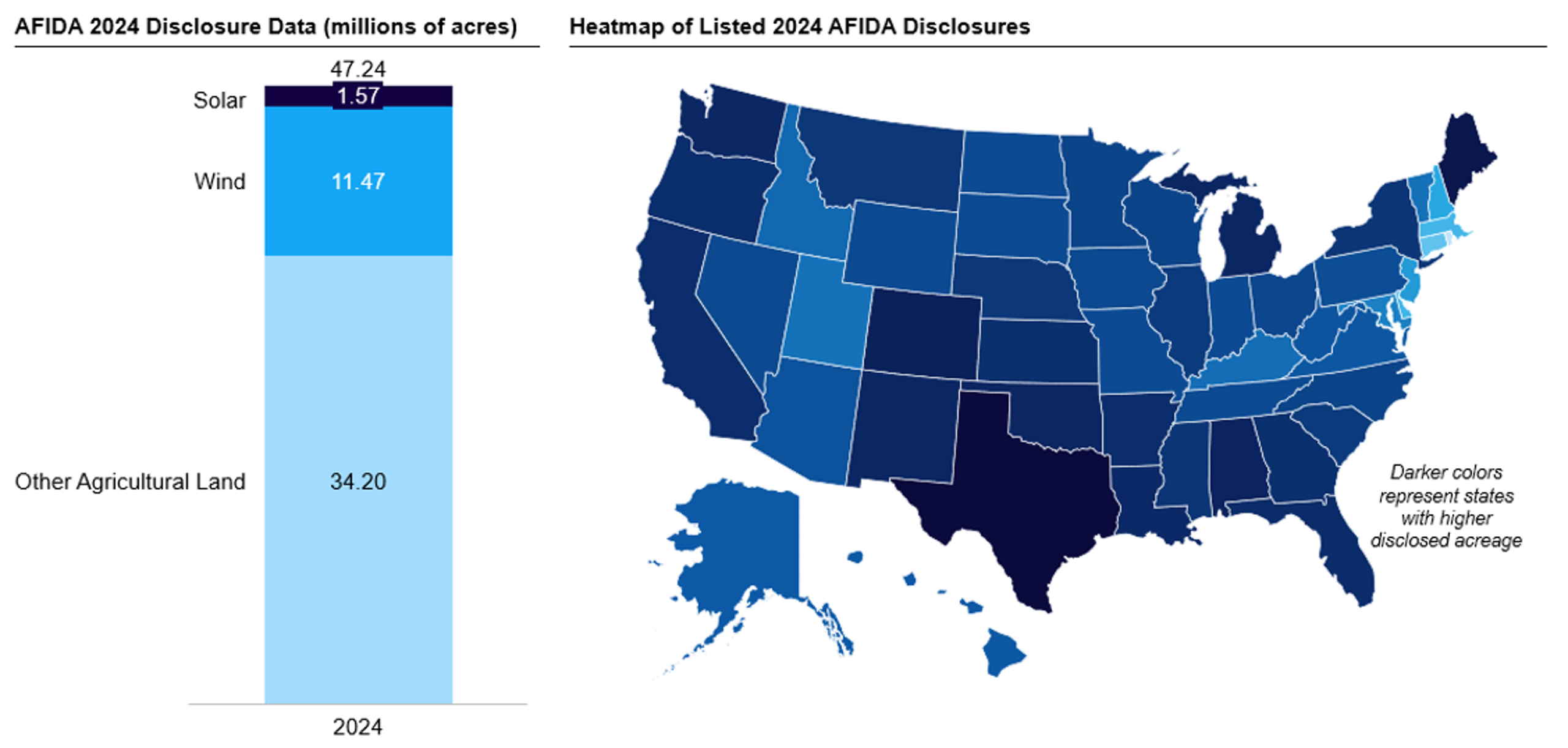
Source: USDA (Note: data was likely cleaned by USDA prior to the report, leading to ~1 million acres overcounted in 2024 submitted data; “wind” and “solar” used as search terms for owner field, actual number of acres may vary)
State-by-State and Foreign Country Disclosures
Several states receive an outsized amount of disclosures for solar and wind (see Exhibit 2). Texas and Colorado are both in the top three on each list, with Colorado solar acreage nearly double that of the next state.
Exhibit 2: Top 10 States for Wind and Solar Disclosures, 2024
| Wind | Acres | Solar | Acres | |
| 1 | Texas | 1,774,165 | Colorado | 398,045 |
| 2 | Oklahoma | 1,683,600 | Texas | 198,977 |
| 3 | Colorado | 1,501,698 | Indiana | 86,247 |
| 4 | Kansas | 1,133,860 | Ohio | 82,782 |
| 5 | Nebraska | 849,438 | Missouri | 64,595 |
| 6 | New Mexico | 834,912 | Oklahoma | 60,017 |
| 7 | Illinois | 581,437 | Illinois | 51,386 |
| 8 | Washington | 404,748 | Wisconsin | 47,506 |
| 9 | Iowa | 382,303 | Nebraska | 41,624 |
| 10 | North Dakota | 329,755 | Michigan | 38,648 |
Source: USDA (Note: “wind” and “solar” used as search terms for owner field, actual number of acres may vary)
The primary country of foreign persons holding agricultural land for renewable energy use in the United States is Canada, followed by Italy (see Exhibit 3).
Exhibit 3: Share of Acres by Country via AFIDA Disclosure, 2024
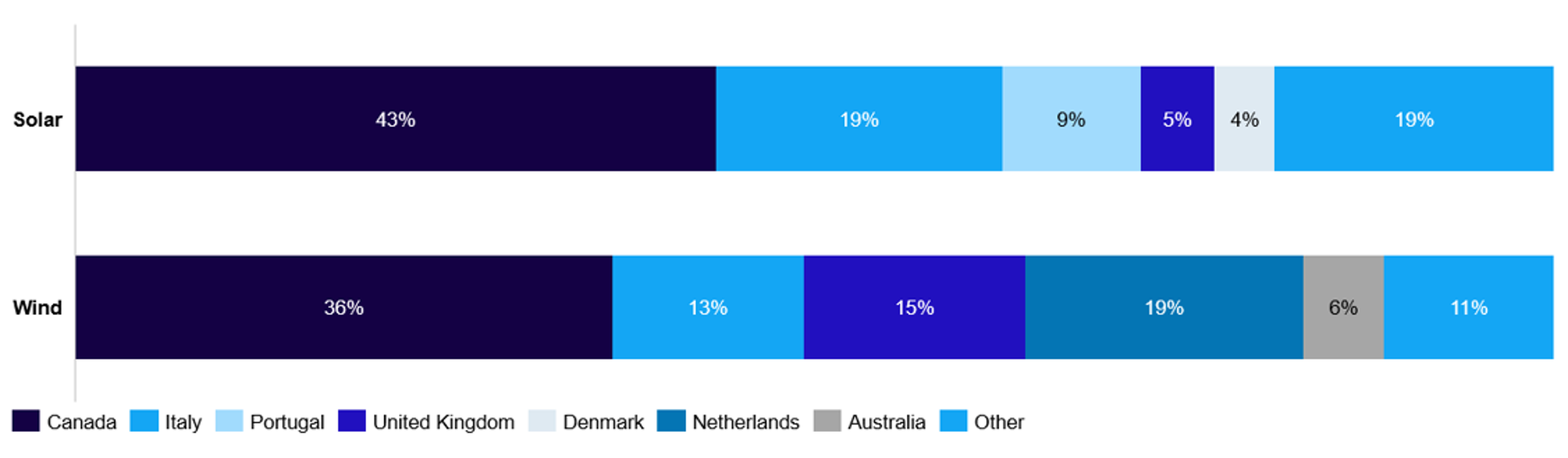
Source: USDA
Proposed New Regulations
On June 25th, the USDA proposed a new rule to implement AFIDA, significantly expanding the scope of covered entities under the rule. The current regulations define “agricultural land” subject to disclosure requirements as “currently used for, or, if currently idle, land last used within the past five years, for farming, ranching, or timber production” (subject to certain exemptions). The proposed rule moves to include a similar definition for farming, ranching, and other traditional agricultural land, but also includes North American Industry Classification System (NAICS) codes 221114 (solar electric power generation), 221115 (wind electric power generation) and 486 (pipeline transportation). The regulations assert that “agricultural land” is having its definition broadened to cover solar and wind generation that “occurs overtop of land otherwise defined” as agricultural land. Likewise, USDA notes that pipelines “span long distances across rural areas and frequently cross private farmland [and that] companies usually secure easements from farmers and design pipelines to allow for continued agricultural use around them,” as a reason to include in the definition.
The proposal also greatly increases the information the submitter would need to include in a disclosure. Specifically, new requirements would require identification of all foreign persons “holding significant interest or substantial control,” including the percentage interests held by each person (and respective country) as well as the aggregate interests held. The proposal would also lower the thresholds for reporting:
- Current Threshold: 10% foreign for individual ownership and 50% for aggregate ownership.
- Proposed Threshold: 10% for both individual and aggregate ownership, with USDA noting that it was considering a 5% threshold.
Additionally, USDA notes that aggregate interest or substantial control can be exercised through a shell corporation, trust, or a partnership (including limited partnerships). Finally, USDA also proposed that beneficial owners would be considered to maintain significant interest or control “simply by virtue of being a beneficial owner and regardless of the amount of interest they may possess.”
Comments Raise Implementation Issues
Comments on the rule closed on August 10th. Several commenters, particularly from infrastructure investing, highlighted various issues with the rule, with most taking issue with the expansion of the scope and the definition of beneficial owners (see Exhibit 4).
Exhibit 4: Selected Commenters and Key Points
| Commenter | Points |
| Global Infrastructure Investor Association | The rule “dramatically expands” the definition of reportable land through the additional scope categories that were not previously covered. A 10% aggregate threshold for investors would cover minority institutional investors who hold “no practical influence” over the management or use of the land itself. |
| Investment Company Institute | The proposal is phrased broadly enough to “potentially reach the investment advisers to funds and other pooled investment vehicles,” rather than only the vehicles. This could include foreign-owned advisers or non-US portfolio managers, even if the adviser holds “no economic interest in the land, exercises its discretion solely on behalf of, and for the benefit of, the vehicle and its investors, and is bound by a fiduciary duty of care and loyalty that runs to the vehicle rather than to the adviser.” |
| America First Policy Institute | Supportive of the proposal, asserting that wind and solar on agricultural land should be included. Specifically, the comment is concerned with placing “adversary-controlled installations along military training corridors. The comment also requests that the reporting provisions should also capture land under “option, lease, or easement for future generation development,” not just currently operational facilities. |
| AFIDA Modernization Coalition | The comment is concerned with the proposal and specifically questions whether the expanded definition of “agricultural land” syncs with AFIDA’s statutory text. The comment requests that USDA specifically reconsider or “substantially revise” the final rule. |
| American Farm Bureau Federation | Comment argues that the final rule should specify that land used for solar, wind, pipeline, or research activities should be covered “when those activities occur on or directly affect agricultural land.” Comment cautions USDA on treating property as agricultural land “solely because of the business classification of an establishment located there.” |
Source: Regulations.gov
Like the OBBBA Tax Credit Guidance, AFIDA FEOC Aspects Likely Focus on Administrability
In the Treasury Department’s February guidance on the new supply chain FEOC provisions for certain energy tax credits, Treasury prioritized creating administrable pathways for compliance that are not so onerous that Treasury would be unable to oversee them. This came after the OBBBA marked a significant, unprecedented expansion of the FEOC provisions under the Inflation Reduction Act (IRA), which had applied to only one tax credit related to electric vehicles.
While the Treasury Department would not implement or oversee AFIDA compliance, USDA would likely contend with many of the same issues in terms of crafting rules that are administrable and verifiable and that do not exceed the authorities delegated in the statutory text. These would be challenged by the scope of the proposed threshold. In general, Treasury releases versions of tax guidance that become more taxpayer-friendly with each administrative step in creating a final rule. Treasury often releases the most burdensome version of a rule first and eases it via proposed and final rules instead of releasing lenient guidance that becomes stricter between versions.
This helps Treasury ensure it can oversee the rules it is setting in place, avoid litigation risk, and helps tax professionals prepare for the most comprehensive reporting requirements first. This was evident in the 30D electric vehicle FEOC rules, where Treasury eased supply chain tracking for graphite and the 45X rules for critical minerals, which permitted certain cost recoveries related to extraction in the final rule that were absent in the proposed rule to make compliance feasible and administrable.
Treasury’s approach will be further constrained by a June court ruling that overturned new beginning of construction guidance (BOC) pertaining to wind and solar projects seeking to claim clean electricity tax credits. While not directly related to FEOC, this ruling demonstrated that Treasury runs significant legal risk if it adopts FEOC rules that discriminate against certain technologies or contain new standards that do not exist in the statutory text of the OBBBA. Treasury’s February guidance avoided this risk, and future proposed and final rules will be cognizant of the legal risks involved in prescriptive rulemakings.
What’s Next
The rule is planned for finalization by the end of 2026 according to the most recent Unified Agenda. The rule’s progress appears broadly on track, with the proposed rule published in early August against its planned target date of July. However, the finalization of the rule could easily be delayed to 2027.
The proposed rule was not classified as a significant regulatory action and was not sent to the Office of Information and Regulatory Affairs (OIRA) for review prior to being published. However, given the economic impact associated with the substantial expansion of entities covered under rule, the final rule may be designated as a significant regulatory action and be subject to OIRA review. Under the second Trump administration, USDA rules have averaged 62 days in OIRA review (median 32 days), with an additional 18 days before publication in the Federal Register.
Read more from Capstone’s Energy Team:
GHG Rollbacks Create Investment Uncertainty for Industry, Shifts Focus to Congress
Plastic Recycling Mandates Face Threats While Battery Mandates Gain Steam
Japan’s Crude Diversification Drive Presents Tailwinds for US Crude Exporters