
Capstone believes state and local budgets will face mounting pressure in 2026 from underperforming tax revenue and cuts to federal funding. States politically opposed to Trump, such as California, New York, and Illinois, face the highest risk of having their transit, climate, and disaster relief grants withheld. However, all states will suffer if Congress fails to reauthorize the Infrastructure Investment and Jobs Act by October 2026.
Outlook at a Glance
- State Budgets Face Shortfalls in FY26 as Revenues Underperform and Cuts to Federally Funded Programs Hit
- Targeted Cuts to Some Federal Programs Aimed at Blue States Will Likely Put Even More Pressure on Their Budgets
- Congress Must Renew the Infrastructure Investment and Jobs Act, a Potential Risk to State and Local Governments Dependent on Federal Transportation Funding IIJA
State Budgets Face Shortfalls in FY26 as Revenues Underperform and Cuts to Federally Funded Programs Hit
| Winners | Texas, Florida, and other states with a history of outperformance. |
| Losers | New York, California, Maryland, Illinois, Washington, and as many as a dozen other states that have already warned of softer-than-expected revenue and the potential impact of cuts to Medicaid, SNAP, and other federally funded programs on state budgets. |
Capstone believes state budgets will come under increasing pressure in 2026 as general revenue trends normalize, with fewer states collecting more than they projected.
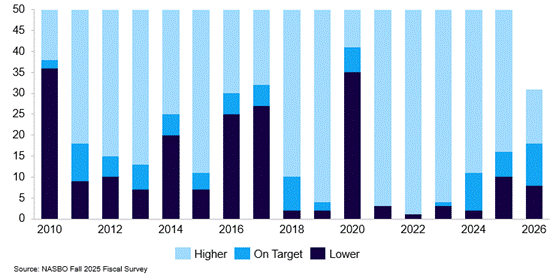
States have enjoyed that status for most of the last decade. In almost every year since 2018, more than 35 states exceeded their revenue projections, and in six of those years, fewer than five states missed their estimates.
The only year since 2018 in which a significant number of states missed their revenue estimates was 2020, and that was almost entirely due to widespread business closures caused by the COVID-19 pandemic.
However, even in 2020, when tax revenue underperformed, state and local governments received generous federal funding, including $150 billion in flexible aid through the Coronavirus Aid, Relief, and Economic Security (CARES) Act and $350 billion from the Coronavirus State and Local Fiscal Recovery Fund. The influx of funding from these and other programs more than offset any lost tax revenue and ensured that state and local governments had more than sufficient revenue in 2020 to make it through the year without imposing meaningful austerity measures to respond to a 4.3% year-over-year decline in tax revenues.
It appears that conditions are changing in the current fiscal year, as states are reporting softer-than-expected monthly tax collections. Thirty-four states have released preliminary revenue estimates for the first couple of months of FY26, and eight are already underperforming; 10 states report collections are on target. Only 13 states (38%) have indicated that collections in FY26 are better than expected.
Excluding COVID, this is the first time since 2017 that more states report flat or below-expected tax collections than report above-expected tax collections.
Exhibit 1: FY General Fund Revenue Collections Compared to Original Revenue Estimates
Even before states began releasing preliminary monthly revenue reports, it appears their budgets will be under pressure in FY26. General fund expenditures are expected to remain nearly flat in most budgets, and revenue is projected to grow by an average of only 0.7% across all states in FY26. This lackluster revenue growth in FY26 is despite several states having imposed modest revenue-raising measures to support the general fund budget.
It is also important to note that some states found it particularly difficult to pass their FY26 budgets in 2025. North Carolina failed to pass a budget at all—and will likely not pass one until early 2026. Massachusetts, South Carolina, Pennsylvania, Michigan, and several other states passed their budgets after constitutionally required deadlines, with most operating for a short period on continuing resolutions to fund the government.
An unusually large number of states failed to pass budgets on time, largely because of significant disagreements between governors and lawmakers over spending priorities and tax policy. Those conflicts were exacerbated by revenue forecasts that projected flat-to-slightly up y/y revenue growth across most states.
Targeted Cuts to Some Federal Programs Aimed at Blue States Will Likely Put Even More Pressure on Their Budgets
| Winners | None |
| Losers | State and local governments that run afoul of the Trump administration enough to have discretionary federal funds withheld. The most likely candidates are California, New York, and Illinois. |
Federal funding for state and local governments (SLGs) accounted for roughly $1.1 trillion of the $6 trillion that SLGs spent in FY25. According to the US Census Bureau’s report on state and local government finances, 58% of this federal funding went to healthcare-related programs such as Medicaid, with the rest supporting education, transportation, and social programs for lower-income people.
Most of that funding flows through well-established programs such as Medicaid, where states receive matching federal funds on a reimbursement basis to cover healthcare costs for eligible beneficiaries. However, other funds are provided through a variety of discretionary grant programs, in which the federal agency has greater discretion in their distribution.
Capstone believes some types of federal funding available to state and local governments are at risk in 2026 because the Trump administration has used its control over the funds to advance its political agenda. Exactly which funds are most at risk is difficult to determine, but we believe funds where federal agencies have some latitude to impose more onerous compliance requirements on states, or where funds are awarded competitively, are likely the most at risk.
Funds provided to SLGs on a formula basis or through reimbursement under long-established policies and procedures are likely to be at the lowest risk. Examples of funds where we see little risk are ordinary-course reimbursement payments made to states under the Medicaid program and formulaic funding provided to state departments of transportation under the National Highway Performance Program (NHPP).
There have already been numerous examples of the Trump administration withholding federal funds, and we believe these examples highlight the kinds of funding most at risk of disruption. A few examples:
- The US Department of Transportation (DOT) has frozen roughly $20 billion in funding for transit and rail infrastructure projects in and around New York City and Chicago. The DOT cited concerns over contracting policies that favor disadvantaged business enterprises and run afoul of a recent DOT interim final rule that bans providing preferential treatment to contractors based on gender or race.
- The Trump administration delayed the release of hundreds of millions of dollars of federal disaster relief funding from the Federal Emergency Management Agency (FEMA) related to the California wildfires earlier this year, even though the expenses were incurred in response to a federally declared natural disaster. This delay has put a significant strain on both state and local budgets.
- The administration has cancelled, delayed, or restructured several grant programs viewed as being “too green” to align with Trump’s policy priorities. Examples of programs that have experienced disruptions in funding include a $5 billion grant program for electric vehicle (EV) chargers, a $1.2 billion program for low-carbon materials for state DOTs, roughly $23 billion in climate funding across different appropriations bills, and more than $800 million in Department of Justice (DOJ) grants to support funding for programs established by state and local governments.
The disruption of this kind of one-off funding is probably not a large enough risk to state and local budgets to bankrupt any of them, but it can lead to sudden, unexpected budgetary holes that are painful to close. A clear example is the $1 billion deficit in the City of Los Angeles for the current fiscal year, which was forecasted when the city was developing its budget in early 2025. The deficit was partly caused by FEMA withholding funds and by the need to use city resources for recovery expenses that the city originally expected to be covered by disaster relief.
The city closed the anticipated $1 billion deficit through a combination of layoffs, cuts to nonessential services, and the transfer of some workers to agencies such as the Port of Los Angeles, which are outside the city’s general fund budget. More than 1,600 city workers lost their jobs, and it is likely that at least some of those jobs would have been saved had federal funding arrived as expected, without delays or disruptions.
Congress Must Renew the Infrastructure Investment and Jobs Act, a Potential Risk to State and Local Governments Dependent on Federal Transportation Funding
| Winners | States such as Florida and Texas that spend most IIJA funds on highways, and where lawmakers are most likely to increase funding in any extension or renewal of IIJA. Government contractors, including United Rentals Inc. (URI), Caterpillar Inc. (CAT), Vulcan Materials Co. (VMC), Martin Marietta Materials Inc. (MLM), Nucor Corp. (NUE), and Sterling Infrastructure Inc. (STRL). |
| Losers | States, such as New York, California, Illinois, New Jersey, and Washington, that spend disproportionately on climate-related initiatives and transit. These funding categories are most at risk of being eliminated, reduced, or frozen in any IIJA extension. |
The Infrastructure Investment and Jobs Act (IIJA) is a $1.2 trillion infrastructure funding package enacted during the Biden administration that must be reauthorized by October 1, 2026. That would not only allow already appropriated funds to continue to be spent, but also provide additional funding after the current fiscal year.
IIJA includes dozens of specific programs covering a range of infrastructure funding needs, but its core is the more than $670 billion in surface transportation funding for roads, bridges, mass transit, and intercity rail. State and local governments receive over $1 trillion in federal grant funding each year, and in 2025, roughly 10% of this funding, or just over $100 billion, was specifically for transportation.
Capstone believes Congress has no choice but to pass an infrastructure funding package in 2026. The details are uncertain, and that is where state and local governments face risk. The primary options Congress would consider in a future infrastructure funding package are:
- A clean one-year extension of funding at current levels for most of the programs included in the IIJA, which would give policymakers time to negotiate a multi-year funding bill after the 2026 elections.
- A multi-year funding bill that covers most of the major categories of infrastructure funding needs included in IIJA but excludes one-off increases in funding for programs the Trump administration has indicated it would not support, such as broadband infrastructure, EV charging, EV buses, and “green” programs unrelated to transportation.
- Whether to maintain current funding levels beyond 2026 or to instead account for inflation since the IIJA became law in 2021. Inputs for highway construction increased 17.2% in 2021 and 16.1% in 2022 due to a shortage of both labor and construction materials.
Federal transportation funding is crucial for supporting infrastructure investments; state and local governments depend on it. Federal funding accounts for 25% of state and local transportation spending, and most of these funds support capital investments. At the same time, state and local funding is heavily weighted toward operating expenses, such as routine road maintenance and mass transit operations.
By law, federal funds can be used to cover up to 80% of the cost of highway projects, 40% of the capital funding needs of state departments of transportation, and more than 40% of the capital funding needs for transit systems in 2024. Without federal infrastructure funds, state and local governments would lack the resources to expand their road networks and transit systems, invest in new rolling stock and buses, or undertake major capital improvement projects, such as repaving highways and constructing new bridges.