
Capstone believes, despite interoperability efforts, fax as a data exchange method remains structurally embedded in healthcare due to disparate technologies, specialty resistance to modernization, and the lowest common denominator nature of the technology. The long onramp of transition to liquid, interoperable data exchange provides opportunity for cloud fax vendors to become full suite interoperability solutions.
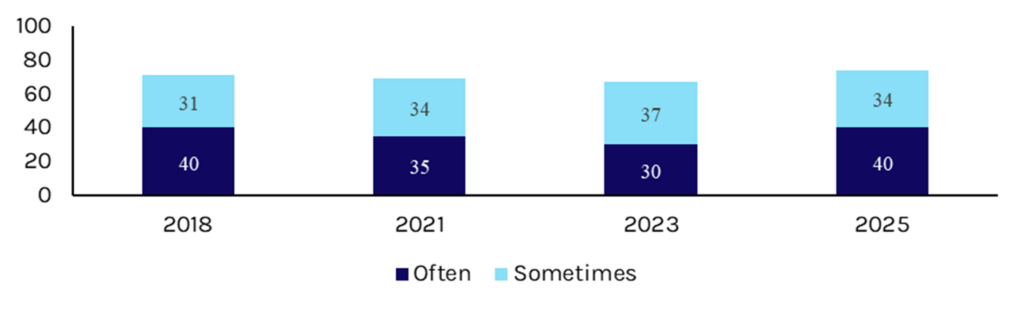
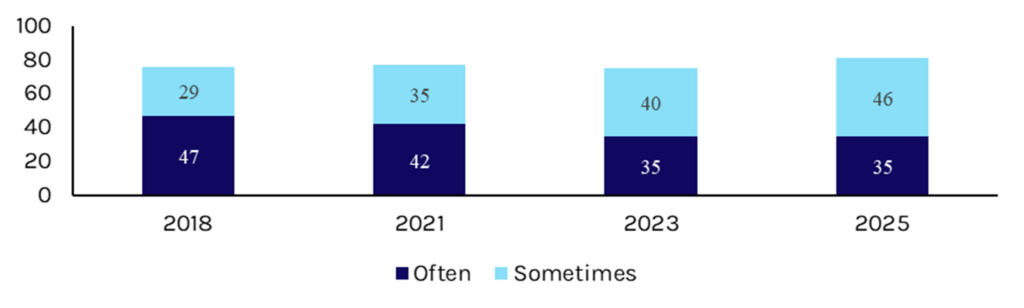
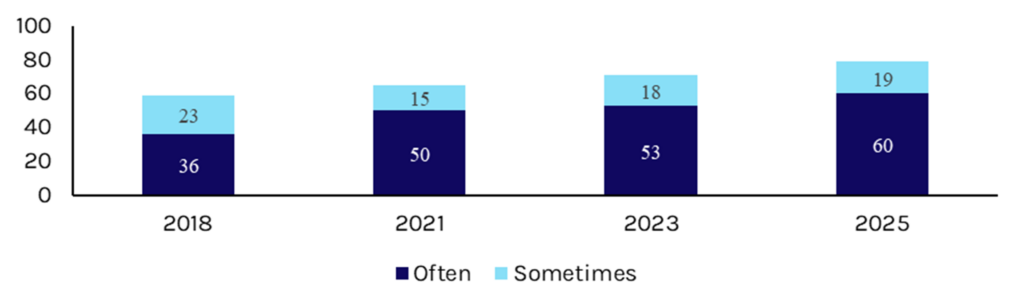
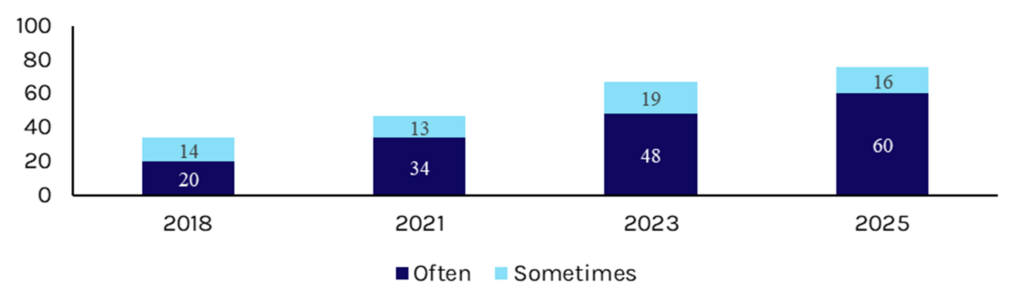
- Despite two decades of federal investment in healthcare IT, hospital system reports of sometimes or often sending and receiving clinical information (e.g., summary of care records) through fax has moderately increased since 2018. Amid this is a complementary increase in local health information exchange and national network use, suggesting fax is not replaced by interoperability efforts.
- The primary volume risk to cloud fax vendors is concentrated in prior authorization and healthcare attachments transactions, which likely face headwinds from the Centers for Medicare & Medicaid Services’ (CMS) Prior Authorization application programming interface (API) requirements in 2027.
- The pace of healthcare IT modernization has been historically slow, indicating that fax displacement will be gradual and cloud fax vendors with an interoperability plan are uniquely positioned to pivot to full suite solutions that serve as central receivers of unstructured data that facilitate interoperable data exchange.
Fax Prevalence in Healthcare
Despite billions of dollars being invested into healthcare digitization efforts during the past two decades under the Health Information Technology for Economic and Clinical Health (HITECH) Act and the 21st Century Cures Act, fax remains one of the most widely used methods of exchanging clinical information between healthcare organizations. This is true largely because thousands of independent healthcare organizations operate on disparate platforms with limited universal standards for data exchange, making fax the lowest common denominator for exchange. It requires no technical integration, imposes no compatibility requirements on other parties, and reliably assists in the exchange of health information. With the lowest common denominator factor, organizations must maintain this exchange capability regardless of interoperability maturity, creating a market for scalable, API-enabled cloud platforms (i.e., Cloud Fax) that integrate with EHRs or standalone systems, maintaining data in a separate environment.
Amid interoperability efforts from the CMS and the Assistant Secretary for Technology Policy/Office of the National Coordinator for Health IT (ASTP/ONC), there is concern that the total volume of faxes will decrease. However, February 2026 data from the agency indicate that the percentage of hospital systems that sometimes or often send (Exhibit 1) and receive (Exhibit 2) summary of care records outside the system through mail or fax has moderately increased since 2018. This comes despite growing interoperability efforts, when in the same time window, the percentage of hospital systems sometimes or often sending summary of care records outside the system via local health information exchange (Exhibit 3) and national network (Exhibit 4) has increased by 20% and 42%, respectively.
Even as hospitals and large systems invest heavily in technology, they remain unable to retire fax capabilities because of the technology decisions of the organizations they exchange information with. An internal investment in a fully integrated EHR platform does not change the fact that an independent physician practice, skilled nursing facility (SNF), home health agency, behavioral health provider, or other provider still operates on analog fax machines.
Complete removal of fax-based communications would require all providers to modernize their communication infrastructure. For those who have resisted to this point, a lack of new funding from federal and state levels is likely to lead to trend maintenance; however, some efforts could threaten volumes of specific transaction types (e.g., prior authorization, attachments).
Exhibit 1: % of Hospitals that Send Summary of Care Records Outside Their System by Mail or Fax
Source: ASTP/ONC data
Exhibit 2: % of Hospitals that Receive Summary of Care Records from Outside Their System by Mail or Fax
Source: ASTP/ONC data
Exhibit 3: % of Hospitals that Send Summary of Care Records Outside Their System by Local HIE
Source: ASTP/ONC data
Exhibit 4: % of Hospitals that Send Summary of Care Records Outside Their System by National Network
Risks to Vendors
The typical model of billing for cloud fax vendors is a hybrid model that blends monthly recurring subscriptions, typically prescribing an allowed pages-per-month, with use-based fees, where greater use results in more favorable rates. As a result, regulatory changes that impact specific transactions can materially impact the revenue of a cloud fax vendor.
The greatest volume of fax-based transactions typically comes in 1) referrals between providers and discharge summaries and care instructions; 2) prior authorizations and healthcare attachments to support prior authorization and claims submissions; and 3) medical record requests (e.g., continuity of care requests, legal and litigation requests from attorneys, insurance company requests for subrogation purposes, release of information). The primary risk of reduced volume lies in prior authorizations and healthcare attachments, particularly due to the structured, routine transaction nature that is supported by prior authorization API requirements, HIPAA-compliant standard transaction formats (X12 278, X12 275), and administrative simplification rules that would require the use of X12 275 for healthcare attachments.
Referrals, Discharges, and Continuity Requests
With all the regulatory requirements of interoperability, these transactions remain the areas where the logic that disparate systems have a hard time connecting with each other stands strong. None of the APIs that CMS has mandated address provider-to-provider interoperability. Even with HITECH and information-blocking prohibitions, exchanging information via fax is still allowable. As such, when a hospital is referring patients to post-acute care, those provider groups may not maintain equal levels of technology, largely requiring fax-based communications. Similarly, when small providers share records with hospitals, the transaction becomes an inbound fax.
Despite no provider-to-provider API requirement, requirements for APIs under Fast Healthcare Interoperability Resources (FHIR) standard should increase comfort levels among organizations, eventually making utilization of such technology ubiquitous, but until that point, fax remains the lowest common denominator. In the meantime, the incremental nature of advancement supports an on-ramp for cloud fax providers to become a full-suite interoperability solution, supporting all exchange types.
On the record request side, some vendors are looking to reduce their reliance on fax-based exchange. Still, smaller providers sharing records with payors for subrogation purposes likely support continued fax utilization.
Prior Authorization and Attachments
By January 1, 2027, CMS-regulated payors (e.g., Medicare Advantage plans) must maintain a FHIR-based API for prior authorization. Due to their investments in these plan types and corollary efforts from EHR vendors to support connection to these APIs, Capstone expects payors to leverage these APIs across all plan types. If plans attempt to limit utilization to CMS-regulated plans, providers will likely find issue with the different process for prior authorization based on beneficiary plan type, resulting in strong pressures for payors to make APIs available.
If the APIs work as intended, the documentation, templates, and rules implementation guide should facilitate more accurate initial submissions, negatively affecting subsequent healthcare attachments volume, which are used to provide additional information upon request, and the initial prior authorization transaction. However, this threat will likely be confined to attachments involved in the prior authorization process. Attachments that are currently used to justify claims submissions do not face the same headwind of streamlined, accurate processes that diminish the need for follow-on health information.
Growth Opportunities for Vendors
Capstone believes there is limited risk that fax volume disappears overnight. Data support the continued reliance on fax as a lowest common denominator form of exchange, and the speed of healthcare transaction modernization has been historically slow. For example, it has been nearly two decades since HITECH and there is still a lapse in EHR utilization based on specialty, with inefficient data exchange among many who were awarded funding for EHR adoption.
While Capstone expects a loss in volume associated with prior authorization and attachments, the long on-ramp of transformation allows cloud fax vendors to reorient and position as full suite interoperability solutions supporting all types of healthcare data exchange. The current competition for these vendors is point solutions, presenting an opportunity for point solution merger and acquisition actions to facilitate the creation of the full-suite tool providers desire.
Given the unique position of cloud fax vendors—receiving unstructured data from various provider types—the opportunity to implement natural language processing capabilities to extract data for healthcare-specific transactions is valuable. Serving as the central system that can connect multiple interfaces across all specialties and provider sizes, and supporting data extraction, structuring, and conversion to modern transaction formats, should support the transition to a core system that facilitates interoperable health data exchange.
Read more from Capstone’s healthcare team:
European Digitization Gaps Create Opportunities for Healthcare IT Investment
The Great Rewiring of Healthcare IT: Policy-Driven Opportunities
The EU’s Healthcare Policy Moment: Why Policy Will Drive More Opportunities and Risks in the EU Healthcare Sphere