

Capstone believes the approach of the midterm elections will dampen appetite for aggressive policy action across both compliance and voluntary carbon markets in 2026. California allowance prices should find support from Cap-and-Invest rulemaking despite federal legal challenges, while energy affordability concerns are likely to push states toward less stringent Renewable Portfolio Standards, weighing on compliance Renewable Energy Certificate (REC) prices.
Outlook at a Glance
- California Allowance Prices to be Boosted by Cap-and-Invest Rulemaking Despite Federal Legal Threats; RGGI Prices to Benefit from Third Program Review Implementation
- WA Measures to Stabilize Allowance Prices Before California Linkage to Pressure WCAs Downward; November 2027 Linkage Target Aggressive, 2028 More Realistic
- CORSIA Approval and 2026 CDM Closure Signal Growing Opportunity for Carbon Removals in UN Carbon Markets
- Political Considerations to Limit RPS Stringency, Weighing on Compliance RECs; Voluntary RECs to Face Enhanced Time and Location Matching Rules
California Allowance Prices to be Boosted by Cap-and-Invest Rulemaking Despite Federal Legal Threats; RGGI Prices to Benefit from Third Program Review Implementation
| Winners | California carbon allowance (CCA) prices, Regional Greenhouse Gas Initiative (RGGI) allowance prices |
| Losers | Obligated entities like industrial facilities and fuel suppliers |
California Cap-and-Invest Rulemaking to Support Prices but Federal Legal Threats Loom
We believe market confidence in California’s Cap-and-Invest program will continue to increase in 2026 as the California Air Resources Board (CARB) makes progress on the rulemaking process to tighten annual allowance budgets to align with the state’s 2030 emissions reduction target. We expect this dynamic to provide positive support for CCA price movement. Trump administration legal challenges to the program remain a risk, but lack a strong legal argument to threaten the program. Nonetheless, we believe any adverse actions from the administration will create buying opportunities.
On the rulemaking process, we expect CARB to issue the Initial Statement of Reasons (ISOR) package, starting the one-year rulemaking timeline, by early 2026. This will likely include removing 118 million allowances over the 2027-2030 budget years to hit the 2030 emissions reduction target and permanently retiring offsets on a one-to-one basis, as required by AB 1207. The key question will be how CARB accounts for the use of offsets to prevent variability in auction revenue after the end of compliance periods.
Given that CARB usually takes 3.5-4 months to issue a Final Statement of Reason after the ISOR, we expect a Board vote around April 2026. The Office of Administrative Law will then review the package and vote on it. We thus expect the program to become effective on September 1, 2026, in line with CARB’s target date, followed by changes being implemented on January 1, 2027.
We see three main catalysts for the legal challenges from the Trump administration: 1) repeal of the Endangerment Finding, likely in early 2026; 2) linkage of California’s Cap-and-Invest program with Washington state in late 2027 or early 2028; and 3) political developments such as the 2026 midterms and 2028 presidential elections prompting action from the Trump administration. Although we expect legal action, we maintain our expectation that the administration does not have a strong legal argument to dismantle or threaten the program’s existence.
RGGI to See Increased Market Interest Ahead of Third Program Review Implementation
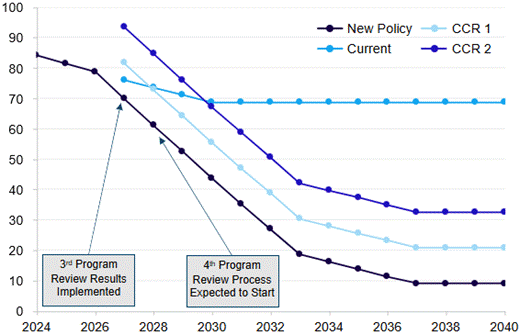
We expect allowance prices to rise across states participating in the Regional Greenhouse Gas Initiative (RGGI) as they anticipate the emissions cap to be lowered at an aggressive pace starting in 2027, when the Third Program Review is implemented. Allowance banking will be a key aspect to watch, as well as whether the Cost Containment Reserve (CCR) is fully dispersed in the first auction of 2026. Notably, RGGI will implement a second CCR and assign fixed volumes to both CCR price tiers, departing from the current practice of calculating the price as a percentage of the annual cap, to limit price spikes.
Energy affordability concerns will remain top of mind across the Northeast. Over the next year, we will be watching how lawmakers and regulators discuss adopting the Third Program Review Results ahead of 2027 implementation. We expect all states to ratify the new changes in 2026, but we will look for signals as to how states will position themselves ahead of the Fourth Program Review deliberations, which are expected to begin in 2028. We believe states will take cues from what’s happening in New York, as Governor Kathy Hochul (D) has continued to pause action on establishing the economy-wide New York Cap-and-Invest program due to energy price pressure. These discussions will serve as key signposts for what priorities may emerge in future program deliberations that we expect to see a dampening of ambition during the Fourth Program Review that could lead to a less aggressive reduction trajectory.
Exhibit 1: RGGI’s Third Program Review Adds a Second and Larger CCR to Prevent Price Spikes (in millions)
Source: RGGI
With Pennsylvania’s participation in the RGGI off the table after a November 2025 state budget deal, we expect Virginia’s path to reentry will be a key development to watch. On the gubernatorial campaign trail, Abigail Spanberger (D) had vocally supported rejoining the RGGI. Now, as governor, we believe she will use executive action in 2026 to reverse her predecessor Glenn Youngkin’s (R) 2023 withdrawal executive order and stop the ongoing appeal of the November 2024 ruling.
We expect Virginia’s reentry prospects to improve market sentiment for RGGI allowance prices, although their impacts will depend on the state’s emissions baseline and allowance cap decisions. The earliest possible date of reentry is 2027, but we believe 2028/2029 is a realistic target, given the uncertainty of negotiations with the RGGI board on Virginia’s cap-and-reduction trajectory.
WA Measures to Stabilize Allowance Prices Before California Linkage to Pressure WCAs Downward; November 2027 Linkage Target Aggressive, 2028 More Realistic
| Winners | CCA prices, Washington obligated entities including industrial facilities and fuel suppliers |
| Losers | Washington carbon allowance (WCA) prices |
Capstone believes Washington state’s target of achieving operational linkage with the Western Climate Initiative by November 1, 2027, is ambitious due to California and Quebec’s competing priorities, ongoing rulemakings, and general regulatory delays. We view 2028 as more realistic. The state is expected to release a draft package with these updates in early 2026 and finalize it by year-end, setting an effective date of January 1, 2027, to begin the process of operational linkage.
As Washington state prepares its market for linkage, we believe implementation of HB 1975’s provisions, designed to stabilize WCA prices ahead of the California linkage, will pressure WCA prices downward after record highs triggered Allowance Price Containment Reserve (APCR) auctions. These provisions include lowering the price ceiling to $80 in 2026-2027 (currently $94.85), extending compliance timelines, retroactively adding vintage allowances, and increasing APCR allowance supply by 2%-5%. Upon linkage, we expect modest tailwinds for CCA prices driven by increased demand.
CORSIA Approval and 2026 CDM Closure Signal Growing Opportunity for Carbon Removals in UN Carbon Markets
| Winners | Carbon removal projects with Article 6 host country authorizations |
| Losers | US-based carbon offset projects |
Capstone expects carbon dioxide removal (CDR) projects with host country authorizations to command premium prices across VCMs in 2026 as United Nations (UN) carbon markets shift toward stricter quality standards. The International Civil Aviation Organization’s approval of CDR methodologies for the Carbon Offsetting and Reduction Scheme for International Aviation (CORSIA) in 2025 and the legacy Clean Development Mechanism’s closure by the end of 2026 signal growing acceptance of removal projects in UN carbon markets. However, fragmented domestic enforcement—particularly the US’s lack of a domestic CORSIA mandate—and ongoing delays in issuing letters of authorization (LoAs) will constrain supply of eligible credits and disadvantage projects without host country approvals.
Carbon Dioxide Removals
We believe carbon dioxide removal (CDR) methodologies will see increased opportunities within the United Nations (UN) carbon markets. During the 2025 Council session of the International Civil Aviation Organization, novel CDR methodologies, including direct air capture (DAC) under Verra and Isometric, were deemed eligible for the Carbon Offsetting and Reduction Scheme for International Aviation (CORSIA). This marks a shift from earlier assessments that had questioned the economic feasibility of such projects. This also mirrors a similar reversal from the Article 6.4 supervisory body, which omitted any restrictions for CDR projects under the Paris Agreement Crediting Mechanism (PACM) after stakeholder pushback to initial objections.
Eventually, we expect CORSIA and PACM rules to converge, establishing a broad standard on “high quality” carbon credits across the VCM, with both CORSIA and PACM credits expected to command higher prices and facilitate increased investor confidence in the VCM. CDR projects are additionally expected to see elevated prices due to generally “higher” perceived standards on permanence and durability over other project types in the market.
COP30 Updates
We expect increased opportunities for CDR after negotiators reached consensus at the UN’s COP30 Summit in November on closing the legacy Clean Development Mechanism (CDM) carbon market by the end of 2026. This change reflects growing pressure from member states to facilitate transition to the new Article 6 PACM. Governments also approved the transfer of over $30 million from the CDM to support capacity-building efforts for the PACM. We expect CDM transitions to eventually mark the issuance of first PACM-eligible credits through 2026. Other Article 6 decisions from COP29 remained unaltered, with discussions on permanence and risk reversals to now resume under future negotiations.
CORSIA Outlook
CORSIA implementation still faces risks from fragmented enforcing legislation across member countries, including the US, which continues to lack a domestic mandate for CORSIA. Additionally, delays in the issuance of letters of authorization (LoAs) from host country governments – which are required for individual carbon offset projects to participate in both CORSIA and Article 6 markets – continue to constrict the supply of CORSIA-eligible credits. LoA-issued projects will, however, command higher prices, with demand from both airlines and other buyers in the VCM.
Political Considerations to Limit RPS Stringency, Weighing on Compliance RECs; Voluntary RECs to Face Enhanced Time and Location Matching Rules
| Winners | Out-of-state solar projects in New Jersey, Voluntary RECs from high-demand areas (if GHG Protocol is implemented) |
| Losers | In-state solar projects in New Jersey, NJ Class I RECs, state RECs where RPS ambitions are diminishing |
Capstone expects compliance Renewable Energy Certificate (REC) prices to face downward pressure in 2026 as energy affordability concerns and approaching midterm elections limit states’ appetite to tighten Renewable Portfolio Standards (RPS), while voluntary REC markets see increased stringency from Greenhouse Gas Protocol guidance favoring hourly and location-matched certificates.
New Jersey’s proposed approval of out-of-state solar projects for Class I REC eligibility will particularly pressure in-state solar projects and Class I REC prices.
Energy Affordability Considerations to Impact Compliance REC Market Elements
In 2026, Capstone believes that energy affordability concerns and scrutiny from the federal government will limit the appetite to tighten RPS, creating fewer drivers behind Renewable Energy Certificate (REC) prices. State-level voters have indicated that rising energy prices are driving electoral outcomes, and we expect state politicians to move carefully as the 2026 midterm elections approach. At the federal level, while we do not expect the Trump administration to launch lawsuits against RPS policies, states with aggressive policies will feel looming pressure, which will weigh on further efforts to take new action.
In 2026, New Jersey and Massachusetts are two states to watch to assess how governors, lawmakers, and regulators are using compliance REC markets to reduce price pressure while keeping an eye on emissions. New Jersey just elected Governor Mikie Sherrill (D), who ran a campaign focused on affordability. We will be closely monitoring how the state’s Board of Public Utilities (BPU) comes down on a proposal allowing out-of-state solar resources to be eligible for New Jersey Class I Renewable Energy Certificates (REC). The proposal has already heavily weighed on prices, and we expect BPU approval would continue the trend.
After this proposal was brought up at the BPU’s October 8th meeting, it delayed a decision for 90 days, and we believe the Board will vote in favor and pursue a subsequent rulemaking process that would likely see changes implemented in 2027. This will also translate into considerations on the state’s RPS following the May 2025 freeze of Class I RPS at 35%. Once Sherrill is officially in office, we expect more clarity on how she proposes to address the issues, and we lean toward the side that further RPS freezes in the interim are likely.
Similar to other Northeastern states, Massachusetts has considered backtracking on RPS requirements, but climate stakeholders have shown resolve in pushing back against any changes. However, we expect affordability to remain a critical battleground in 2026. In November, House Democrats on the Massachusetts Joint Committee for Telecommunications, Utilities, and Energy advanced an energy affordability bill that proposed rollbacks of the state’s climate goals and renewable energy requirements, including reducing annual increases in the state’s RPS from 3% to 1%.
As written, the bill would have reduced the growth in the number of RECs Massachusetts utilities are required to purchase, which would have decreased prices. However, while we believe the bill will not pass as written, we expect the legislature to push to pass a bill addressing energy affordability concerns in 2025 ahead of the 2026 election.
The proposed scale-back of Massachusetts’ RPS follows adjustments to RPS programs in Connecticut and Maine in 2025, which weighed on REC prices in those states. Connecticut reduced its 2030 RPS requirement from 40% to 29%, and its 2026 requirement from 32% to 25%. The Maine legislature considered proposals to make large hydropower and geothermal facilities RPS-eligible before eventually expanding the existing RPS and establishing a new class of RECs for large hydropower and nuclear facilities. Alongside the Massachusetts proposal, these developments underscore the threat affordability concerns pose to status quo RPS programs even in historically climate-forward states.
Voluntary RECs to See Increased Stringency
We expect ongoing criticism from Republican state attorneys general and guidance from the Greenhouse Gas Protocol (GHGP) to temper market interest in unbundled, annually matched RECs as firms keep an eye on reputational and legal risks. On September 20th, the GHGP opened a public consultation on its Scope 2 Guidance, which establishes the rules for the accounting of corporate emissions from purchased electricity. The public comment period was recently extended from December 19, 2025, to January 31, 2026. The Guidance is expected to be finalized in 2027, with the updated rules likely to be in effect from the 2028 reporting year.
Under the proposed rules, RECs will now require hourly matching between the issuance and electricity consumption points – a theme gaining more interest from standard-setting bodies. RECs will additionally need to be sourced from the same market boundary in which the reporting entity’s operations are located, such that the generated electricity could “plausibly” be a part of the generation mix serving the load point through a connected grid. Specific exemptions and alternate reporting frameworks in the absence of more granular data will be finalized during the consultation process. Notably, Google and Microsoft have helped to support the working group and are actively advocating for 24/7 carbon-free energy procurement to limit greenwashing claims. Other tech companies, like META and Amazon, have pushed back against this, but we expect the tide to favor more accurate accounting assessments.