
The Bottom Line:
Capstone believes Californians have a clear choice in November for the next state insurance commissioner. Democratic state Senator Ben Allen, an establishment candidate, is set for a November faceoff against Jane Kim, a progressive with various controversial proposals. Relative to Kim, Allen is more industry-friendly and would represent a continuation of departing Commissioner Ricardo Lara’s tenure.
- As Lara’s term ends, the state’s Fair Access to Insurance Requirements (FAIR) Plan, the state insurer of last resort, remains in a weak fiscal position—signaling the market’s long road to stability—even as carriers have benefitted from the Sustainable Insurance Strategy (SIS), Lara’s signature reform package to coax insurers to write more risk in the state.
- The race to succeed Lara places the state squarely at a crossroads. Kim, endorsed by Senator Bernie Sanders (I-VT), won the June primary with over 27% of the vote. She proposes to establish state-backed disaster and auto insurance options and profitability limits for carriers, among other disruptive reforms.
- In contrast to Kim, Allen, who received 19% of the vote in the primary, has proposed several industry-friendly measures, including adding flexibilities for insurers in rate-making, expediting rate review timelines, and focusing on risk reduction through mitigation funding and home hardening.
California Election Spotlight: A State at an Insurance Policy Crossroads
California’s property and casualty (P&C) insurance market is governed by the Insurance Rate Reduction and Reform Act, known as Proposition 103. Prop 103 made the insurance commissioner an elected position. California is one of only 11 states with such a regime.
Lara, the current California Department of Insurance (CDI) commissioner, is term-limited and departs his post at year-end. Throughout his tenure, Lara has been criticized by consumer advocacy organizations for various insurer-friendly reforms, including most elements of the Sustainable Insurance Strategy (SIS), which implemented policy changes to encourage insurers to underwrite more in the state following a spate of devastating wildfires.
That contentious reform effort, which is broadly favorable for the insurance industry, has informed debate this election cycle between the two candidates that remain in the race to succeed Lara. While Allen has promised to generally continue Lara’s efforts to strengthen the market, Kim has proposed public options, profit caps, and other measures that would pose meaningful risks to carriers if implemented. The election has significant stakes for carriers and raises the possibility of significant policy changes in the nation’s largest P&C market.
Lara’s Sustainable Insurance Strategy Provides Foundation for Next Insurance Chief
Lara’s landmark SIS, finalized in December 2024, is a comprehensive initiative to modernize the state’s P&C regulatory framework, aiming to promote access to affordable insurance in a state characterized by heightened wildfire risks. SIS consists of a suite of reform measures, most of which have been implemented administratively, to soften some of Prop 103’s most burdensome provisions:
- Catastrophe Models and Reinsurance Costs: SIS implemented new flexibilities for insurers, provided certain underwriting conditions are met, to incorporate forward-looking wildfire risk models and net reinsurance costs into rate filings. Both of these inputs to rate filings were historically prohibited in the state. All else equal, we would expect the flexibilities to enable carriers to price risk more accurately.
- Increasing Insurance Availability and Access: SIS also sought commitments from carriers in the state to write a minimum of 85% of their market share in “wildfire distressed areas.” Subject to various nuances and some industry-friendly administrative discretion in what constitutes a “distressed area,” this minimum is designed to incentivize carriers to underwrite some of the riskiest properties in exchange for the aforementioned flexibilities in rate-making.
- Decreasing FAIR Plan Policyholders: In addition, SIS aims to facilitate the depopulation of the state’s FAIR Plan, a state insurer of last resort providing fire coverage for the most hard-to-insure properties. By mandating that carriers offer premium discounts for homeowners that have implemented various home hardening and mitigation measures consistent with the Safer from Wildfires program, the policy aims to cede less risky policies back to the private market. As discussed later, the effort has seen minimal success thus far.
- Streamlining Rate Filings and Approvals: Through the SIS and other measures aimed at limiting the influence of “public intervenors” in the rate-making process, Lara has taken administrative steps to hasten rate filing processes to facilitate faster approval of actuarially sound rates in hopes of enabling insurers to achieve rate adequacy and better manage their balance sheet risk.
- Modernizing the FAIR Plan: SIS expanded commercial coverage limits, aiming to address gaps for homeowners associations, affordable housing developers, and other housing stock.
To date, SIS has incentivized carriers, including Mercury General Corp. (MCY), Zurich Insurance Group AC’s (ZURN on the Swiss exchange) Farmers Insurance, and Pacific Specialty Insurance Co., to incrementally increase underwriting in the state. We expect this trend to persist in the near term (0-2 years), subject to potential policy changes following the November 2026 election (discussed below) and to instances of severe wildfires or other catastrophes that could further diminish carriers’ willingness to underwrite in high-risk regions.
FAIR Plan Remains in Precarious Financial Shape, Signaling Market’s Long Road to Stability
Although reform efforts have taken meaningful steps to facilitate greater private market participation, the California FAIR Plan continues to face heightened financial exposure.
The Plan—a syndicated fire insurance pool of all P&C carriers operating in the state to provide basic property insurance to California homeowners unable to obtain coverage in the private market—is not intended to compete with private carriers. In recent years, however, the Plan has become the default option for many Californians amid insurance access challenges, resulting in exponential growth in its financial exposure.
As of March 2026, the FAIR Plan’s total policies-in-force (PIF) totaled 684,388 (a 152% increase from September 2022), with its financial exposure exceeding $750 billion as of March 2026, driven by increased coverage denials and reduced access in the state’s riskiest regions (see Exhibit 1).
Exhibit 1: California FAIR Plan Financial Exposure in Billions (2022-2025)
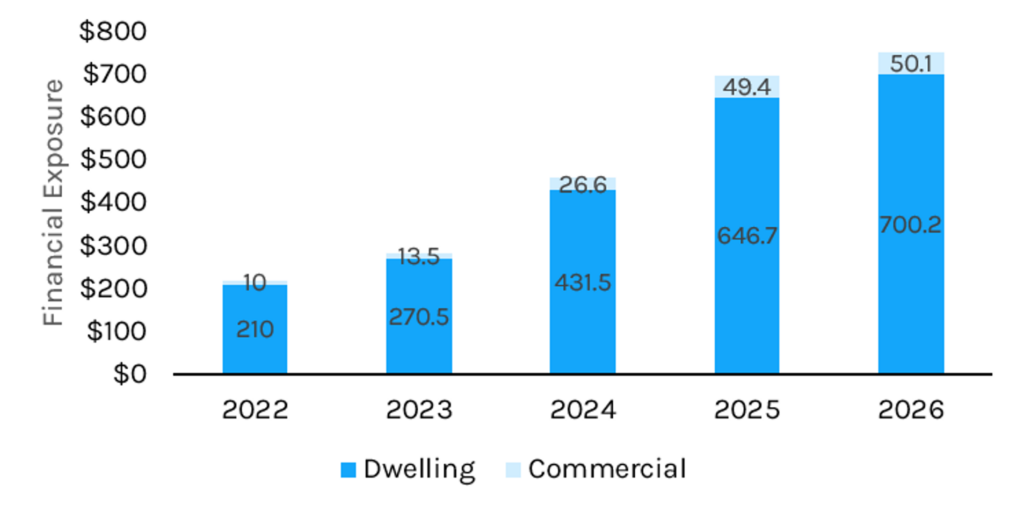
Source: FAIR Plan; Note: Data as of September each year, except in 2026, which spans through March.
Consistent with the incremental success of other SIS reforms, renewed private-market participation should reduce the FAIR Plan’s balance sheet over time. That hasn’t happened.
Following the 2025 Los Angeles fires, the FAIR Plan incurred over $4 billion in losses, forcing CDI to levy a $1 billion assessment on admitted insurance companies to cover claims for the first time since 1994. Subsequently, the Plan filed for a 35.8% rate increase, which CDI reduced to 29.1% prior to approval.
The new rate, set to take effect in October 2026, represents the largest CDI-approved increase in recent years, exceeding the ~20% increase in 2019 and the ~16% increases in 2021 and 2023, signaling CDI’s amenability to both ensuring the solvency of the Plan and recognition of the state’s long road to P&C market stability. The FAIR Plan’s exposure can serve as a barometer of the general private market’s health and an indication of carriers’ risk appetite in a state characterized by heightened climate risk. Indeed, the FAIR Plan’s growing exposure—even as SIS reforms gradually take effect—suggests that carriers, at least in the state’s riskiest locations, either do not want that risk on their balance sheets or believe they are not sufficiently rate-adequate to write it.
Kim Set for Faceoff in November Election Against Fellow Democrat Allen
Following a June primary election with more than 10 candidates on the ballot, civil rights attorney and former member of the San Francisco Board of Supervisors Jane Kim and State Senator Ben Allen are set to face off in November 2026 to succeed Lara. Kim outperformed Allen in a crowded primary field (see Exhibit 2).
Exhibit 2: California Insurance Commissioner June Primary Results
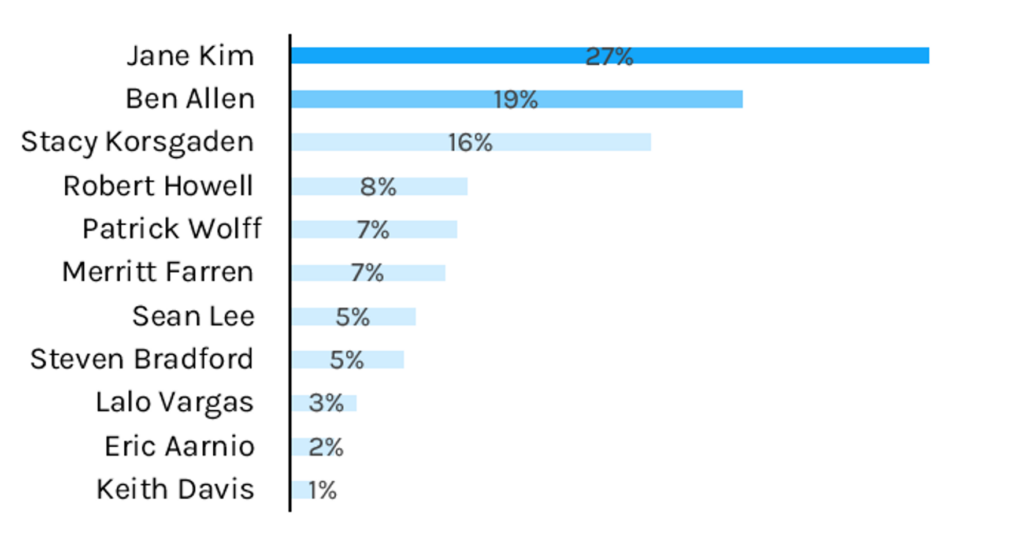
Source: Associated Press, New York Times
The outcome of the election has significant implications for P&C carriers and service providers in the state, with the private market’s health hanging in the balance. We spotlight the policy platforms of Kim and Allen and assess their potential implications for insurers in Exhibits 3 and 4.
Exhibit 3: Jane Kim’s Key Policy Priorities and Potential Impacts
| Priority | Key Details | Impact on Insurers |
| Lower Costs | – Establish a state-run nonprofit disaster insurance program. – Create minimum loss ratio standards to limit the profitability of carriers in the state. Over a three-year period, this proposal would set an average loss ratio floor of 70% and 65% for auto and homeowners insurance, respectively. – Expand California’s public option auto insurance program to all California residents. – Create a searchable annual report on insurance company expenditures. – Establish new disaster mitigation grant funding programs. | – Kim’s platform to lower costs targets the bottom line of carriers, proposing to limit profits of carriers within the state and socialize certain insurance programs. – If adopted, we would expect minimum loss ratios to pose significant risks to the carriers’ profitability in the state. – State-run disaster and auto insurance programs, if priced below competitive levels, could undercut and outcompete private carriers in the state. If priced at actuarially sound levels, private carriers could remain competitive. |
| Guaranteed Coverage | – Require (1) guaranteed replacement for total losses on homes, (2) coverage of increased replacement costs associated with inflation, labour shortages, or material costs up to 50%, (3) coverage of costs associated with newer building codes up to 25%, and (4) policyholder consent for any reductions in coverage. – Require insurers to provide policyholders with six months’ advance notice prior to nonrenewals or material policy changes. | – Enhanced coverage requirements will likely result in increased costs for carriers associated with more frequent or higher-cost claims. – To the extent that these requirements are paired with increased scrutiny of rate increases, we believe carriers could face reduced profit margins attributable to these higher costs. |
| Fast and Fair Claims | – Prohibit insurers from raising premiums or nonrenewing policies due to the filing of a claim. – Mandate interest payments on delayed claims. – Require immediate payouts of total losses to consumers following a disaster. – Focus on insurers with enhanced complaint rates during market conduct exams. | – Prohibiting premium rate increases associated with claims filings is likely to increase risk for insurers and poses risks to carriers rate adequacy. – Interest payments on delayed claims and immediate payouts on total losses tied to disasters would place pressure on carriers to expedite the payment of claims, reducing carriers’ ability to investigate or challenge certain claims, perhaps inviting fraud and/or litigation. |
Source: Jane Kim for Insurance Commissioner
Kim’s proposal to create a state-backed insurance system in which policyholders’ premiums fund a state plan to cover losses from wildfires and floods has generated significant pushback over potential costs.
While Kim’s proposals are compelling to some California voters enduring severe wildfire events and associated insurance market challenges, questions about the underlying mechanics, including funding, have gained focus across the industry.
Moreover, it is important to note that many of Kim’s proposals, including the public options and profitability caps, likely require legislation given limits on the administrative authority of CDI. If she wins the election, Kim is likely to need support from the governor and legislature to authorize and/or fund her flagship proposals, allocate capital, and likely amend Prop 103. While the legislature has broadly supported tactical insurance market reforms in recent years, fiscal constraints create meaningful uncertainty around lawmakers’ willingness to underwrite the risk Kim’s proposals would ultimately require.
Taken together, enhanced carrier transparency requirements, policy lock-in effects from extended nonrenewal deadlines, and exit fees would make California a more difficult operating environment for insurers.
Exhibit 4: Ben Allen’s Key Policy Priorities and Potential Impacts
| Priority | Key Details | Impact on Insurers |
| Stabilizing the Insurance Market | – Adopt reforms to allow for the use of wildfire catastrophe modeling. – Expedite rate review timelines. – Expand mitigation funding programs. – Develop fire-risk reduction objectives. | – Allen’s platform appears to closely mirror that of Lara’s and is more favorable to industry relative to Kim’s. Broadly permitting wildfire catastrophe modeling in California would result in more actuarially sound premiums. – Expedited rate review timelines, again consistent with Lara’s SIS, would enable carriers to more efficiently achieve rate adequacy and manage balance sheet risk. – At scale, mitigation funding programs have the potential to encourage greater private market underwriting by reducing risks. |
| Post-Disaster Insurer Compliance | – Require higher initial payments for disaster survivors. – Enhance oversight of the FAIR plan. – Mandate explanations for post-disaster claims denials. | – Some of Allen’s post-disaster policies would result in greater cost and compliance burdens for operators, such as higher initial payments to survivors and mandatory explanations for claims denials. – These proposals are much less restrictive for insurers than Kim’s policy proposals. |
| Making the Department More Transparent and Accountable | – Update department infrastructure to expedite the handling of complaints and rate requests. – Require that insurers simplify explanations of certain discounts. – Increase education efforts related to mitigation funding. – Publish dashboards that include market share and claims information. – Create an insurance consumer advocate position at CDI. | – Some of Allen’s proposed measures could result in net positive outcomes for insurers. For example, expedited rate-request infrastructure would enable carriers to achieve rate adequacy more efficiently, provided that CDI approves actuarially sound rate requests. – However, several of the state senator’s proposals could result in enhanced public and regulatory scrutiny of carriers in the state, such as a public dashboard, which includes claims information and the creation of an insurance consumer advocate role. |
| Getting People Off the FAIR Plan | – Rebuilding faith in California’s insurance market by continuing a push for mitigation programs and rewarding new market entrants. – Establish a new business division to encourage the entry of admitted carriers into the state. – Maintain solvency of the FAIR plan while pushing for reforms to ensure prompt payment of claims. – Supporting resilient redevelopment in post-disaster communities. | – Allen’s proposed shift away from the FAIR Plan and efforts to welcome new insurance carriers to California are broadly favorable for the insurance industry in the state, especially as the FAIR Plan’s financial exposure remains at peak levels. – The state senator’s emphasis on enhancing mitigation funding efforts and improving the resilience of communities could also lower risks across various geographies, perhaps encouraging greater private market underwriting. |
Source: Ben Allen for Insurance Commissioner
Compared to his opponent, Allen’s proposals are significantly more industry-friendly. Much of his policy platform would create opportunities for carriers in the state, including depopulating the FAIR Plan, focusing on mitigation and home hardening to reduce risk on a community-wide basis, and taking steps to ensure carriers can price risk accurately.
Looking Ahead
Voters will choose between Kim and Allen at the ballot box on November 3, 2026. While public polling has not been conducted since the June primary, Kim outperformed Allen in the crowded primary election by nearly 680,000 votes.
As cost-of-living struggles and affordability concerns have become central issues for voters across the country (and especially with respect to rising insurance costs in disaster-prone locations), Kim’s platform aimed at lowering costs appears to have resonated with the California electorate. However, five republican candidates collectively received over 37% of the vote in the primary, and given Allen’s relatively more industry-friendly approach, we generally view Republican voters as more likely to support Allen than Kim.
The election remains several months away, and many developments could occur prior to November that could alter the candidates’ current trajectories. We will continue to track the election and the key policy proposals put forward by Kim and Allen in the coming months.
Read more of Capstone’s financial services coverage:
Insurers’ Increasing Exposure to Private Credit Attracts Regulators’ Scrutiny
States Race to Regulate Earned Wage Access
Trump Punches at Banks (Again)