

There is an adage in Washington that the only thing Republicans and Democrats can agree on anymore is being tough on China. This was the case when Congress overwhelmingly passed the Uyghur Forced Labor Prevention Act (UFLPA) of 2021. Under the law, imports made wholly or in part in the Xinjiang Uyghur Autonomous Region (XUAR) are presumed to be made with forced labor and therefore cannot enter the United States. Customs and Border Protection (CBP) enforces the law and demands scrupulous documentation from any importer trying to enter XUAR-made goods into the United States.
For all investors, the UFLPA signaled a shift in how the US would approach trade with China. President Trump’s first-term Section 301 tariffs created headaches for importers directly sourcing from China, but the UFLPA had the potential to impact all imports that contain any subcomponents of Chinese origin. Strong enforcement by CBP would mean a complete reimagining of supply chains for dozens of industries, whereas weaker enforcement would not create the same urgency.
Enforcement Trends Point to Relaxation
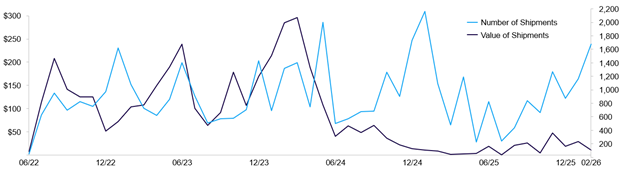
Enforcement, after peaking in mid-2024, has been on the decline. While data show this enforcement trend began before President Trump’s second term, there is evidence to support the idea that his administration is de-emphasizing enforcement of the UFLPA.
Exhibit 1: Value (in $M) versus Number of Shipments Detained Under UFLPA
Source: CBP, Capstone analysis
First, the Trump administration has not added any new companies to the UFLPA’s “Entity List,” which documents companies known to operate in the XUAR, compared to 144 by President Biden. The lack of additions to the list has alarmed some Democrats in Congress, who sent a letter to the Secretary of Homeland Security and Commissioner of CBP, calling it “very concerning.”
Second, the administration has changed how it records certain UFLPA enforcement data, making it look more rigorous than under Biden. During the Biden administration, a single detained container holding a shirt, a solar panel, and a toy would be considered one detained shipment. Under the new method, each item is counted individually, meaning the shirt, solar panel, and toy count as three. A January 2026 CBP notice said the “modification has resulted in a significant change in the number of UFLPA enforcement actions” recorded.
Finally, UFLPA enforcement appears to have declined in importance within CBP due to personnel issues. As the administration has introduced increasingly complex tariffs on most US imports, CBP has likely shifted personnel from enforcing the UFLPA toward enforcing tariffs.
Stability is the Priority
To be clear, none of these factors alone is proof of a conscious decision, but together, they paint a picture of an administration that is taking a lighter touch on UFLPA enforcement.
It’s fair for investors to wonder why this is happening. After all, the Trump administration has seemingly gone out of its way to make forced labor a nominal cornerstone of its trade policy. The Office of the US Trade Representative is currently investigating 60 trading partners under Section 301 to assess these partners’ “failure to impose and effectively enforce a ban on the importation of goods produced with forced labor.” Moreover, trade agreements with Malaysia and Cambodia include provisions that those countries must adopt and implement prohibitions on the importation of goods made wholly or in part with forced labor. However, there remains an incongruity between the administration’s stated interest in forced labor prohibitions and its approach to the UFLPA.
We believe UFLPA enforcement has waned because President Trump is prioritizing stable trade relations with China, especially ahead of his trip to Beijing next week. Chinese leaders are sensitive to the UFLPA and will welcome less aggressive enforcement, laying the groundwork for constructive dialogue. For Trump, stability carries fewer risks heading into the midterms, helps solidify US agricultural exports, and secures a supply of critical minerals. US-China trade watchers are keenly aware that Trump has handled the US -China relationship with uncharacteristic care since the two sides agreed to a one-year trade truce last fall. Trump has turned down several opportunities to impose tariffs on China since the truce began, despite having the opportunity to do so on pharmaceuticals, critical minerals, and semiconductors (twice).
The implications of this status quo, with its less-than-rigorous UFLPA enforcement and a seemingly stable truce on trade, present investors with plenty of downside and limited upside. US-China trade negotiations can go sideways quickly, as we saw last spring when Trump imposed duties upwards of 100% on all Chinese imports. CBP can also ramp up enforcement of the law as quickly as it backed off. The UFLPA still gives CBP unprecedented latitude to detain shipments and create uncertainty for importers. Any White House looking to use sticks to decouple US importers from China can quickly reach for the UFLPA to create significant reputational risks, operational delays worth millions, and ethical inquiries.
A preservation of the status quo following the Trump-Xi summit may be the most comfortable outcome for investors. The US is unlikely to reduce tariffs on China much more, and while UFLPA enforcement can ebb even more, there may be a limit to how long Congressional Republicans stay quiet on lax UFLPA implementation. If Democrats win at least one chamber of Congress in the midterms, expect them to ramp up the heat on CBP, Rubio, and new Department of Homeland Security Secretary Markwayne Mullin.
Importers may welcome some relative calm in UFLPA enforcement as they continue to reshuffle supply chains, but they should not let their guard down. Investors should understand that UFLPA enforcement can ramp up as quickly as it has declined, bringing along the ethical, reputational, and operational risks that were so prescient during peak UFLPA implementation. Capstone continues to monitor these and other underappreciated developments across trade and supply chain policy.
Read more of Capstone’s trade coverage:
The Tariff Pileup: Layered Policies, Rising Prices, and Growing Risks
Our Biggest Trade Policy Calls: What We Got Right and Wrong and What We Learned