

Capstone believes that the Trump administration’s fiscal year (FY) 2027 budget request benefits sectors favored by President Trump, such as nuclear, natural gas, coal, and transmission. Small modular nuclear reactors will likely receive additional loan support, while hydrogen, carbon capture, renewables, and electric vehicles face another attempt to repeal funding. Still, Congress is likely to prevent deep cuts, as it did in last year’s appropriations process.
- On April 3rd, the US Department of Energy (DOE) published its FY2027 budget in brief, giving Congress a roadmap of the Trump administration’s spending priorities across key energy programs and offices. As with the FY2026 appropriations, Congress is unlikely to accept these requests in full, given that the support of at least seven Democratic senators will be needed to pass any measure.
- Congress will likely approve a request from the Office of Energy Dominance Financing (EDF), formerly known as the Loan Programs Office, for an additional $200 million in credit subsidy to support developers of small modular reactors and other advanced nuclear reactors. Programmatic changes to the Section 1703 loan program will continue to position EDF to support projects favored by Trump, including coal, natural gas, transmission, nuclear, geothermal, bioenergy, refineries, and critical minerals. Technologies that Trump dislikes, including wind, solar, hydrogen, carbon capture, utilization, and storage (CCUS), and electric vehicles (EVs), face spending cuts.
- Congress is unlikely to approve all of the cuts the administration wants to impose on hydrogen, renewables, and carbon capture suboffices. The administration also remains focused on promoting enhanced oil recovery (EOR) and enhanced gas recovery (EGR) and rescinding unobligated funding for the Regional Clean Hydrogen Hubs (H2Hubs), National Electric Vehicle Infrastructure (NEVI), and Charging and Fueling Infrastructure (CFI) programs.
- The administration’s request to maintain FY2026 levels for the Office of Geothermal is underwhelming, but Congress could still approve a higher amount, given bipartisan support. The Strategic Petroleum Reserve (SPR) would receive funding for facility improvements. No funds were requested to refill the reserve, which will potentially be done through a second budget reconciliation.
Loan Programs Will Continue to Bolster Nuclear and Other Favored Tech, Turn Away from EVs
Section 1703 Loan Program Likely to Receive Additional Credit Subsidy for Nuclear
The EDF is requesting an additional $200 million in credit subsidy for financing small modular and other advanced nuclear reactors, building on the $150 million already appropriated toward the Section 1703 loan program in FY2026. We believe this funding continues to demonstrate the administration’s strong interest in supporting early mover nuclear projects, and we expect Congress to ultimately approve this amount. However, we note that both the money allocated in FY2026 and the FY2027 request would not be enough to wholly support even one project. Potential beneficiaries of future EDF financing include a joint venture between GE Vernova Inc. (GEV) and Hitachi Ltd. (6501 on the Tokyo stock exchange), GE Hitachi, and Holtec International.
The budget request also notes that, as of September 30th, 2025, the Title 17 loan programs had $189 billion in requested financing across 88 applications. EDF expects to obligate $37 billion through September 30th, 2026 (see Exhibit 1), of which approximately $30.6 billion has already been announced to date. This largely reflects the $26.5 billion loan to Southern Co.’s (SO) subsidiaries, Georgia Power and Alabama Power, to expand natural gas-fired generation, uprate existing nuclear reactors, modernize hydropower plants, and perform grid upgrades.
Notably, the EDF is requesting to repeal and rescind all loan authority (i.e., volume of loans available to issue) and credit subsidy (i.e., the government’s funding to offset expected losses on riskier projects) made available in prior appropriations, replacing it with a fresh $30 billion in new loan authority tied to a specific subset of eligible projects under the Section 1703 loan program: geothermal; hydropower; bioenergy; transmission and distribution; advanced fossil energy technology (including coal gasification); advanced nuclear energy facilities (including the manufacturing of nuclear supply components for advanced nuclear reactors); refineries; and domestic critical mineral production, processing, manufacturing, and recycling (see Exhibit 1). This would realign the Section 1703 loan program with Republicans’ statutory changes to the Section 1706 program, which removed the emissions-reduction requirement for eligible projects.
Exhibit 1: DOE’s Expected Loan Authority Obligations, FY2026-2027
| Program | FY2026 Expected Obligation | FY2027 Expected Obligation | Inflation Reduction Act (2022) Authorizations |
| Section 1703 | $1 billion | $6 billion | $40 billion* |
| Section 1706 | $36 billion | $70 billion | $250 billion |
| Total | $37 billion | $76 billion | $290 billion |
Source: DOE, Congressional Research Service
General Note: The Biden administration obligated billions of dollars worth of loans under both programs in FY2025, which is not reflected in this table. The amount of remaining authority left in both programs as of the publication of this note is roughly estimated to be $200 billion.
Note(*): The DOE is requesting to rescind the remaining Section 1703 loan authority and replace it with $30 billion
Requested Rescission of ATVM Program’s Credit Subsidy Unlikely to Materialize
The EDF proposed a full rescission of the unobligated credit subsidy funding for the Advanced Technology Vehicle Manufacturing (ATVM) program, effectively halting the origination of new loans. Specifically, the budget would eliminate approximately $2.32 billion in remaining credit subsidy authority originally appropriated in 2009, while maintaining $9.5 million in administrative funding to allow the DOE to continue monitoring the existing loan portfolio.
The proposal reflects the continued broader shift away from support for EVs, with the administration arguing that ATVM has primarily supported EV and component manufacturing that is misaligned with Executive Order 14154, Unleashing American Energy. We believe there is limited appetite in Congress to approve this request, given that it declined to pass a similar rescission request in the FY2026 cycle, and that the program could be repurposed to support Republican policy priorities such as domestic manufacturing.
We note that a complete repeal of ATVM could have impacts far beyond EVs, particularly for critical mineral projects that had increasingly come to rely on the program as their primary source of federal financing. ATVM has served as a key financing tool to promote the onshoring of critical minerals by linking upstream extraction and processing to downstream EV end users. This structure allowed projects to anchor demand through automotive supply chains while getting access to federal financing at attractive rates. Compared to Title 17 loans, ATVM loans were offered an interest rate equal to the US Treasury-equivalent yield curve with zero credit spread, resulting in cheap financing for these projects.
ATVM has also provided flexibility in capital stacking. Projects could combine an ATVM loan with other forms of federal support, such as tax credits or Department of Defense grants, so long as they could demonstrate the underlying commercial viability. By contrast, Title 17 financing generally has imposed tighter constraints. In practice, this made ATVM the more attractive pathway for nearly all critical mineral projects, except for Michigan Potash.
Repurposed Biden-Era Funds Would Support Baseload Resources and Transmission
As Capstone expected, the DOE is planning to repurpose money allocated by the bipartisan Infrastructure Investment and Jobs Act of 2021 (IIJA) to fund the administration’s energy priorities. Specifically, the budget requests $3.5 billion to preserve approximately 9 GW and add around 9-13 GW of firm baseload power through uprates (such as coal, natural gas, nuclear, and hydropower). It remains unclear whether Congress would approve this request, since this would be a new line item in the appropriations bill and have no historical approval rate.
If Congress approves this proposal, these funds could eventually be directed to the following programs: the Transmission Facilitation Program; the Grid Resilience and Innovation Partnerships (GRIP) Program; Transmission Facility Financing loan program; EDF’s Section 1703 and 1706 loan programs; Office of Nuclear Energy’s Utility Power Reactor Incremental Scaling Effort (UPRISE); and the Hydrocarbons and Geothermal Energy Office (HGEO), among others. We view these proposals as part of the administration’s “speed to power” strategy, which seeks to leverage existing programs and funding to support the buildout of data centers and boost American competitiveness in artificial intelligence.
Hydrogen, Carbon Management, Renewables Continue to Fall Out of Favor
H2Hubs Funding Targeted, but Congressional Intervention Expected Once Again
The administration will seek to repurpose $3.5 billion in unobligated balances from the H2Hubs program to its Baseload Power initiative, as well as $1.2 billion in unobligated balances to the Artificial Intelligence and Quantum initiative. The rest of the H2Hub program’s unobligated balances, approximately $3 billion, would be, as the budget request says, “permanently canceled.” As with the FY2026 budget proposal, we believe Congress will decline the administration’s request. However, the request highlights the administration’s unfavorable view of the H2Hubs program writ large and likely foreshadows “no-go” decisions once remaining hubs complete already-funded “Phase 1” activities.
Beyond H2Hubs, there are provisions in the HGEO’s budget-in-brief that are favorable to hydrogen developers. The document calls for “a slight funding increase for hydrogen production pathways utilizing energy resources from natural gas and petroleum systems” (that is, blue and gray hydrogen). However, the administration is also trying to eliminate all administrative funding for the Hydrogen and Fuel Cell Technologies Office (HFTO).
Remaining CIFIA Funds on the Chopping Block, While EOR and EGR Efforts to Continue
Unsurprisingly, the administration is requesting that Congress repeal and rescind all remaining unobligated balances from the Carbon Dioxide Infrastructure Finance and Innovation Program (CIFIA), including $588 million in available credit subsidy. Congress already approved reallocating $1.5 billion toward nuclear demonstration programs last year, so we believe this proposal is likely to have support. On the other hand, the HGEO budget-in-brief does note that, “efficient and costeffective CO2 transport systems is a vital component to improve and expand upon EOR and EGR operations.” The administration’s request aims to “support basins with multiple subsurface projects where knowledge gained will support EOR and EGR activities, rapid development of capabilities to support data centers, and mining activities.”
Former EERE Offices Teed Up for Elimination, but Congress Unlikely to Approve in Full
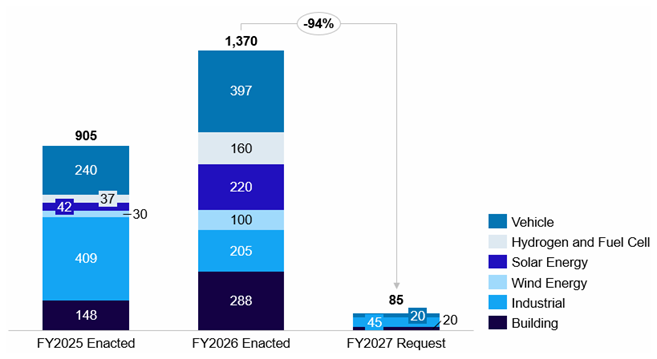
The administration is proposing to cut all or most funding across multiple Office of Energy Efficiency and Renewable Energy (EERE) sub-offices that have been reorganized under the new Office of Critical Minerals and Energy Innovations (CMEI), including: HFTO, Solar Energy Technologies (SETO), Wind Energy Technologies (WETO), Vehicle Technologies Office (VTO), Building Technologies (BTO), and Industrial Technologies (ITO) (see Exhibit 2). We do not believe these aspects of the budget-in-brief will be enacted by Congress, given that FY2026 bipartisan negotiations notably increased funding for most of these offices instead.
Exhibit 2: CMEI Sub-Office Funding by Budget Control ($M)
Source: DOE
Another Attempt to Claw Back NEVI Funds Unlikely to Succeed
The Trump administration has once again proposed rescinding unobligated funding from the NEVI and CFI programs as part of the budget request. Both programs have faced sustained pressure over the past year, including funding freezes, proposed executive recissions, congressional reappropriations, and increased regulatory constraints.
Despite these renewed efforts to claw back funding, we believe Congress is unlikely to support a full rescission. Lawmakers have already demonstrated they are reluctant to eliminate the funding outright, opting instead for a partial reduction of roughly $500 million in NEVI funds in the most recent Transportation, Housing, and Urban Development (THUD) appropriations cycle. This suggests a continued preference for trimming at the margins rather than dismantling the program entirely.
A key constraint on full rescission is that a significant portion of funding is already embedded in state-level planning. State departments of transportation have developed and, in many cases, received approval for EV charging deployment plans after the US Department of Transportation (DOT) issued updated NEVI guidance in August 2025 following a multi-state legal challenge over the funding freeze. More broadly, NEVI allocations benefit a wide range of states across the political spectrum, including large awards to traditionally Republican states such as Texas, which has been appropriated approximately $407.7 million.
Geothermal Stagnates, While the SPR Gets a Slight Boost for Major Maintenance and Remediation
Enhanced Geothermal System Funding Would Remain at FY2026 Level Despite Bipartisan Support
The DOE’s request would maintain FY2026’s $150 million in programmatic funding for the Office of Geothermal, with $92 million directed toward enhanced geothermal systems (EGS) research. We view this as negative for EGS developers, including drilling contractor and geothermal startup owner Nabor Industries Ltd. (NBR), given that higher funding levels likely would enjoy bipartisan support in Congress. Nevertheless, the administration remains focused on “maintain[ing] momentum on EGS greenfield demonstrations” and will “work to address critical geothermal project permitting challenges.” Congress may well opt to give the Office of Geothermal more funding than DOE requested, given recent attention.
We believe the numerous bipartisan geothermal reforms under consideration in both chambers of Congress (these would include creating new financing opportunities, improving tax treatment on federal lands, and expediting permitting) will need to be folded into a larger legislative package to become law, given that Congress rarely passes single-issue legislation.
DOE Punts on Directly Funding SPR Refill; Congress Likely to Grant Higher Funding for Repairs
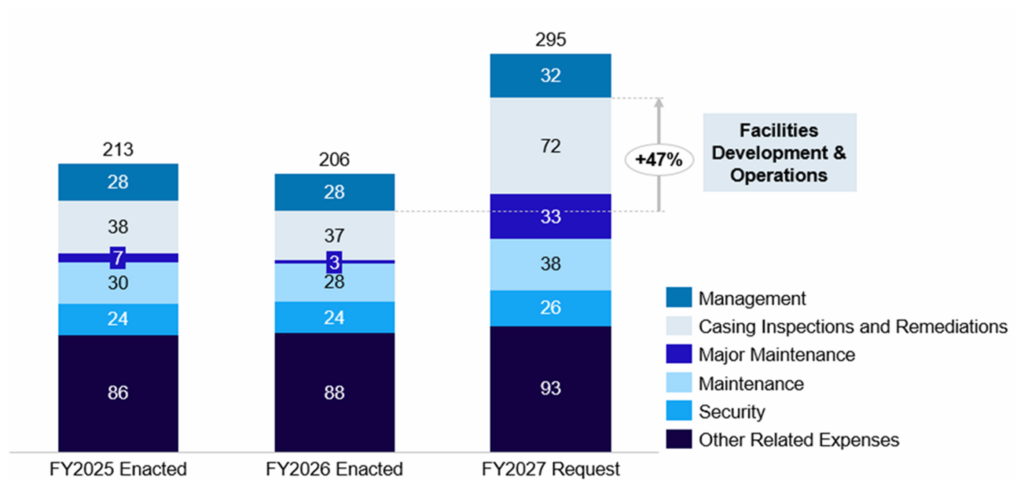
Despite its exclusion from the DOE’s budget request, we expect congressional Republicans to propose authorizing new funding for at least a partial refill of the Strategic Petroleum Reserve (SPR) in FY2026 appropriations, a reconciliation package, or a supplemental defense funding package. The DOE’s request seeks an additional $84 million for SPR repairs and improvements above the FY2026 enacted levels, which we expect Congress will grant. As shown in Exhibit 3, much of the additional funding would go to casing inspections, remediation work, and major maintenance. The administration expects to conduct 12 remediations and eight workovers in the next fiscal year based on the Cavern Integrity schedule.
Meanwhile, the DOE did not request new funding for the Strategic Petroleum Account (SPA), which holds funds dedicated to filling the SPR. We believe this may signal that the administration expects Congress to allocate new SPA funding through a second budget reconciliation bill as proposed by the Republican Study Committee in January.
- Exchanges: According to the SPR budget-in-brief, the SPR crude oil inventory was at 415.4 million barrels (MMbbl) at the end of February 2026. On March 11th, DOE announced a 172 MMbbl release of crude oil from the reserve over 120 days and arranged to then repurchase 200 MMbbl “within the next year” in response to a prolonged conflict with Iran. The DOE’s first tranche of Iran exchanges offered 86 MMbbl for release from April to May 2026, with buyers required to return those barrels, plus interest, from November 2026 to September 2028. Ultimately, the DOE awarded ~45 MMbbl to eight bidders.
- Budget Reconciliation: The Republican Study Committee’s January 2026 framework for a second budget reconciliation bill included a provision that would authorize $1.1 billion to refill the SPR, in whole or in part with discounted Venezuelan oil made available by recent US military intervention in the country. We still believe a second reconciliation bill is unlikely to pass this year.
- Congressionally Mandated Sales: Instead of funding an actual refill, Congress could cancel any or all of the 92.6 MMbbl of congressionally-mandated SPR sales through FY2031, including 5 million MMbbl in FY2028.
Exhibit 3: Strategic Petroleum Reserve Funding by Budget Control ($M)
What’s Next
We believe the House and Senate Appropriations committees will release their legislative proposals in June or July. DOE funding expires on September 30th, 2026.
Read more from Capstone’s energy team:
Trump Tried to Kill Offshore Wind: Here Is Why Projects Are Surviving
How the EU’s Aviation Fuel Mandate Review Creates a Window for Airlines
New Carbon Accounting Rules Put Agriculture and Biofuels Under the Microscope