

Despite years of debate over affordability and market reform, Europe’s power sector remains governed by a political economy that continues to favor generators. Capstone believes European power utilities represent an enduring investment opportunity through 2026 and beyond, underpinned by structurally elevated margins post-Ukraine crisis and the absence of the political will to implement meaningful revenue curbs at the EU level. While industry associations continue pressing for marginal pricing reform and energy cost relief, Capstone believes the European Commission’s electrification agenda and fragmented industrial lobbying will ensure that generator profitability remains largely untouched. Europe’s electricity prices have fallen from their crisis peaks, yet the market mechanisms that delivered windfall margins remain firmly intact.
Continental Europe: Structural Margin Expansion Post-2022
European power generators have experienced a fundamental shift in profitability since the 2022 energy crisis. Despite electricity prices declining from their 2022 peaks, margins remain structurally elevated compared to pre-crisis levels due to sustained high gas prices and the continuation of marginal pricing mechanisms.
Exhibit 1: European Utility EBITDA Comparison, 2021-2024
| Company | 2021 EBITDA (€bn) | 2024 EBITDA (€bn) | EBITDA Change 2021-2024 | EBITDA Margin Change 2021-2024 |
|---|---|---|---|---|
| Enel | 19.2 | 22.8 | +18.8% | +24.0% |
| Iberdrola | 8.2 | 10.5 | +28.1% | +23.6% |
| EDF | 18.0 | 36.5 | +102.8% | +44.6% |
| RWE | 3.7* | 5.7 | +55.6% | +42.5% |
| Engie | 10.6 | 15.6 | +47.2% | +15.3% |
Source: Company disclosures, Bloomberg, Capstone analysis
*adjusted EBITDA
European gas prices remain approximately double pre-Ukraine 2022 levels, with Dutch Title Transfer Facility (TTF) futures trading around €36/MWh in the last 12 months compared to €11-13/MWh between 2019 and 2021. This structural shift sustains elevated electricity wholesale prices through the merit order mechanism and reflects three factors that Capstone expects to persist in the coming years and to remain politically difficult to unwind:
- First, Russian gas volumes are unlikely to return to pre-war levels even if a near-term ceasefire occurs. European infrastructure has been reconfigured around liquefied natural gas (LNG) imports and Norwegian pipeline gas, and political appetite for renewed dependence on Russian supply remains minimal across Member States.
- Second, US LNG – now Europe’s primary marginal supply source – carries inherent cost premiums over historical Russian pipeline gas due to liquefaction, shipping, and regasification costs, establishing a structurally higher marginal cost of supply for the power system.
- Third, European environmental regulations increasingly impose costs on natural gas. Carbon pricing through the EU Emissions Trading System (ETS) continues to tighten, and emerging regulations on methane emissions add compliance costs throughout the gas value chain, reinforcing gas’s position as a persistently expensive price-setting technology.
During the energy crisis, the European Commission imposed a temporary revenue cap on inframarginal generators to capture windfall gains from high gas prices. The measure expired with the crisis, and the Commission has since discouraged Member States from extending similar interventions to preserve investment incentives needed to meet 2030 electrification targets. The UK is a notable outlier. Its Electricity Generator Levy imposes a 45% tax on generation revenues above £77.94/MWh from 2023 to 2028, covering most merchant nuclear, renewable, and biomass output. Combined with a 25% corporation tax rate, this results in an effective marginal tax rate of roughly 70% on excess revenues. While currently isolated, the UK levy illustrates a potential policy template for fiscally constrained governments, even if broader EU-level replication remains unlikely.
Political Economy Favors Generators Over Industrial Consumers
The disconnect between persistent industrial struggles over electricity costs and competitiveness, and the limited political pressure on generator margins, reflects structural asymmetries in influence. Europe’s power generators have successfully aligned their interests with the European Commission’s agenda for electrification and decarbonization. By framing marginal pricing as essential to investment certainty and efficient dispatch, generators positioned profitability as a functional requirement for system reliability and decarbonisation rather than as evidence of policy failure.
This strategy proved effective during the 2024 Electricity Market Design reform, which preserved marginal pricing while expanding long-term contracting options such as Power Purchase Agreements (power purchase agreements (PPAs) and Contracts for Difference – instruments that stabilise revenues without undermining wholesale price formation or compressing margins ex ante.
Industrial consumers who are struggling with maintaining competitiveness have been unable to mount a unified counterweight. Trade associations often include vertically integrated utilities or energy-active members, diluting advocacy for lower prices. Even where cost pressures are acute, industry lacks coordination mechanisms to aggregate demand or articulate coherent reform proposals, leaving its lobbying fragmented and largely reactive rather than strategically aligned.
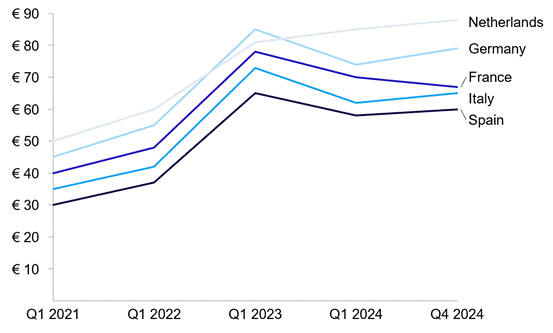
Instead, the Commission remains focused on long-term cost reduction through renewable buildout, avoiding near-term measures that would directly pressure generator margins. Recent EU grid initiatives further reinforce this approach: rather than revisiting wholesale price formation or generator revenues, policy efforts are increasingly directed toward accelerating grid investment and addressing system constraints. This has pushed Member States to pursue ad hoc industrial relief measures, with uneven capacity to do so. Meanwhile, the Commission’s reliance on PPAs has highlighted generators’ strong negotiating position: with wholesale prices elevated but volatile, generators demand PPA premiums that preserve expected market revenues, while industrial buyers—seeking prices below forward curves—find limited willingness to discount amid tight supply conditions, permitting bottlenecks, and disciplined utility CAPEX strategies.
Exhibit 2: PPA Prices in Select European Markets, 2021-2024
Source: LevelTen Energy, BloombergNEF, Veyt
The stalled tripartite contract initiative illustrates these limits. While framed in February 2025 as a mechanism for stable industrial supply, it offered no pricing discipline for generators and merely focused on permitting, public finance, and coordination. Industrial participants sought access to CfD-backed power at or near strike prices; generators refused to view such arrangements as requiring them to lock in revenues below market-based expectations, and progress has stalled.
Marginal Pricing Reform: Debate Without Consequence
As renewable penetration rises, some industrial groups are again questioning marginal pricing, shifting from crisis-era rhetoric toward arguments about structural inefficiency. Proposals such as technology-specific markets or split day-ahead pricing are being discussed but face severe technical, economic, and political barriers.
Technology segmentation would create classification and dispatch problems for grid operators while replacing a single scarcity signal with administratively determined outcomes. Politically, it would invite technology-specific lobbying- nuclear, gas, and renewables all arguing for preferential treatment – leading to regulatory capture rather than efficiency.
The 2024 reform process demonstrated that both the Commission and most Member States remain committed to marginal pricing, reinforced by state ownership stakes in major generators and analytical evidence that alternatives would raise long-run system costs.
Investment Implications
For investors, this debate is noise rather than signal. Industrial lobbying remains fragmented, while policymakers and generators continue to defend marginal pricing, supporting structurally higher margins. Capstone expects European power generators to sustain EBITDA margins 20–30% above 2021 levels through 2026–2028, with the political and regulatory backdrop remaining broadly supportive despite ongoing affordability concerns, and with downside risk more likely to materialise through member state-specific fiscal measures than through EU-wide market redesign.
Absent a coordinated industrial counterweight, Europe’s electrification agenda will continue to shield generator profitability—even as affordability pressures persist. For investors, the policy debate matters less than its outcome: Europe’s power generators remain positioned to sustain elevated margins, with downside risk concentrated in national tax measures rather than EU-wide market redesign.