

In 2026, we believe Europe’s policy outlook will be shaped by the struggle for strategic autonomy. A year into Trump’s 2nd term, Europe is increasingly vulnerable to external pressures. Policymakers will spur plans to boost digital sovereignty, competitiveness, and resilience to security threats. We see underappreciated support in strategic sectors, including AI, digital infrastructure, steel, semiconductors, and defence tech.
Outlook at a Glance
- As the EU Council and Parliament Debate the €1.8 Trillion Multiannual Financial Framework, Tech and Biotech Emerge as Winners, While Farming and Tobacco Lose
- Momentum Is Building for a Revised EU Chips Act, Which Would Likely Focus on Design Rather Than Manufacturing Given the EU’s Structural Disadvantages
- Policymakers Will Aim to Strengthen the EU’s Computing Infrastructure, Simplify Regulation, and Reduce Dependency on Non-EU Technology
- EU Trade Tensions With the US and China Will Persist in 2026, With European Steelmakers to be the Relative Winners While Automakers Suffer
- Increases in Member State and EU Defence Spending Will Benefit Counter-Drone Manufacturers, Air and Space Shielding Technology, and Protection of Eastern Flank
As the EU Council and Parliament Debate the €1.8 Trillion Multiannual Financial Framework, Tech and Biotech Emerge as Winners, While Farming and Tobacco Lose
| Winners | Semiconductor equipment makers, including ASML Holding NV (ASML) Cloud providers, such as SAP SE (SAP) and OVH Groupe SA (OVH on the Paris exchange) Biotechs that benefit from EU funding, including BioNTech SE (BNTX) and Evotec SE (EVO) |
| Losers | Agriculture equipment manufacturers, such as CNH Industrial NV (CNH) Tobacco companies, including British American Tobacco PLC (BTI), Imperial Tobacco Group (IMB on the London exchange), and Scandinavian Tobacco Group AS (STG on the Copenhagen exchange) |
The 2028-2034 Multiannual Financial Framework
For most of 2026, the EU Council and Parliament will debate the European Commission’s proposed €1.8 trillion Multiannual Financial Framework (MFF), the EU’s long-term budgetary planning tool. The MFF enables the EU to set its strategic policy priorities by establishing spending categories (headings) and maximum annual budget levels (ceilings). While a simple majority in the European Parliament is sufficient for the proposal to move forward, it requires unanimous approval from all 27 EU Member States—representing the EU Council—for adoption.
The proposal for 2028-2034 would establish four major spending headings: National Cohesion, Agriculture & Maritime; Competitiveness, Prosperity, & Security; Global Europe; and Administration.
The European Competitiveness Fund Picks Winners and Losers
The proposed MFF includes the launch of the €409 billion European Competitiveness Fund (ECF) under the Competitiveness, Prosperity, & Security heading. The ECF identifies areas it classifies as critical to EU competitiveness: Defence & Space; Clean Transition and Decarbonisation; Health & Bio-economy; Digital Leadership; and the Horizon Europe research and innovation programme.
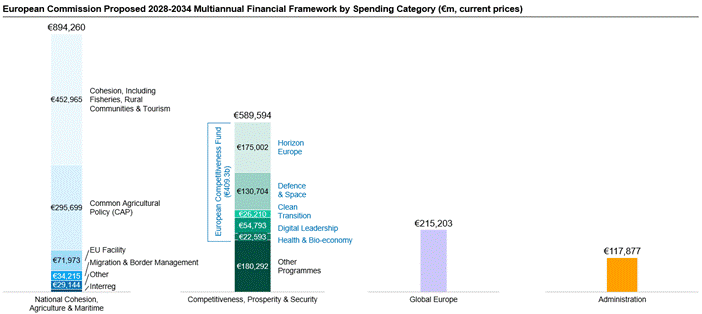
The Digital Leadership component’s €55 billion allocation over the 2028-2034 period represents a substantial increase over the current MFF, which allocated €8.2 billion to the similar Digital Europe Programme and €2.6 billion to the Connecting Europe facility. Several subsectors of the broader digital space will benefit, such as AI gigafactories, high-performance computing, quantum technologies, semiconductors, robotics, large data and cloud technologies, and 6G. EU semiconductor equipment maker ASML and cloud providers, such as SAP and OVH Groupe, are likely to be winners.
The Health and Bio-economy component of the ECF, a €22.5 billion envelope, includes EU4Health, which is heavily geared towards research and development and is one of 14 existing competitiveness programs that the Commission is streamlining into the ECF. This change represents a policy pivot by the Commission, from prioritising fundamental research to funneling resources to improving market-driven competitiveness. EU biotechs, including BioNTech and Evotec, stand to benefit.
Agriculture and Tobacco Will Be Hit by Budget Cuts and Taxes
In the proposal, the Common Agricultural Policy (CAP)—the EU’s flagship rural development and support programme—has been reduced from €386 billion to €300 billion, a roughly 30% cut in real terms. Spain and Italy are resisting the change.
The €86 billion reduction would negatively impact companies that generate revenue from CAP-driven spending, such as agricultural equipment manufacturer CNH Industrial.
The MFF proposal includes a new tax called the Tobacco Excise Duty Own Resource (TEDOR). It will enable the EU to collect a 15% share of tobacco revenue. In parallel, the EU also launched a review of the Tobacco Excise Tax Directive (TED), which could increase minimum tax rates to €215 per 1,000 cigarettes and 63% of the weighted average retail price. As expected, the proposal has provoked strong opposition from the tobacco lobby, while the governments of Sweden, Italy, Greece, Romania, Bulgaria, and Portugal have expressed concerns about TEDOR’s impact on national budgets.
We believe the TED will negatively impact EU- and UK-based tobacco companies, including British American Tobacco, Imperial Brands, and Scandinavian Tobacco.
—Aaron Gao, [email protected]
Momentum Is Building for a Revised EU Chips Act, Which Would Likely Focus on Design Rather Than Manufacturing Given the EU’s Structural Disadvantages
| Winners: | Fabless chip designers, including Melexis NV (MELE on the Brussels exchange), Elmos Semiconductor SE (ELG on the Frankfurt exchange), and Nordic Semiconductor ASA (NOD on the Oslo exchange) |
| Losers: | N/A |
Member States and Industry Are Lobbying for a New EU Chips Act
Momentum is building for a revised European Chips Act (EUCA 2.0 or Chips Act 2.0) following the July 2025 decision by Intel Corp. (INTC) to halt its German and Polish investments—a setback that underscores the limitations of the current legislative framework in driving meaningful expansion of EU semiconductor manufacturing capacity.
The Intel news followed a 28 April 2025 report in which the European Court of Auditors (ECA) concluded that the EU was not on track to meet the policy goal of 20% of global chip production, established with the first Chips Act (EUCA) in 2023. The auditors estimated that the EU was responsible for only 7%-8% of global production.
Member States, at the initiative of the nine most important EU countries for the semiconductor industry (Austria, Belgium, Finland, France, Germany, Italy, Poland, and the Netherlands), launched the Semiconductor Coalition to develop a coordinated approach to strategic funding and policies. On the industry side, both SEMI Europe and the European Semiconductor Industry Association have been actively pushing for an EUCA 2.0.
The EUCA was set up to mobilise more than €43 billion of public investments and matching private investments for a target of €86 billion in funding. However, the Commission is directly responsible for only €4.5 billion of those investments through Horizon Europe and the Digital Europe Programme. Member States were slated to contribute €35.3 billion, while €2.1 billion came from leveraged equity support and €1.4 billion from the EU’s long-term budget and the European Investment Bank through the InvestEU programme.
Currently, while the EU boasts equipment maker ASML and automotive- and industrial-chip-focused integrated device manufacturers NXP Semiconductors NV (NXPI), Infineon Technologies AG (IFX on the Frankfurt exchange), and STMicroelectronics NV (STM), it lacks global players in advanced manufacturing and back-end processes.
The EU faces structural challenges in semiconductor manufacturing, including dependence on raw materials, high energy costs, environmental regulations, and skilled-labor shortages. These constraints, coupled with competition from other governments (e.g., US Chips Act grants and Chinese equity funding), make it difficult for the EU to achieve its goal of 20% of global semiconductor production by 2030.
On 21 October 2025, the Commission published its 2026 work programme, which moved a planned evaluation report from Q3 2026 to Q1 2026. We believe the EU’s accelerated legislative timeline could lead to the adoption of a new EUCA 2.0 by Q4 2026 or Q1 2027. On 5 September 2025, the Commission launched a public consultation and call for evidence on the evaluation and review of the Chips Act. The 12-week consultation period allows stakeholders to provide feedback on the EUCA’s current functioning.
As described in our EU Chips Act report, we continue to hold the view that the Commission is likely to place greater emphasis on supporting chip design. We believe the Commission is likely to involve a mix of increased funding, particularly from the EU rather than Member States, and a more focused approach to promoting projects that require less capital investment.
This policy change benefits smaller fabless EU players, which design chips but do not manufacture them. They include Melexis, Nordic Semiconductor, and Elmos Semiconductor.
—Aaron Gao, [email protected]
EU Policymakers Work to Strengthen the EU’s Computing Infrastructure, Simplify Regulation, and Reduce Dependency on Non-EU Technology
| Winners: | European data centers, cloud providers, and open-source-based companies, such as Deutsche Telekom AG (DTE on Frankfurt Stock Exchange) and OVH Groupe SA (OVH on Euronext Paris); defence technology and AI companies |
| Losers: | N/A |
EU AI Continent Action Plan and Data Union Strategy to Drive EU Competitiveness
Policymakers are looking to strengthen the EU’s computing infrastructure, access to high-quality data, and AI algorithms through a more business-friendly regulatory framework. To that end, in April 2025, the EU launched its AI Continent Action Plan to drive the bloc’s data and AI ambitions. The Data Union Strategy (DUS), published 19 November 2025, reframes EU digital policy around three pillars: infrastructure development, regulatory simplification, and reassertion of data sovereignty.
EU policy has shifted from regulating emerging technologies to fostering an environment where they can be developed. This follows similar plans in the UK under the AI Opportunities Action Plan, set out in January 2025, which also aims to enhance sovereign compute capacity and boost AI adoption.
Pillar I of the DUS aims to close Europe’s infrastructure and data centre capacity gap relative to the US and China by stimulating investment and driving voluntary data sharing. Capstone believes that the forthcoming Cloud and AI Development Act, in particular, has the potential to support new data centre development and AI compute capacity through clear targets. The strategy will also build on existing initiatives, such as Common European Data Spaces and new EU Data Labs, to expand AI-ready datasets and strengthen cross-sector collaboration.
Defence, Security, and Digital Sovereignty Emerge as Strategic Priorities
Since their launch in 2020, data spaces have seen slow progress. The Healthcare Data Space is currently the most advanced. A new defence data space has been established under the DUS, which we believe will likely be prioritised as an emerging strategic priority. Additionally, an EU Defence Industry Transformation Roadmap was published, which will, among other initiatives, allocate EU funding and encourage Member States to dedicate c. 10% of arms budgets to emerging and disruptive technologies.
Pillar III of the DUS aims to enhance EU data sovereignty as part of a broader push toward digital sovereignty, a key emerging priority. It gained momentum at a Franco-German summit on 18th November, at which a strong political consensus emerged with all 27 member states committing to reducing dependencies on non-EU technology and strengthening digital resilience.
Regulatory Simplification Initiatives Will Enable AI Innovation
Regulatory simplification is a key part of the DUS, enabling growth. Pillar II aims to reduce the regulatory burden for EU businesses and unlock high-value data flows for AI. The Digital Omnibus package has the potential to bring commercially significant changes for businesses across sectors. It seeks to rationalize overlapping regulations, including the General Data Protection Regulation (GDPR), the E-Privacy Directive, the Data Governance Act, the Data Act, and Cybersecurity rules. One key proposed area of simplification is to expand the legal basis under the GDPR to include “legitimate interest” for processing personal data during AI model development and operation, provided safeguards are met. This would remove prior legal uncertainty and make it much easier for organizations to use personal data for AI development.
The “digital fitness check” process should also be closely monitored by businesses across all sectors. It will serve as a systemic review of the digital rulebook, assessing the cumulative regulatory burden and impact on competitiveness.
What to Expect in 2026
We expect legislative momentum in 2026 to cultivate innovation in AI and to harmonize and reduce regulatory burdens for businesses. The Cloud and AI Development Act will likely be proposed in Q1 2026, and feedback for businesses as part of a “digital fitness check” is open until March 2026. This is likely to inform potential further simplification or harmonisation measures. The Digital Omnibus package is expected to be finalized and adopted by the end of 2026. These will clarify investment frameworks for AI infrastructure, enhance regulatory predictability, and catalyze new capital formation across digital industries.
Results from the Digital Sovereignty Taskforce will be presented at the Franco-German Council of Ministers in 2026. EU procurement rules will also be revised in 2026, with greater emphasis on digital sovereignty. Public authorities and enterprises across several Member States are already looking to reduce reliance on US digital infrastructure providers and enhance private infrastructure capacity. They are turning to European-based cloud offerings and open-source-based tech businesses, such as the technology programs provided by Deutsche Telekom, (DTE on Frankfurt Stock Exchange) with its Open Telekom Cloud, and OVH (OVH on Euronext Paris) with OVHcloud.
—Eva Borbely, [email protected]
Trade Tensions With the US and China Will Persist in 2026, With European Steelmakers to be the Relative Winners While Automakers Suffer
| Winners | EU steelmakers: Aperam SA (APAM on the Amsterdam exchange), ArcelorMittal SA (MT on the Amsterdam exchange), ThyssenKrupp AG (TKA on the Frankfurt exchange), and SSAB AB (SSAB on the Stockholm exchange) |
| Losers | EU automakers: Volkswagen AG (VOW on the Frankfurt exchange), Mercedes-Benz Group AG (MBG on the Frankfurt exchange), BMW Group (BMW on the Frankfurt exchange) |
Trade Tensions With the US and China
On 8 May 2025, the EU and UK reached a trade deal under which the US reduced auto tariffs from 27.5% to 10% and maintained a 10% baseline tariff on the UK, while the UK removed tariffs on US beef and offered a duty-free tariff-rate quota for US ethanol. The UK also agreed to reduce non-tariff barriers and work with the US on trade security (focusing on China).
On 27 July 2025, the EU and US reached a trade and tariff agreement establishing a 15% tariff rate across most sectors, including automobiles, semiconductors, pharmaceuticals, and lumber. This rate represented a significant reduction from President Trump’s earlier threats. However, the US tariffs on steel and aluminum remain unchanged. As part of the agreement, the EU committed to purchasing $750 billion in US energy and to making new investments totaling $600 billion in the US, all by 2028. Despite the EU-US trade agreement, there is still a risk that US tariffs could be raised or reinstated, particularly in strategic sectors.
Meanwhile, trade tensions between the EU and China have been building for years. The issues are wide-ranging, including market access, intellectual property, state subsidies, and geopolitical competition. The EU views China’s economic practices as undermining fair competition; China’s push for self-sufficiency and its perceived support for Russia are also sticking points. In this context, the EU has introduced a de-risking policy to reduce dependence on China for strategic goods.
What to Expect in 2026
Despite the trade agreement reached between the US and the EU, we see downside risks in 2026. In 2025, Trump threatened to impose tariffs on countries that target major US tech giants, such as Alphabet Inc.’s Google (GOOG) and Amazon.com Inc. (AMZN), through taxes and regulations. We continue to believe the US is considering launching a Section 301 investigation into the EU’s digital regulations and the Digital Services Taxes implemented by European member states. Additionally, there are growing risks that the EU-US trade deal could collapse if the EU fails to meet its commitments.
Summit talks in July 2025 between China and the EU did not reach an agreement on tariffs for electric vehicles (EVs). The EU continues to impose countervailing duties on Chinese-made EVs, ranging from 8% to 35%. However, the effectiveness of EU tariffs has been called into question, as Chinese EV brands saw their market share in the EU double last year, now accounting for roughly 10% of the total market. We expect the EU to take further action in 2026.
Starting in early 2026, the EU will impose duties on small packages ordered online from platforms such as Shein and Temu (PDD). These charges will be implemented two years earlier than initially planned, as part of the EU’s broader reform of its Customs Union, which includes ending the duty-free exemption for low-value parcels. The UK is similarly in the process of removing the low-value duty exemption.
Steel tariffs will be a key battleground in 2026 as the EU tries to address Chinese overcapacity and win relief on US steel tariffs. In October 2025, the Commission proposed new steel tariffs as the current safeguards will expire in June 2026. The Commission’s proposal would tighten steel import rules, cutting tariff-rate quotas by 47%, doubling tariffs from 25% to 50%, and introducing a new “melt and pour” rule of origin requirement. EU steel producers stand to benefit from tightened steel tariffs, while automakers are likely to face increased costs.
Given the current geopolitical climate, we anticipate future trade policies will increasingly prioritise national security, resulting in greater protectionism and heightened trade tensions with China and the US. China is likely to retaliate against EU trade measures by targeting EU luxury goods makers or wine and spirits producers, consistent with its past actions.
—Aaron Gao, [email protected]
Increases in Member State and EU Defence Spending Will Benefit Counter-Drone Manufacturers, Air and Space Shielding Technology, and Eastern Flank Protection
| Winners | Drone and counter drone companies: Hensoldt AG (HAG on the Frankfurt Exchange) Air Shield: Leonardo SpA (LDO on the Milan Exchange) Space assets: Airbus SE (AIR on the Paris Exchange) |
| Losers | N/A |
Amid persistent criticism from the Trump administration, which culminated in its December National Defence Strategy urging Europe to take “primary responsibility” for its own defence, the continent is pursuing strategic autonomy in military matters. Given the sustained fiscal challenges facing most European states, we believe the EU will continue to play an outsized role in Europe’s rearmament over the medium term. As a result, we expect the market to underprice the significance of the EU’s Readiness 2030 roadmap and investment focus. Manufacturers of drones, air and space shielding technology, and defence systems that can protect the EU’s eastern border will especially benefit.
National Spending Plans
At the 2025 NATO Summit, EU Member States committed to investing 5% of GDP on core defence (3.5%) and resilience-related (1.5%) spending by 2035. This is a material increase, representing hundreds of billions, given that some EU Member States currently spend c. 1% of GDP on defence. In parallel, the EU’s 2030 Readiness plan aims to shift from the current fragmented model of national defence efforts to a more combined effort. Despite the commitment to NATO, we anticipate that several European capitals will struggle to meaningfully increase their defence allocations. We believe the EU will spend only 2% of GDP this year, and Europe as a whole is unlikely to hit the 3% mark by 2030, also making it unlikely they will reach 3.5% by 2035. In an era of strained welfare states and mounting demographic pressures, sustaining higher defence spending will require difficult trade-offs that few governments have confronted.
Several large European states, including France and Spain, lack clear or credible paths to meet the obligation, given ongoing political or fiscal challenges. The UK plans to increase defence spending to 2.6% of GDP by April 2027, but this is funded mainly through overseas aid cuts that cannot sustain further increases, and the government plans on reaching 3% only in a second term, which polls currently suggest is unlikely. There are some exceptions. Germany has committed to doubling defence spending (from €86B to c. €156B) to reach the 3.5% target by 2029, financed by relaxing its previously conservative fiscal policy.
EU’s Readiness 2030 Roadmap
In October 2025, the European Commission published its Readiness Roadmap 2030, confirming its intent to launch nine “capability coalitions” to fill defence gaps: air and missile defence, artillery/munitions, cyber/AI/electronic warfare, strategic enables (lift, refueling, C4ISTAR, space), ground combat, maritime, military mobility, and protection of critical infrastructure. Each “coalition” will be led and co-led by individual Member States, and are designed to drive multi-country procurement and industrial projects starting in 2026. These will then feed into four higher-level “flagship” projects underpinning future European security:
| Flagship | Key Milestones |
|---|---|
| European Drone Defence Initiative: Establishing comprehensive drone and counter-drone capabilities | Q1 2026: Launch End 2026: Initial capacity End 2027: Functional |
| Eastern Flank Watch: Fortify eastern borders against Russia/Belarus | Q1 2026: Launch End 2028: Functional |
| European Air Shield: Integrated missile defense with NATO | Q2 2026: Launch End 2026: Prioritized in work programs |
| European Space Shield: Protect space assets, reduce dependencies | Q2 2026: Launch 2026+: Coordinated procurement |
This intra-EU capacity-building initiative will be financed through multiple sources. The EU’s SAFE instrument, adopted in May 2025, will provide €150 billion of EU-backed loans to Member States to finance joint procurements of defence equipment (for which a priority is placed for the above nine capability areas). SAFE aims to be at least 50% disbursed by Q3 2028, with priority given to procurement that supports the capability coalitions and flagships. To a lesser extent, the European Defence Industry Programme (EDIP) will also provide financing by co-funding industrial projects meeting these priority areas.
The EU is set to materially increase funding for defence and open eligibility for defence funding from broader funding buckets, according to initial proposals. The €7.95 billion European Defence Fund and EDIP are being subsumed, along with substantial additional capital, into a new segment of the European Competitiveness Fund for Defence, valued at c.€131 billion. Military Mobility spending is similarly set to increase tenfold from €1.74B to c.€17.6B. Other non-Defence funds will become more open to defence and dual-use bids, such as the EU’s Horizon Europe Fund, worth c. € 175 billion.
—Tom Bellini, [email protected]