


We believe the Internal Revenue Service’s (IRS) September 28th ruling taxing certain Section 351 transactions signals further restrictions on other aggressive tax-aware strategies over the next two years, which is a negative for exchange-traded fund (ETF) sponsors and asset managers that use those strategies. Routine strategies like basic direct indexing face limited risk.
- On September 28th, the Treasury and the IRS issued a ruling that certain transactions are taxable. The taxable transactions combine Section 351 contributions that defer tax on appreciated securities contributed to ETFs with Section 852(b)(6) in-kind redemptions that avoid ETF-level tax. The agencies also requested public comment on other tax-aware ETF redemption strategies and trades that generate ordinary losses offset by capital gains. The notice distinguishes these strategies from conventional tax planning methods like basic direct indexing.
- These actions followed a July conference at which Treasury officials identified seven strategies under scrutiny. Capstone believes the ruling demonstrates that the administration views these strategies as inconsistent with the purpose of federal tax rules and that there is a risk of further restrictions following the public comment period.
- ETF sponsors and asset and wealth managers using targeted strategies, including the specified Section 351 structure, would be negatively impacted because they would no longer be able to offer the intended tax benefit to investor clients.
Tax-aware Strategies Growing Rapidly
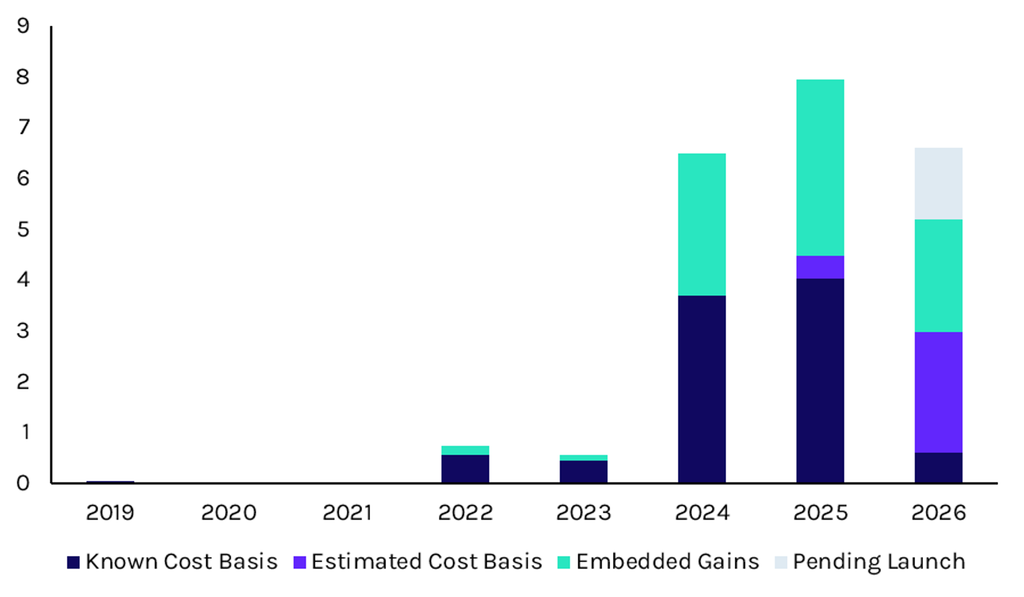
Over the past decades, low-fee indexes have commoditized access to portfolios with beta exposure and diversification. More recently, many entities within the investment management ecosystem have responded by pioneering new “tax-aware” strategies that seek to improve on investors’ post-tax returns. One such approach, tax-aware long-short, is estimated to be a ~$170 billion asset under management (AUM) industry by some analysts. Another approach, ETF seeding under Section 351 of the Internal Revenue Code (IRC), drove ~$8 billion in ETF launch AUM in 2025 (see Exhibit 1).
Exhibit 1: Launch AUM of ETFs Seeded In-Kind Under Section 351, $ Billions
Source: Tax Alpha Insider
Note: Data includes all Section 351-seeded ETFs. Not all utilize redemption strategies under scrutiny from Treasury and the IRS.
Tax Official Scrutiny
Background
There are a broad range of strategies that can be described as tax-aware. Toward the most trivial end, an investor may elect to realize gains only after those gains transition from short term to long term. However, many more aggressive approaches rely on interactions of multiple aspects of the tax code or counter-intuitive characterizations of transactions. In early 2026, reports indicated that Treasury was engaged in dialogue with the Investment Company Institute (ICI) regarding some of these aggressive tax-aware strategies. Subsequently, on July 21st, two Treasury officials spoke at a Wall Street Tax Association conference, publicly identifying seven strategies the department was scrutinizing and inviting audience discussion regarding their consistency, or lack thereof, with the intentions of Congress. On September 28th, Treasury and the IRS took their first formal action by issuing a Revenue Ruling on one such strategy and a notice requesting public comment on the others.
Revenue Ruling Eliminates Certain Section 351 and 852(b)(6) Combinations
Section 351 of the IRC states that “no gain or loss shall be recognized if property is transferred to a corporation… in exchange for stock… in [the] corporation… [resulting] in control of the corporation.” Under this provision, investors in newly formed ETFs may offer diversified baskets of appreciated securities and receive ETF shares without stepping up their basis.
This process benefits investors, who may move into the new investment without realizing gains, and ETFs, which may attract additional capital held by investors who have tax incentives to avoid transacting out of the fund. In some cases, the investor’s initial basket may approximate the intended strategy of the ETF, but in many cases, the ETF takes advantage of redemption allowances under Section 852(b)(6) to transition into a substantially different portfolio without realizing gains.
The new Revenue Ruling holds that, within the scope of Section 351, “transactions [may not be] undertaken… to enable [an investor] to exchange… [an] appreciated portfolio… for a materially different portfolio… without recognizing any… gains.” As such, those transactions are considered taxable.
In issuing the ruling, the agencies invoked the “substance over form” doctrine and emphasized that notional compliance with tax rules should not allow investors to deviate from a more straightforward tax outcome without an economically material difference. Conversely, the ruling also cited the First Circuit Court of Appeals’ prior ruling that, “the purpose of [Section 351 is] to save the taxpayer from an immediate recognition of a gain… where in a popular and economic sense there has been a mere change in the form of ownership,” indicating that ETF seeding under Section 351 is likely permissible where the contributed basket of securities remains substantially similar to the ETF’s strategy.
Notice Requesting Public Comment Repeats Prior List of Strategies, Does Not Touch Long-short
In addition to the Revenue Ruling discussed above, the agencies also issued a notice requesting public comment detailing several other strategies under review. The list was substantially equivalent to the strategies discussed during the July conference. It included four strategies (1-4) that are utilized by ETFs to avoid realization of gains, and three (5-7) that are directly employed by investment managers to generate capital gains and offset ordinary losses:
- Section 351 and 852(b)(6) Combinations, Partnership Variation: Individual investors join to form a partnership which conducts Section 351 seeding on their behalf.
- ETF Box Spreads: An ETF develops a box spread with Treasury yield-like returns. It then utilizes certain ETF redemption mechanics to characterize gains as net asset value (NAV) appreciation and defer capital gain realization.
- Record Date Strategies: An ETF holds other ETFs within its own structure. It rotates the internal ETFs out before they issue dividends via 852(b)(6) redemptions.
- Income Test Avoidance: An ETF utilizes 852(b)(6) redemptions to dispose of assets that would otherwise generate non-qualifying income.
- Straddles with Mixed Character: Investors establish and identify offsetting positions, one of which utilizes the 60/40 tax rule, and the other of which provides ordinary gains and losses. If the 60/40 position gains, the taxpayer receives 60/40 gains and ordinary losses. If the 60/40 position loses, they offset the gain and loss with no tax exposure.
- Same-day Foreign Currency Forwards: Investors use hindsight to elect whether to characterize certain foreign exchange transactions as either capital gains or ordinary losses under Section 988(a)(1)(B), depending on the outcome of a short-term (e.g., opened and closed on the same day) trade.
- Selective Swap Terminations: Investors close swaps early to generate capital gains, while holding loss swaps to payment to generate ordinary losses.
In Capstone’s view, these strategies generally utilize tax mechanics to generate benefits that are not intuitively within the purpose of the mechanic. As such, we expect further action to rein in these strategies in the short term (next two years).
The notices, consistent with Treasury officials’ remarks during the July conference, emphasized that traditionally standard tax-aware investment management, such as basic loss harvesting, was not being scrutinized. We believe this leaves certain aggressive-but-unmentioned tax-aware strategies, such as long-short, in a slight gray area. Although the administration has not indicated intent to act on these strategies, certain brand-name brokers, such as Schwab and Fidelity, have repeatedly increased restrictions or fees on accounts holding tax-aware long-short strategies throughout 2026.
What’s Next
The public comment period is scheduled to end on October 28th, after which the agencies will analyze the information provided by the industry and by taxpayer advocates.
If the agencies elect to issue additional Revenue Rulings, they may do so by the end of Q1 2027. For guidance that Treasury determines requires the full rulemaking process, proposed rules may come in 2027 and final rules in 2028.
Read more from Capstone’s Financial and Business Services team:
Rent Control Policies Will Threaten Real Estate Investment Trusts
California Industry Faces Policy Crossroads in Race for Insurance Commissioner
What Regulators Are Doing About Insurer Investment in Private Assets